

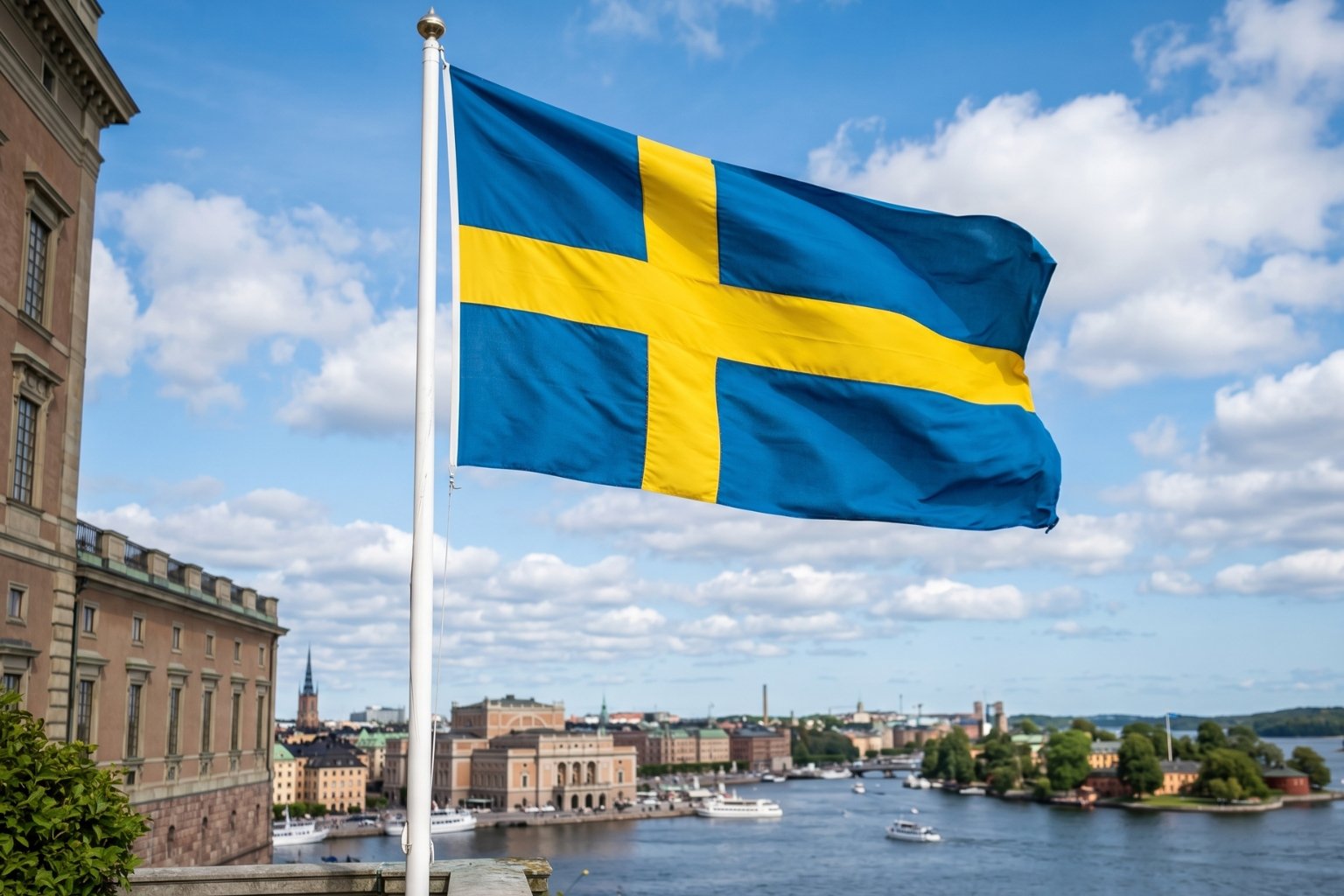

Two colors. One cross. Five centuries of political will, royal ambition, and northern identity compressed into a piece of cloth that every Swede recognizes before they can read. The Swedish flag looks deceptively simple. It is not. Behind that blue field and golden cross lies a story that runs through medieval dynasties, a bloody union with Denmark, a war of liberation, and a legal framework precise enough to specify the exact shade of yellow by color code. Here is what the flag actually means, and how it came to look the way it does.
What the Swedish Flag Looks Like
The flag of Sweden consists of a sky-blue rectangular field crossed by a golden yellow Nordic Cross. The cross extends to all four edges of the flag, with its vertical bar placed closer to the hoist than to the fly. This asymmetric positioning is not accidental and is shared by every Nordic flag.
The standard civil proportions are 5:8 (width to length). A wider format of 10:16 is also used in certain official contexts. A swallow-tailed version exists for naval use, making it one of the oldest naval ensigns still in active service anywhere in the world.
The Flag Act of 1982 and a companion color ordinance from 1983 legally define not just the proportions but the exact color values, referencing NCS (Natural Color System) codes and CIE coordinates. The blue is a clear mid-blue, and the yellow is a warm, saturated gold. There is no ambiguity left to interpretation.
The Colors of the Swedish Flag and What They Mean
Blue
The blue of the Swedish flag is most directly traced to the national coat of arms, which has featured a blue shield since the 14th century. Symbolically, blue carries associations with loyalty, truth, and justice in European heraldic tradition. In the Swedish context, it also reflects the country’s geography: a landscape defined by lakes, rivers, and long coastlines, a nation that has always oriented itself toward the water.
It is worth noting that the specific blue used on the Swedish flag is lighter and more vivid than the navy blues found on many other national flags. It reads as sky more than sea, which is fitting for a country where summer days stretch nearly without end.
Yellow (Gold)
The gold of the cross comes from the same heraldic source: the three golden crowns on the blue shield of the Swedish coat of arms, documented in use since at least 1442. In heraldic language, gold traditionally signifies generosity, wealth, and the light of faith. In Sweden’s case, the yellow also carries an association with the long, bright summers that follow the country’s dark winters, a symbolic counterweight built into the national colors.
Together, blue and gold have been Sweden’s colors for so long that they predate the flag itself. They appear in royal seals, battle standards, and official documents going back to the late medieval period.
The Origins of the Swedish Flag
The exact birth date of the Swedish flag is unknown. What historians can confirm is that blue and yellow appeared together on Swedish heraldic symbols from the late 14th century, beginning with the Folkung dynasty’s shield: a blue field with a gold lion, and later the formal coat of arms showing three golden crowns on blue, which became the foundation of Swedish visual identity.
The first recorded use of a yellow cross on a blue field dates to the mid-16th century. Before that, the earliest Swedish flags appear to have been simple horizontal stripes in blue and yellow, with no cross. The cross design was adopted under clear influence from Denmark’s Dannebrog, the oldest continuously used national flag in the world and the template for every Nordic cross that followed.
Two competing theories exist about the flag’s immediate origin. Some historians point to the personal seal of Carl Knutson Bonde, a Swedish nobleman and regent of the 15th century, as an early source. Others argue the design evolved directly from the coat of arms adopted in 1442. Most likely, both streams fed into the same result.
From the Kalmar Union to Gustav Vasa
To understand why Sweden needed its own flag, you need to understand the Kalmar Union.
From 1397 to 1523, Denmark, Norway, and Sweden were united under a single crown, dominated in practice by Denmark. The union had its own banner: a red Nordic cross on a yellow field, documented in a letter from King Erik of Pomerania in 1430. Sweden, though part of this union, chafed under Danish dominance for much of its duration.
The rupture came violently. In 1520, the Danish king Christian II executed dozens of Swedish nobles and clergy in what became known as the Stockholm Bloodbath, a political massacre designed to crush Swedish resistance. It had the opposite effect. A young Swedish nobleman named Gustav Vasa launched a rebellion that succeeded in driving out Danish forces and ending the union entirely.
On June 6, 1523, Gustav Vasa was elected king of an independent Sweden. The Kalmar Union was finished. Sweden needed a visual identity that was emphatically its own, and the blue-and-gold cross, drawn from the national coat of arms and distinct from Denmark’s red-and-white, filled that role. The flag was not just decorative. It was a declaration.
In 1569, King John III took the step of formally standardizing the flag across the Swedish Empire, ordering that the cross from the coat of arms appear on all flags and banners of the realm.
The Flag Through Swedish History
The 17th century saw the swallow-tailed naval ensign come into wide use, distinguishing warships from merchant vessels. This version, with its forked fly, became iconic enough to survive into the present day as the official flag of the Swedish Navy.
The flag’s next major transformation came in the early 19th century. Following the Congress of Vienna in 1815, Sweden and Norway were placed under the rule of a single king while remaining formally equal kingdoms. To represent this dual arrangement, a union mark was added to the upper canton of both the Norwegian and Swedish flags: a combined emblem using elements from both countries’ colors. It was a diplomatic compromise stitched in cloth.
The union lasted ninety years. When Norway declared independence in 1905, Sweden accepted the dissolution peacefully, and the union mark was removed. On June 22, 1906, Sweden officially adopted the current flag law, codifying the clean blue-and-yellow design that had been the foundation all along. The union experiment was over, and the flag returned to itself.
The Nordic Cross: Sweden Within a Family of Flags
All five Nordic nations share the same fundamental design: an off-center cross on a colored field. Denmark has a white cross on red. Norway adds a blue cross within a white cross on red. Finland uses a blue cross on white. Iceland uses a red cross within a white cross on blue.
Sweden’s combination of blue and yellow is unique in the Nordic family. While its neighbors all work in variations of red and white, Sweden stands apart visually, which makes its flag immediately recognizable within the group.
The asymmetric placement of the cross, shifted toward the hoist, is a deliberate design feature shared across all Nordic flags. It traces back to the Dannebrog and was carried forward by each country that adopted the Nordic cross tradition. The off-center placement creates a visual tension that actually makes the flags easier to read at a distance, since the eye naturally moves left to right and the cross division creates a clear focal point near the pole.
Swedish Flag Day and National Day
Sweden celebrates its National Day on June 6, a date chosen for two reasons. It marks the day in 1523 when Gustav Vasa was elected king, formally ending the Kalmar Union. It also marks June 6, 1809, when Sweden adopted a new constitution that significantly restructured royal power after a period of political crisis.
Flag Day was first celebrated in 1916, with ceremonies in Stockholm and over a hundred locations across the country. The king attended the main event at Stockholm’s stadium. The day became an official national holiday in 1983 and received status as a public holiday with a day off in 2005, relatively late compared to many countries.
The celebration typically involves flag-raising ceremonies at public buildings, concerts, and community gatherings. It is not a particularly boisterous holiday by Swedish standards, but it is a genuine one.
Specifications and Legal Framework
| Flag Type | Proportions | Primary Use |
|---|---|---|
| Civil flag | 5:8 | General public, ships in civilian use |
| State flag | 5:8 | Government buildings and officials |
| Naval ensign (swallow-tailed) | 5:8 with forked fly | Swedish Navy vessels |
| Royal standard | Variable | King and royal family |
The Flag Act of 1982 (Lag om Sveriges flagga) established the legal framework for the flag’s use and design. The 1983 color ordinance (Förordning med riktlinjer för färgnyanserna i Sveriges flagga) added precise color definitions using NCS codes and CIE coordinates, ensuring that no manufacturer, printer, or institution can deviate from the official shades.
Designated flag days are set by the government and cover national events, royal occasions, and dates of historical significance. The flag is expected to be lowered at sunset unless illuminated, a detail that reflects the same Nordic pragmatism embedded in the flag’s centuries-long history.
