

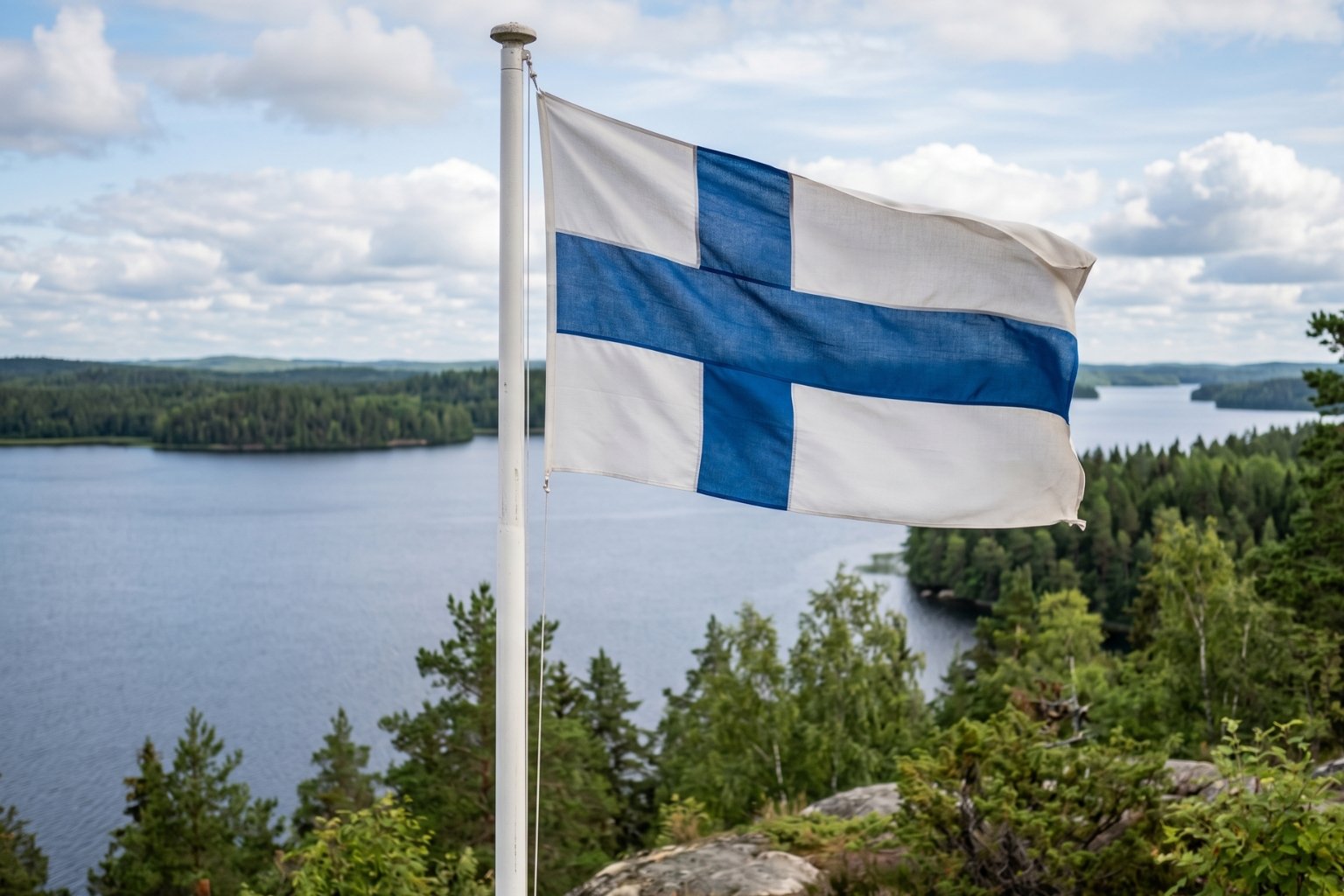

Finland chose its flag the way a poet chooses words. A country blanketed in snow for half the year, threaded together by 188,000 lakes, looked at itself honestly and said: those two things. Blue and white. The story behind that clarity took over a century to settle.
What Does the Finnish Flag Look Like?
The Finnish flag is known in Finnish as the Siniristilippu, which translates literally as the Blue Cross Flag. Its design is clean and immediately recognizable: a deep blue Nordic cross set on a white field, with the vertical arm of the cross shifted toward the hoist side in the traditional Scandinavian arrangement.
The official proportions follow an 11:18 ratio. The cross arms measure 3 units thick against a field divided as 4:3:4 vertically and 5:3:10 horizontally. The official shade of blue is Pantone 294C, a color Finnish law describes as sea blue. It sits between navy and bright blue, neither dark nor vivid, exactly the color of a Finnish lake on an overcast afternoon.
What Do the Colors of the Finnish Flag Mean?
The Blue
The blue represents Finland’s lakes and its sky. The country holds more lakes per square kilometer than almost anywhere on earth, and the connection between that geography and national identity runs deep. In 1863, the Swedish-Finnish poet Zacharias Topelius articulated it in a poem that would later become part of the national anthem tradition, describing the flag’s colors as the blue of our lakes and the white snow of our winters. That phrase became the standard interpretation, and it stuck because it was simply true.
The specific shade matters. Sea blue is not the navy of authority or the turquoise of the tropics. It is the blue of open water under northern light, calm and serious.
The White
The white field represents snow, winter, and the particular purity of Finland’s landscape. Finland spends roughly five months under snow cover each year. The white is also associated with the strange luminosity of the Finnish summer, the white nights when darkness never fully falls. The field reads as vast, uninterrupted, and quiet, which is a reasonably accurate description of much of the country itself.
The Nordic Cross
The cross is not merely decorative. It places Finland within the family of Nordic nations, sharing a visual grammar with Denmark, Norway, Sweden, and Iceland, all of which use the offset cross on their flags. The design descends from the Dannebrog, the Danish flag, one of the oldest national flags in the world. The horizontal shift toward the hoist is a structural convention that gives the flags of the region their distinctive asymmetry. It also represents Christianity, the shared religious tradition of the Nordic world, though in Finland the cross reads today primarily as a statement of geographic and cultural belonging.
The Origin of the Finnish Flag: A Design Born from Conflict
Finland spent roughly 700 years under foreign rule, first under Sweden from the 13th century, then under Russia from 1809. During those centuries, Finns flew the Swedish flag, then the Russian one. The question of a national symbol was not just aesthetic; it was political, and for a long time it was dangerous.
The first stirrings came in 1848, when Finland was still a Grand Duchy of the Russian Empire. At a student ball in Helsinki, the song Maamme (Our Country) was performed for the first time, and a flag was raised bearing the coat of arms of Finland, a golden lion on red, surrounded by laurel leaves on a white field. It was a statement, not yet a national flag, but a recognizable act of cultural assertion.
In 1861, the Nyländska Jaktklubben, a yacht club founded in Helsinki, became the first institution to fly a blue cross on white as a Finnish identification. Yacht clubs operated in a gray zone, maritime flags were less politically scrutinized than land flags, and the blue cross quietly entered circulation as a Finnish symbol.
The real debate came in the final decades of the 19th century. Two camps formed around two very different visions of what a Finnish flag should say. The heraldic camp argued for the traditional colors of the Finnish coat of arms: red and yellow, which had centuries of historical legitimacy behind them. The naturalist camp argued for blue and white, the colors of the landscape, the lakes, the snow, the sky. They were not historians arguing about precedent. They were Finns describing what they saw when they looked out the window.
The naturalist argument won, not only on aesthetic grounds but because it offered something the heraldic tradition could not: a color story that belonged to no foreign power. Red and yellow had been used under Swedish and Russian rule. Blue and white were Finland’s own.
How the Finnish Flag Became Official
Finland declared independence on December 6, 1917, after the collapse of the Russian Empire following the Bolshevik Revolution. The country was weeks old when the question of the flag became urgent.
A design competition was held. Many submissions arrived. The winning design came from two Finnish artists: Bruno Tuukkanen and Eero Snellman. Their version refined and formalized the blue cross on white that had been circulating informally for decades. Parliament approved it, and on May 29, 1918, less than six months after independence, the Act on the Flag of Finland made it official.
The date falls during a year that was also marked by a brutal civil war between Finnish Reds and Whites. The adoption of a blue and white flag carried immediate symbolic weight as a statement of unity and of a new identity no longer defined by the flags of foreign crowns.
The Different Versions of the Finnish Flag
The Siniristilippu is not a single flag but a family of related variants, each assigned to a specific context by Finnish law.
| Version | Design | Who Uses It |
|---|---|---|
| Civil flag | Blue cross on white field | All private citizens and organizations |
| State flag | Civil design plus coat of arms at cross center | Government bodies and official buildings |
| Military flag | Swallow-tailed state flag | Finnish Defence Forces |
| Presidential standard | Military flag with the Cross of Liberty in the canton | The President of Finland |
The Act on the Flag of Finland (1978) governs proportions, colors, and display rules. Every citizen has the legal right to fly the civil flag, provided it conforms to the prescribed dimensions and the correct shade of blue. Modifications, added symbols, and disrespectful use are prohibited under the same law.
The Finnish Flag in Everyday Life and Culture
Finland has a precise and affectionate relationship with its flag. It is not used the way some countries use theirs, as a tool of aggressive patriotism or political theater. It appears at specific moments, on specific days, with a quiet consistency that reflects something about Finnish character in general.
There are 17 official flag-flying days each year, including Independence Day on December 6, the birthday of the President, and Midsummer. The Midsummer custom is perhaps the most charming: the flag is raised at 6pm on Midsummer Eve and lowered at 9pm on Midsummer’s Day. Those hours bookend the brightest weekend of the year, when Finns gather around bonfires and the sky barely darkens. Flying the flag at that specific window is not a regulation that feels bureaucratic. It feels like a small ritual of seasonal joy.
The blue and white palette extends well beyond the flagpole. It runs through Finnish design culture from Marimekko textiles to ceramic tableware, sauna accessories, and hockey jerseys. The colors carry no aggression and no grandeur. They carry geography, and in Finland that is enough.
When a Finn raises the Siniristilippu, they are not making a claim about superiority. They are making a statement about place: the lakes, the snow, the long winters, the luminous summers. Seven hundred years of borrowed flags, and then finally, their own.
