

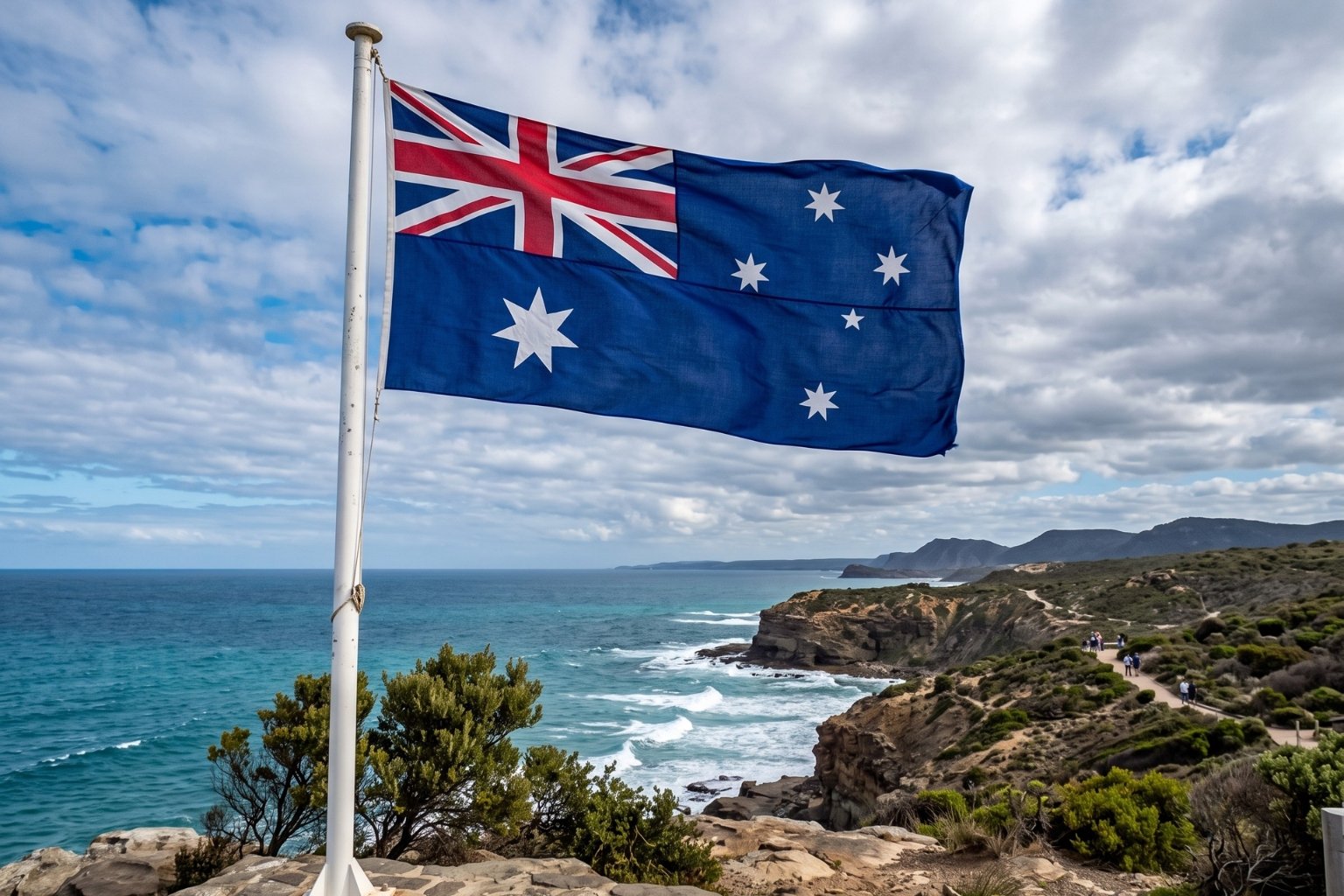

Most people can picture the Australian flag without much effort: a deep blue field, a small Union Jack tucked in one corner, a scatter of white stars. Fewer could explain why each piece is there, or that Australia actually flies more than one national flag with equal legal standing. The Australia flag carries a surprisingly dense story, one that touches astronomy, colonial history, a design competition with over 32,000 entries, and a debate that is still very much alive today.
What Each Element of the Flag Means
The design looks simple at first glance, but every element was chosen deliberately, and each one still means something specific to the people who fly it.
The Blue Field
The background is a rich navy blue, chosen originally because it matched the British Blue Ensign, the naval flag format the design was built on. Over time it has taken on its own local reading, evoking the surrounding oceans and the wide, clear southern sky.
The Union Jack
Sitting in the canton, the upper left corner and the position of honour in flag heraldry, the Union Jack marks Australia’s roots as a set of British colonies. It is the part of the flag most often cited in the ongoing debate about whether the design still fits a modern, multicultural nation.
The Commonwealth Star
Below the Union Jack sits a large white star with seven points. Six points originally stood for the six founding states: New South Wales, Victoria, Queensland, South Australia, Western Australia and Tasmania. A seventh point was added in 1908 to represent the territories, present and future.
The Southern Cross
On the right side of the flag, five white stars trace the Southern Cross, one of the most recognisable constellations in the southern sky and visible only from below the equator. Four stars carry seven points each, the fifth and smallest carries five, a detail that traces back to how brightly each star actually shines at night.
How the Flag Came to Be
The flag is not a colonial hand me down. It was designed by Australians, for Australians, through a public process that remains one of the largest design competitions ever held.
Federation and the 1901 Design Competition
After Australia federated on 1 January 1901, the new government opened a competition to find a national flag. Entries poured in, 32,823 of them, and five nearly identical designs were declared joint winners: an artist, a schoolboy, a young draughtsman, an architect and a ship’s officer, none of whom had ever met. The winning design was first raised on 3 September 1901 in Melbourne, a date now marked as Australian National Flag Day.
From Six Points to Seven
The original Commonwealth Star had six points, one for each founding state. In 1908, a seventh point was added to account for Australia’s territories, giving the flag the design still in use today.
Blue Ensign or Red Ensign
For decades, Australia officially had two versions of the same flag: a blue ensign for government and naval use, and a red ensign for merchant shipping. The public rarely respected the distinction, and confusion between the two ran deep enough that the Prime Minister issued a formal statement in 1941 asking Australians to stick to the blue version.
The Flags Act of 1953
The Flags Act finally settled the matter, legally naming the blue ensign the Australian National Flag. It also set out the precise specifications still used to manufacture the flag today.
Quick Reference
| Element | Detail |
|---|---|
| Adopted | 3 September 1901, legally confirmed 1953 |
| Colors | Blue, white, red |
| Union Jack | Britain’s colonial legacy |
| Commonwealth Star | Six states, one for all territories |
| Southern Cross | Five stars, southern hemisphere navigation and identity |
| Proportions | 1:2 |
Three Flags, Not One
Talk about the Australia flag usually stops at the blue ensign, but Australia recognises three national flags with equal legal status, and the other two carry stories the blue ensign simply cannot tell.
The Aboriginal Flag
Designed by Harold Thomas and first raised in Adelaide in 1971, the flag uses black for Aboriginal people, red for the earth and for ochre, and a yellow circle for the sun. It became a fixture of the land rights movement before gaining official recognition in 1995.
The Torres Strait Islander Flag
Designed by Bernard Namok and adopted in 1992, this flag uses green bands for land, a blue band for the sea, black lines for the people, and a white Dhari, a traditional headdress, at its centre, with a five pointed star beneath it representing the island groups of the strait.
Why All Three Matter
Flying only the blue ensign tells half the story of who lives in Australia. Seeing all three flags together, as is increasingly common at public buildings and events, gives a far more accurate picture of the country’s layered identity.
The Flag Debate That Keeps Coming Back
Since the 1980s, Australia has never fully settled the question of whether its flag still fits. Ausflag, founded in 1981, argues the current design leans too heavily on British history and looks too similar to the flags of New Zealand, Tuvalu and the Cook Islands. The Australian National Flag Association, founded in 1983, defends the flag’s historical weight and its ties to generations who served under it. The conversation tends to resurface whenever the republic question comes up, and shows no sign of disappearing for good.
Spotting the Flag as a Traveler
Anyone visiting Australia will see the blue ensign constantly: outside government buildings, at cricket and rugby grounds, and everywhere on Australia Day, held each year on 26 January. Increasingly, travelers will also spot the Aboriginal flag flown alongside it at civic buildings, universities and during NAIDOC Week in July, a useful cue for understanding which communities and histories a place is choosing to honour.
Flags People Mix It Up With
The Southern Cross appears on several Pacific flags, which leads to genuine confusion. New Zealand’s flag uses a similar blue field and a smaller, four star Southern Cross without a Commonwealth Star. Tuvalu’s flag scatters nine stars across a lighter blue field. The Cook Islands uses a ring of fifteen stars instead of a cross pattern. The Union Jack in the canton is the fastest way to confirm you are looking at the Australian flag specifically.
Frequently Asked Questions
How many stars are on the Australian flag? Six in total: the large Commonwealth Star and the five stars of the Southern Cross.
What do the colors of the Australian flag mean? Blue reflects the surrounding seas and skies, white represents the stars and the Union Jack’s cross, and red appears within the Union Jack itself, tied to Britain’s colonial history.
When was the Australian flag adopted? It was first flown in 1901 and legally confirmed as the national flag under the Flags Act of 1953.
Why does the Union Jack still appear on the flag? It marks Australia’s founding as a set of British colonies and its ongoing ties to the Commonwealth, a detail that remains central to the current flag debate.
Is the Aboriginal flag an official flag of Australia? Yes. Alongside the Torres Strait Islander flag, it holds equal legal recognition as an official flag of Australia since 1995.
