

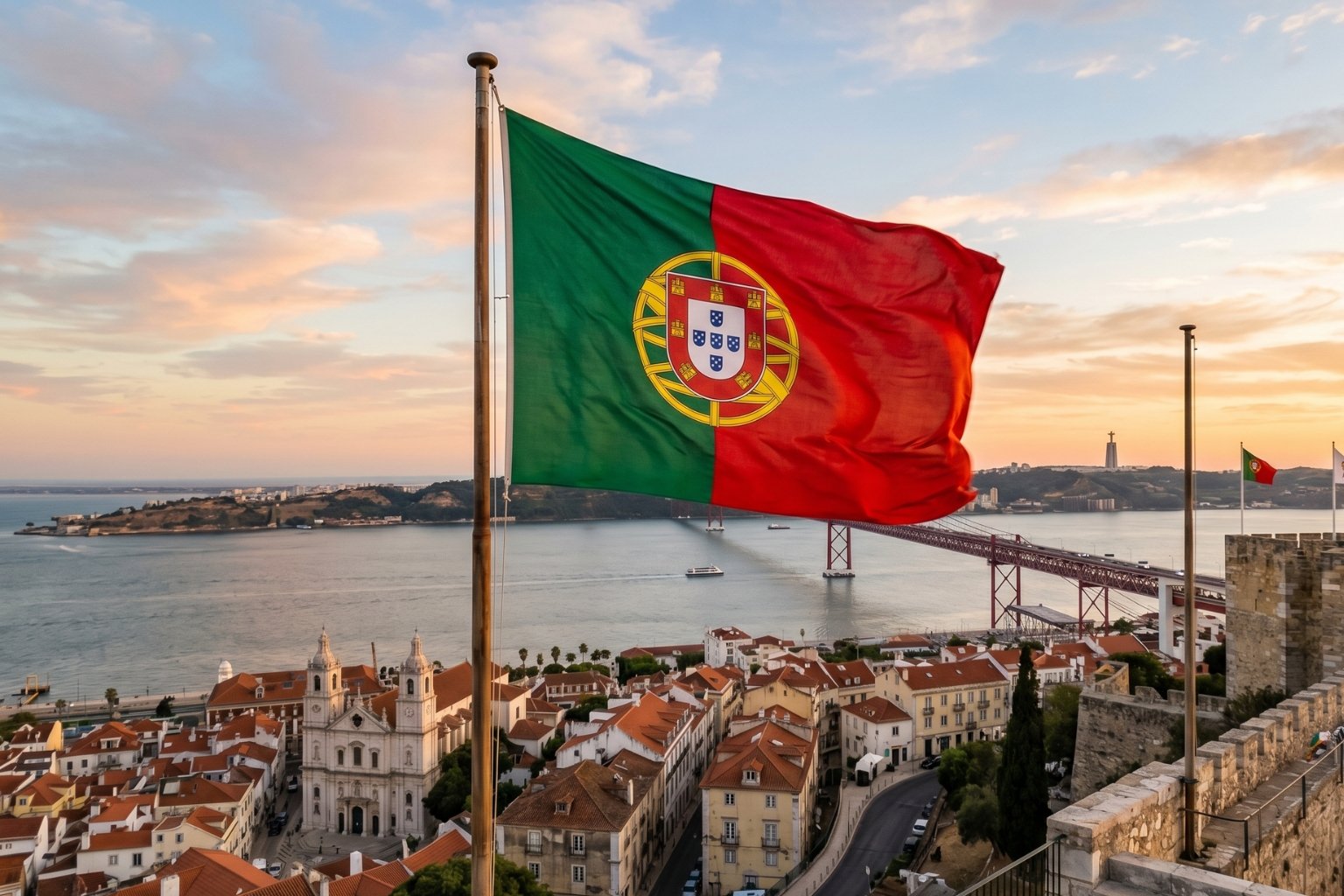

The Portuguese flag is not designed to be pretty. It is designed to remember. Green and red, a golden sphere, five shields nested inside a shield, seven castles along a border: every element traces back to a battle fought, an ocean crossed, or a monarchy overthrown. Few flags in Europe carry this much biography in such a compact space.
What the Portugal Flag Looks Like
The flag is divided vertically into two fields of unequal width: green on the hoist side, occupying two-fifths of the total length, and red on the fly side, taking up the remaining three-fifths. The official proportions are 2:3. At the boundary between the two colors, slightly left of center, sits the national coat of arms: a golden armillary sphere overlaid with a red-bordered shield. The off-center placement is deliberate, giving the flag an asymmetry that feels neither accidental nor decorative. It is a flag that does not sit still.
The Colors Green and Red: A Political Choice, Not an Aesthetic One
Why Green?
Most sources will tell you green represents hope. That is true, but incomplete. Green was the color adopted by the Portuguese Republican Party in the late nineteenth century, visible on banners and pamphlets long before any revolution succeeded. When the monarchy fell in October 1910 and a commission sat down to design a new national flag, green was added not for poetry but for politics. The old royal standard had a plain red background. The new republic needed to look nothing like it. Green solved that problem and brought its own symbolism along.
Why Red?
Red carries the weight that green cannot. It represents the blood shed by those who fought for Portugal across nine centuries: against the Moors, against Castile, against Napoleon, and finally against the monarchy itself. Red predates the republic by centuries. It appeared on the flags of the Order of Christ, the military-religious order that funded the great voyages of discovery, and on dozens of banners flown in battles that shaped the Iberian peninsula.
The Proportion Is Intentional
There is more red than green on this flag: three-fifths against two-fifths. More blood than hope. This is not a compositional accident. It mirrors something essential in the Portuguese sensibility, the same pull toward saudade, that bittersweet relationship with loss, longing, and the past that defines so much of Portuguese culture, from fado to the very pace of Lisbon on a gray afternoon. The flag, without saying a word, says: we remember more than we dream.
The Coat of Arms: A History Lesson in One Emblem
The White Shield and the Five Quinas
At the center of the coat of arms sits a white shield bearing five small blue shields arranged in a cross, each marked with five white dots. These are the quinas, and their origin is tied directly to the founding of Portugal itself.
According to tradition, Afonso Henriques, the first King of Portugal, defeated five Moorish kings at the Battle of Ourique in 1139. The five shields represent those five kings. The dots on each shield are more contested: some historians read them as bezants, coins symbolizing the royal right to mint money and assert sovereignty. Others see the five wounds of Christ, a religious reading that suited a crusading king fighting under papal blessing. Both interpretations have survived because neither can be fully dismissed.
The Seven Golden Castles
Surrounding the central shield runs a red border bearing seven golden castles. These are the Moorish fortresses taken by Portuguese kings as the Reconquista pushed southward across the peninsula. Each castle on the flag represents a real fortification, a place where a siege was laid and a border was redrawn. The castles belong to the medieval period of Portuguese expansion, before the sea routes, before the caravels, when the kingdom was still being built on land, one battle at a time.
The Armillary Sphere
Nothing on this flag travels as far as the armillary sphere, that gold skeletal globe that frames the coat of arms. An armillary sphere was a precision navigation instrument, a model of the celestial sphere made of interlocking rings, used by astronomers and navigators to track the position of stars and chart a course across open water.
It was the personal emblem of Prince Henry the Navigator, who organized and financed the Portuguese exploration of the African coast in the fifteenth century. King Manuel I (1495-1521) later adopted it as a royal symbol, using it to declare himself sovereign of five continents as Portuguese sailors reached Brazil, India, and the coasts of East Africa and Asia. The sphere was added to the coat of arms in 1816, under the empire, then removed when Brazil became independent. It was revived in 1911, when the republic deliberately chose to reclaim Portugal’s greatest era as part of its new identity.
The armillary sphere is the Age of Discovery made gold on a flag. It says: we were once the people who mapped the world.
How the Portugal Flag Evolved Over 900 Years
The flag that flies today is young. The country behind it is not.
The first symbol that can be traced to Portugal belongs to Henry of Burgundy, the Count of Portugal, who carried a shield marked with a blue cross on white into battle against the Moors around 1095. This was not a national flag in any modern sense, but it was the beginning of a visual identity.
His son, Afonso Henriques, founded the Kingdom of Portugal in 1143 and began developing the heraldic language that would survive for centuries. The quinas emerged under his reign or shortly after, under Sancho I. Successive kings added castles, rearranged elements, and modified the coat of arms, but the shield with its five blue quinas remained the constant.
By the nineteenth century, the constitutional monarchy was flying a flag with blue and white vertical stripes bearing the coat of arms, colors inherited from the royal house. This was the flag of a monarchy in decline, challenged by republicanism, economic crisis, and colonial tensions.
On October 5, 1910, a revolution ended 800 years of monarchy. Two days later, a commission was appointed to design a new national flag. It was given one brief: the new flag must look nothing like the old one.
Who Designed the Current Flag
The commission was composed of three men: Columbano Bordalo Pinheiro, Portugal’s most celebrated painter of the era; João Chagas, a journalist, revolutionary, and one of the architects of the republic; and Abel Botelho, a novelist and diplomat. They were not vexillographers. They were intellectuals with strong opinions and a clear political mission.
Their design was finalized and officially adopted on June 30, 1911. Green and red replaced blue and white. The armillary sphere was restored from the imperial era. The quinas and the castles remained, because the republic understood that continuity with the deep past gave the new regime a legitimacy that revolution alone could not.
The flag was not designed to break from history. It was designed to reinterpret it.
What Makes the Portugal Flag Distinctive Among European Flags
In a continent of tricolors, the Portuguese flag stands apart. The use of an armillary sphere on a national flag is rare globally and unique in Europe. No other European flag places a navigation instrument at its center, a reminder that Portugal was once a maritime empire whose routes defined the modern world.
The off-center placement of the coat of arms, straddling the boundary between green and red, gives the flag an unusual visual tension. Most European flags are symmetrical, balanced, easy to reproduce. Portugal’s is deliberately complex, layered, and difficult to reduce to a simple icon.
The green and red combination appears elsewhere in the world, but nowhere in Europe with this specific weight of meaning. And the proportion, more red than green, more past than future, gives the flag a gravity that few national symbols manage without becoming mournful.
This is a flag that takes its country seriously.
