

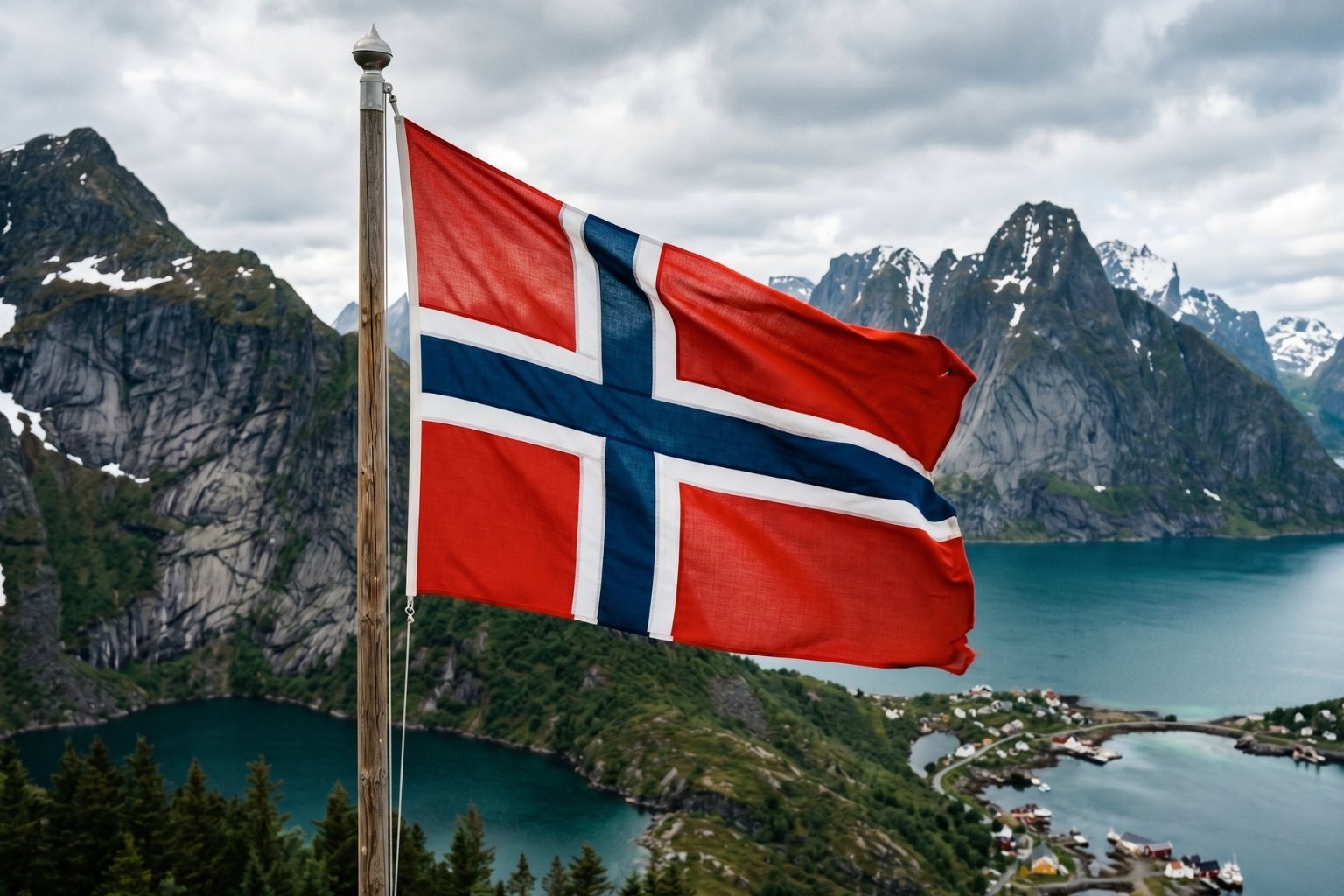

In Norway, the flag does not decorate. It lives. You see it snapping in the wind outside private homes on an ordinary Tuesday, brandished by children in parades on May 17th, stitched onto hikers’ backpacks in the mountains. This relationship between a people and their banner has nothing to do with nationalism as performance.
It tells something older and more intimate: an identity forged through hardship, a freedom the country had to defend color by color, for nearly a century. And that story begins not with a king, but with a parliamentary vote, a merchant from Bergen, and possibly, according to the family itself, a ten-year-old boy.
What Does the Norwegian Flag Look Like?
The Norwegian flag is a vivid red field crossed by a blue Nordic cross outlined in white, with the vertical bar shifted toward the left, the hoist side. The official proportions are 8 to 11. This rectangular format is the civil flag, used by private citizens and public institutions alike. A separate variant exists with three pointed tails, known in Norwegian as the splittet flagg, reserved for military and naval use and recognizable by its forked, flame-like end.
Placed next to the Danish Dannebrog, the resemblance is immediate: same red field, same white cross. The Norwegian difference comes down to a single addition, the blue cross superimposed over the white one, and it is precisely that addition which compresses two centuries of political history into one design.
The Colors of the Norwegian Flag and What They Mean
Red and White: The Debt to Denmark
Red and white were not born in Oslo. They came from Copenhagen. For nearly four centuries, from 1380 to 1814, Norway was united with Denmark, and the Dannebrog, the oldest national flag still in use anywhere in the world, became the de facto ensign of Norwegian ships from the 17th century onward.
When Norway found a brief window of independence in 1814, following Denmark’s defeat in the Napoleonic Wars, these colors were deeply embedded in collective memory and maritime practice. Keeping them was neither nostalgia nor weakness. It was an acknowledgment of cultural reality, a bet on continuity over rupture.
Blue: The Color That Changed Everything
The addition of blue in 1821 was the most politically loaded act in the flag’s design. On the surface, it acknowledged the new union with Sweden, imposed on Norway after just a few months of independence. But Fredrik Meltzer, the man who brought the proposal to the Storting, had a different logic in mind.
His letters make his thinking legible: the combination of red, white, and blue belonged to free nations, revolutionary France, the United States, the Netherlands, Great Britain. By choosing these three colors, the Norwegian parliament was not describing the country as it was in 1821, still under Swedish oversight, but as it intended to be recognized: a sovereign nation among sovereign nations.
The Cross: Christianity and Nordic Belonging
The Nordic cross, with its vertical bar shifted to the left of center, is the visual element that ties Norway to its Scandinavian neighbors. Its origin traces back to the Dannebrog, which appeared in the 13th century according to Danish tradition. The same design appears on the flags of Denmark, Sweden, Finland, Iceland, and the Faroe Islands. It carries a historical Christian meaning, but today it reads primarily as a marker of shared Nordic identity, a sign of cultural kinship that each country expresses in its own colors.
Who Designed the Norwegian Flag?
The official answer is Fredrik Meltzer, born in Bergen in 1779, a prosperous merchant from a family of German origin, a signatory of the Norwegian constitution at Eidsvoll in 1814, and representative of Bergen in the Storting from 1821 to 1828.
The answer the family has kept for two centuries is more interesting. In 2010, Meltzer’s great-great-granddaughter told NRK that it was not the parliamentarian who sketched the final design. It was his ten-year-old son. Meltzer himself left no written explanation of his formal choices, but his letters to the Storting reveal his thinking: he rejected proposals too close to the Dannebrog, which risked confusion at sea. He wanted a flag in the colors of liberty, with a cross to honor Scandinavian tradition, and simple enough that any sailor who already owned a Dannebrog could just sew on the blue without starting over.
On May 4, 1821, he submitted his proposal to parliament alongside many others. Both chambers approved it on May 11th and 16th. The Swedish king, Carl Johan, signed his approval with a single word: gillas. In old Swedish, that means approved. Archivists at the Norwegian National Archives like to point out that it may be the first recorded use of the word in the sense of a like, back in 1821.
The History of the Norwegian Flag, Step by Step
Before 1814: The Lion Banner and the Danish Era
The earliest recorded trace of a distinctly Norwegian flag dates to 1318: a red banner bearing a golden lion, the emblem of the medieval Norwegian monarchy. Over the course of the union with Denmark, the lion was gradually incorporated as a heraldic element within flags derived from the Dannebrog, but it no longer constituted an independent national standard.
From the 17th century onward, Norwegian merchant ships simply flew the Dannebrog. Norway had no flag of its own.
1814: A Constitution, but Which Flag?
When Crown Prince Christian Frederik declared Norwegian independence in the spring of 1814, he created a first distinctive flag in haste: the Dannebrog with the crowned Norwegian lion holding an axe in the upper left canton. That flag served as the state ensign until 1815 and as the merchant flag until 1821.
The independence was short-lived. By autumn 1814, Norway was forced into a personal union with Sweden. The joint war flag became the Swedish flag with a red canton marking Norway, a compromise that satisfied no one.
1821: The Year of Flag Confusion
The year 1821 entered Norwegian history books under the name flaggforvirringens ar, the year of flag confusion. Ships flying hybrid, poorly recognized ensigns were captured by pirates who could not identify the vessel’s nationality. The Storting decided the country needed a flag that was clear, singular, and unmistakable.
It was in this context of practical urgency, as much as national assertion, that Meltzer submitted his proposal. It was approved in May, but the king refused to sign the formal flag law. He simply granted civilian use of the design by royal decree on July 13, 1821. The army and navy were to continue flying the Swedish union flag.
1844 to 1898: The Herring Salad Flag
In 1844, King Oscar I imposed a union badge in the upper canton of both the Norwegian and Swedish flags, nominally to symbolize the equality of the two kingdoms. The badge crammed elements of both flags into a single square, producing something visually incoherent.
The Swedes themselves nicknamed it Sillsallad, the herring salad, a reference to the colorful, jumbled mixture it resembled. In Norway, that nickname became a rallying point for resistance. The badge was read as a mark of subordination dressed up as partnership. The nascent Norwegian nationalist movement made it a precise political target.
1898 to 1905: The Flag as an Act of Resistance
In 1898, seven years before full independence, the Norwegian parliament adopted Meltzer’s pure tricolor as the national flag, stripping out the union badge entirely. It was a deliberate political act, voted through against Swedish opposition.
On June 7, 1905, the union with Sweden was dissolved peacefully. The flag Meltzer had designed three quarters of a century earlier, and that the country had carried as the banner of an identity still waiting to be recognized, became at last, officially, the flag of a fully sovereign state.
The Norwegian Flag Against Other Nordic Flags
| Country | Background | Cross | Key distinction |
|---|---|---|---|
| Norway | Red | Blue, outlined in white | Blue added in 1821, colors of liberty |
| Denmark | Red | White | The Dannebrog, oldest of all, origin of the family |
| Sweden | Blue | Yellow/gold | The only blue background in the Nordic group |
| Finland | White | Blue | White field evoking snow and lakes |
| Iceland | Blue | Red, outlined in white | Inverts the Norwegian color scheme |
The family resemblance is undeniable. What distinguishes each flag is the way each country reinterpreted the Danish inheritance through its own particular history.
The Norwegian Flag in Daily Life
In Norway, the flag does not stay folded in a drawer for solemn occasions. It is part of domestic and public life in a way that often surprises foreign visitors.
The official flag days (flaggdager) are numerous: the birthday of King Harald V, May 1st for Labour Day, May 8th for Liberation Day, June 4th for the dissolution of the Swedish union, and several other dates tied to the royal family and major Christian holidays. An unwritten rule holds that the flag is only flown between 8 in the morning and sunset, and that it must never touch the ground, which would signal surrender.
But the date above all others is May 17th, Syttende Mai, Constitution Day. On that day, Norway does not parade tanks and soldiers. It parades children. Thousands of school processions move through the streets of towns and villages to the sound of brass bands, participants dressed in the bunad, the traditional regional costume. In Oslo, the children march up Karl Johans gate to the Royal Palace, where the royal family waves from the balcony for hours. In every hand: a small red, white, and blue flag.
During the Nazi occupation, from 1940 to 1945, German authorities banned all May 17th celebrations. Wearing the national colors was an act of resistance. When the parades returned in May 1945, days after liberation, every flag raised in the street carried the weight of five years of prohibition. That moment remains alive in Norwegian collective memory, and it explains, at least in part, why a piece of red, white, and blue cloth can still, today, bring people to tears.
