

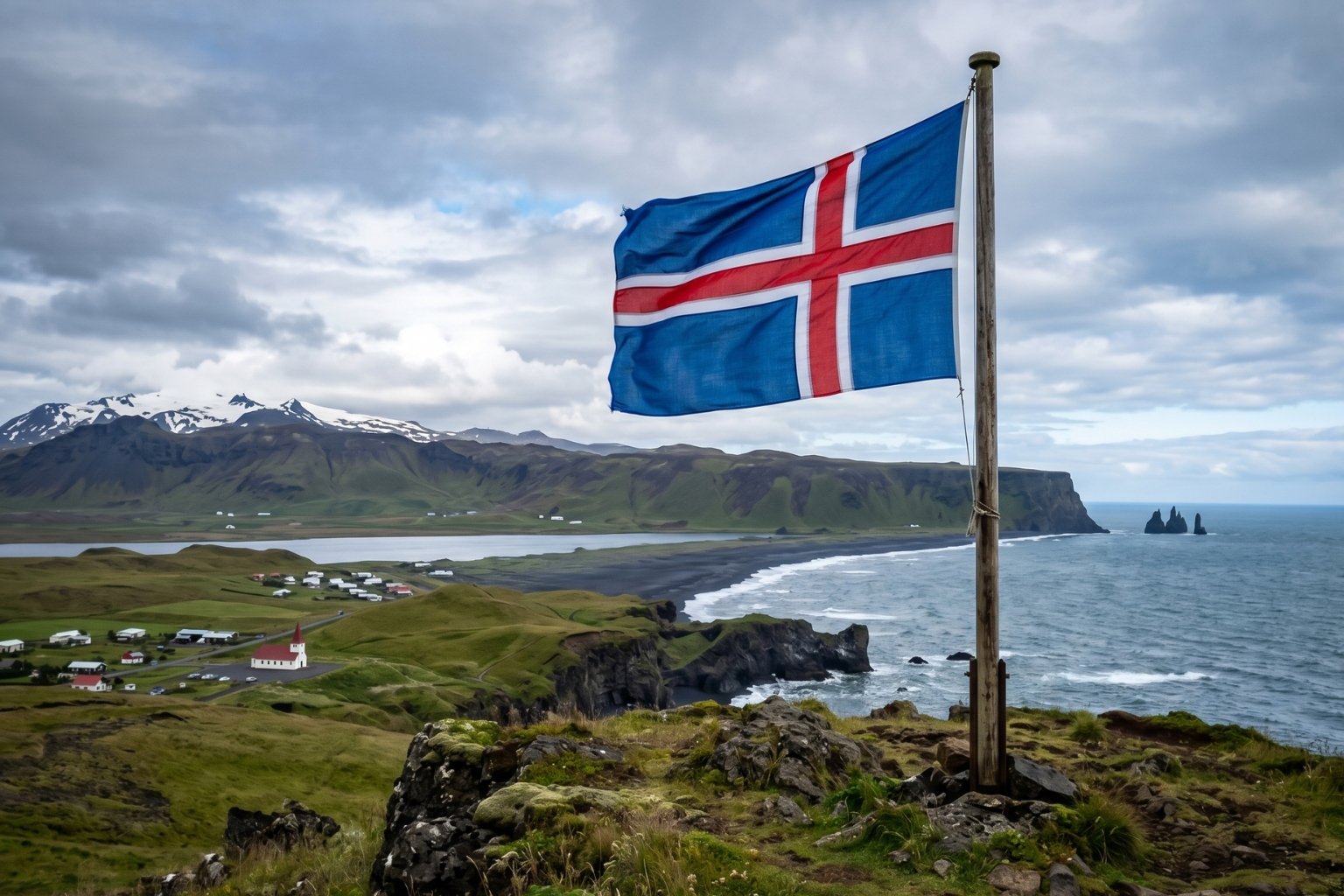

A cold blue field, a white cross, and a burning red cut through the center. Before you even know what country it belongs to, the Iceland flag tells you something true: this is a place where ice and fire coexist without apology. What looks like a simple Nordic design is actually the result of decades of political negotiation, competing visions, one Danish king’s aesthetic preference, and a nation’s long, quiet insistence on existing on its own terms.
What Does the Iceland Flag Look Like?
The flag features a deep blue field crossed by a white-bordered red Nordic cross. Like all Scandinavian crosses, it is offset toward the hoist side rather than centered, giving the flag an asymmetric balance that has become the visual signature of the entire Nordic family of nations.
The official proportions follow an 18:25 ratio (width to length). The red cross occupies 1/9 of the flag’s width, and the white border on either side is half that, at 1/18. The blue sections form two pairs of rectangles: the hoist-side squares are equilateral, and the fly-side panels are twice as long.
In official color systems, the blue is rendered as Pantone 2728C (a strong, saturated cobalt) and the red as Pantone 2347C (a vivid, warm red with no orange in it). On the water, against grey skies, or snapping above a Reykjavík rooftop, these are colors that hold their own.
What the Three Colors of the Iceland Flag Actually Mean
Blue: The World That Surrounds the Island
The dominant blue represents the Atlantic Ocean, the sky above, and the dark silhouettes of volcanic mountains that frame the Icelandic landscape from almost every vantage point. It is not a decorative choice. Iceland is defined by its ocean relationship in a way few countries are: the sea fed it for centuries, isolated it for just as long, and still shapes the national psychology. The blue is not decorative. It is geographic.
White: Ice, Glaciers, and the Frozen Interior
The white cross speaks to the glaciers and snow that cover roughly 11 percent of Iceland’s surface. Vatnajökull, the largest glacier in Europe, sits over an active volcanic system. The white in the flag is not merely winter. It is that specific Icelandic tension between stillness and what churns underneath. Before Matthías Þórðarson gave the colors their now-familiar interpretation in 1906, blue and white were already the traditional colors of Icelandic clothing, a quiet cultural identity worn long before it was ever flown.
Red: Fire Under the Ice
The red is the most loaded element of the three. It was originally introduced for reasons that had nothing to do with volcanoes (more on that in a moment), but Icelanders reclaimed its meaning and made it their own. Today, the red cross stands for volcanic fire, for the lava fields that cover much of the island’s interior, for the geological fact that Iceland sits directly on the Mid-Atlantic Ridge and is still, tectonically speaking, in the middle of being made. The red is not symbolic of danger. It is symbolic of energy, of origin, of a landscape that is genuinely alive.
The Nordic Cross: Iceland’s Place in a Shared Visual Language
Every Scandinavian flag, from Denmark to Finland, carries some version of the Nordic cross, also known as the Scandinavian cross or St. Philip’s cross. The tradition traces back to the Dannebrog, Denmark’s flag, one of the oldest national flags in the world, reportedly dating to the 13th century. According to legend, a red cloth bearing a white cross fell from the sky during a battle in Estonia in 1219, and Danish forces took it as a sign of divine favor.
Whether or not the legend holds, Denmark carried the cross motif across its territories for centuries. As Nordic nations gained independence one by one, they retained the cross as a shared emblem, each adding their own color logic. The cross was not merely religious in the modern sense. It was territorial, historical, and eventually a mark of Nordic solidarity that transcended the politics of any given moment.
When Iceland chose the Nordic cross for its own flag, it was making a double declaration: we are independent, and we belong to this part of the world.
The History of the Iceland Flag
Before the Flag: A Cod and a Falcon
For most of its history under Danish rule, Iceland was represented in the Danish royal arms not by a proud symbol but by a dried codfish, a stockfish without its head. From the 16th century until 1903, this was the official emblem of the island. Accurate, perhaps, given the centrality of fish to Icelandic survival. Inspiring, not particularly.
In 1873, Icelandic artist Sigurður Guðmundsson proposed something more compelling: a white falcon on a blue field. The falcon already carried weight in Icelandic imagination, appearing in the island’s medieval literature and associated with power, independence, and aerial freedom. The image of a bird taking flight mapped neatly onto the political ambitions of a nation beginning to imagine its own future. The flag was never officially recognized, but it was widely used among Icelanders both at home and among the large communities who emigrated to Canada in the late 19th century.
In 1903, the Danish authorities officially replaced the stockfish with a falcon on a blue shield in the coat of arms. Progress, of a sort.
Hvítbláinn: The Flag the People Loved
In 1897, writer and scholar Einar Benediktsson put forward a new argument: Iceland, as a Christian nation with Nordic roots, deserved a flag in the Scandinavian tradition. He proposed a simple blue field with a white Nordic cross, a design that came to be known as Hvítbláinn, meaning “the white-blue.” It circulated, gained affection, and was considered by many Icelanders to be the obvious choice. It also had a problem: Greece already flew blue and white.
Matthías Þórðarson and the 1906 Proposal
The flag that would eventually become official came out of a student council meeting in Reykjavík in 1906. A young man named Matthías Þórðarson, who would later become curator of the National Museum of Iceland, presented a three-color design and explained exactly what each element meant: the red cross for the volcanic lava and fire, the white for the glaciers and snow, the blue for the ocean. He was not describing a vague landscape. He was naming Iceland’s physical reality and planting it in cloth.
The design caught the attention of the government. The population still preferred Benediktsson’s simpler Hvítbláinn, but politically, Þórðarson’s tri-color design had momentum.
The Danish King’s Condition
Here is the detail most articles skim past. When Iceland sought official recognition for its flag, it needed the approval of the Danish king. Royal sanction was granted, but not unconditionally. The blue-and-white design was rejected because of its resemblance to the Greek flag. The king’s requirement: add red to distinguish it. The red cross went inside the white cross, and on 19 June 1915, the flag was officially declared Iceland’s national flag.
What began as a diplomatic technicality became, in Icelandic hands, a volcanic symbol. The king wanted differentiation. Icelanders got fire.
1918 and 1944: Two Moments the Flag Meant Everything
On 1 December 1918, Iceland became a sovereign state in personal union with Denmark, and Þórðarson’s flag became the national flag in full legal standing. The design did not change. It did not need to.
On 17 June 1944, Iceland proclaimed itself a republic, cutting the last formal ties to Denmark. The flag was written into law exactly as it was. The date, June 17, coincides with the birthday of Jón Sigurðsson, the leader of Iceland’s 19th-century independence movement. Every year on that day, the flag is everywhere.
Iceland Flag Days: When the Flag Comes Alive
Since 1991, Iceland has observed a set of official flag days on which the national flag is flown from public buildings and institutions. These include:
- 17 June: Republic Day and the birthday of Jón Sigurðsson, the most charged date in the Icelandic calendar
- 1 December: Sovereignty Day, marking the 1918 agreement with Denmark
- The first Sunday in June: Seafarers’ Day, a nod to Iceland’s permanent debt to the ocean
- President’s Day and select Christian holidays, including Good Friday and Christmas Day
Icelanders do not treat flag-flying as ceremony for ceremony’s sake. On Republic Day in particular, the flag appears on houses, in windows, carried in parades, worn as pins. It is a genuinely popular expression of national identity rather than institutional performance.
Iceland vs. the Other Nordic Flags: A Quick Reference
Five countries share the Nordic cross. Keeping them apart is easier with context than with memorization.
| Country | Background | Cross Colors | Distinguishing Feature |
|---|---|---|---|
| Iceland | Deep blue | White border, red center | Red inside white cross |
| Denmark | Red | White cross only | Oldest Nordic flag design |
| Norway | Red | White border, blue center | Blue inside white cross |
| Sweden | Blue | Yellow/gold | Only Nordic flag with gold |
| Finland | White | Blue cross only | Palest, most minimal palette |
Iceland and Norway are the most commonly confused, and the logic is simple once you see it: Norway has a blue cross inside white, Iceland has a red cross inside white. They are mirror interpretations of the same formula, which makes sense historically: the red in Iceland’s flag was added partly in reference to Norway’s own color heritage.
A Flag That Earns Its Complexity
Most flags are designed. Iceland’s was negotiated, debated, adjusted, and in the end made more meaningful by the very conditions imposed on it. The red that a Danish king insisted upon became a volcano. The white cross that a Scandinavian scholar imagined became a glacier. The blue that clothed Icelandic fishermen for generations became an ocean and a sky.
The Iceland flag does not ask you to admire it. It simply shows you, in three colors and one offset cross, exactly what kind of place made it.
