

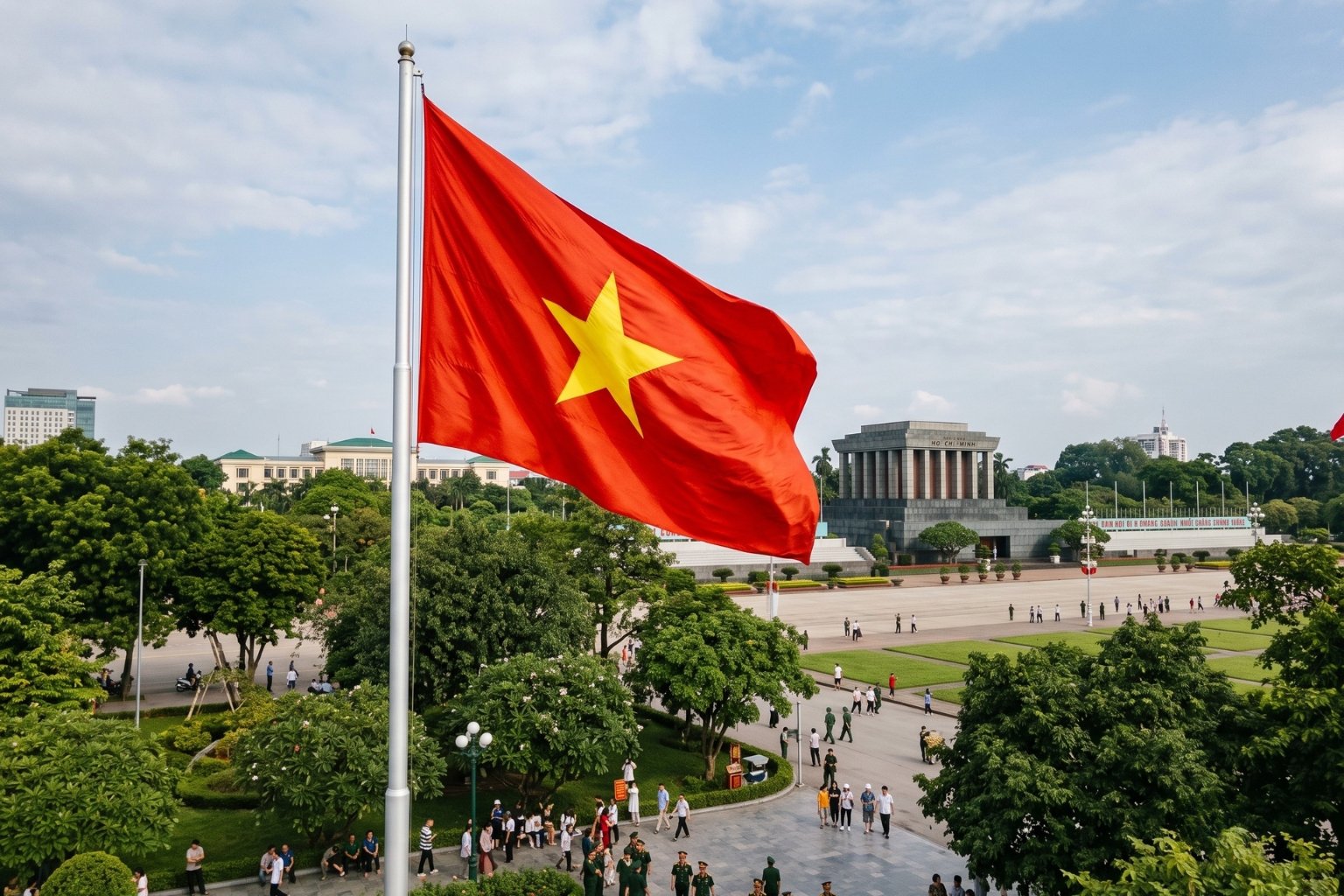

Every sunrise in Hanoi, soldiers march out to raise one plain red flag with a single gold star over Ba Dinh Square, right where Ho Chi Minh read Vietnam’s declaration of independence in 1945. The Vietnam flag looks almost too simple for the weight it carries, yet its colors, its meaning and its history stretch back further than most visitors expect, and historians still disagree about who actually drew that star. Behind two colors sits a country remade by colonial rule, split by war and stitched back together in 1976.
What the Vietnam Flag Looks Like
The design itself takes seconds to describe. A solid red field fills the whole rectangle, and one gold star with five points sits at the center, large enough that its tips almost reach the flag’s edges. The official proportions are 2 to 3, so a flag two meters tall stretches three meters wide.
| Element | Description |
|---|---|
| Field color | Solid red |
| Central symbol | Gold star, five points |
| Proportions | 2 to 3 (height to width) |
| Official Vietnamese name | Cờ đỏ sao vàng |
The Meaning Behind the Colors and the Star
Red, Blood and the Fight for Independence
According to the poem left behind by its credited designer, the red background stood for blood, specifically the blood spilled by Vietnamese fighters during decades of resistance against French colonial rule. The color also echoes the red flags of leftist movements that spread from the French Revolution through twentieth century communist parties, a visual language Vietnam’s revolutionaries knew well by the 1940s.
Yellow, Two Different Readings
The gold star carries a more layered story. The designer’s own poem describes yellow as the color of the Vietnamese people’s skin, a proud reference at a time when the population lived under foreign rule. Historians also point to an older thread, Vietnamese emperors had used yellow as an imperial color for centuries before the flag existed, borrowed from Chinese dynastic tradition.
The Five Points of the Star
Each point of the star stands for one class of Vietnamese society working toward the same goal, intellectuals, farmers, workers, traders and soldiers. The idea was to picture a country united across every occupation, not just one revolutionary faction, a detail that mattered enormously during a period when unity was the entire argument for independence.
Who Actually Designed the Flag? A Disputed Origin
Vietnamese state media has long credited Nguyen Huu Tien, an uprising leader captured by French forces and executed in August 1941, months after the flag’s first appearance. His authorship rests mainly on a poem published decades later, in 1981, and on testimony gathered after his death rather than any document he signed himself.
That version is not the only one. In 2001 Vietnam’s own Ministry of Culture stated there was no solid documentation proving Tien designed the flag, and in 2005 a provincial official proposed a second name, Le Quang So, a cadre from the Mekong Delta whose family and 1968 memoir tell a different story of the star’s design. Neither claim has been fully settled, and Vietnamese state media has never directly addressed the second version.
From Dynastic Banners to a National Symbol, a Short History
Vietnam’s flag did not begin in 1940. Its colors and symbols draw on centuries of banners tied to specific dynasties, colonial administrations and short lived occupations, long before the current design ever existed.
Imperial Yellow Under the Nguyen Dynasty
In the early nineteenth century, Emperor Gia Long flew a yellow flag with a blue border and a red sun, a design tied directly to imperial China’s use of yellow as the color of the ruling class. Yellow stayed connected to Vietnamese authority for roughly two thousand years, long before it ever touched a modern national flag.
French Rule and the Protectorate Flag
Once France controlled the region by the late nineteenth century, colonial flags folded the French tricolor into local designs, most visibly a yellow field carrying the French flag in one corner from 1923 onward. Vietnamese identity, during this period, had almost no independent visual symbol of its own.
A Brief Japanese Occupation
Japan’s takeover of Indochina in March 1945 lasted only months, but it brought its own short lived flags, including a yellow banner split by a red stripe. None of these versions outlasted the year.
The 1940 Uprising and the Flag’s First Appearance
The flag now flown across Vietnam made its debut on November 23, 1940, during a failed uprising against French rule in the south of the country, known as the Southern Uprising. That first appearance ended in defeat and executions, yet the design survived the movement that created it.
Independence Day, September 2, 1945
After Japan’s surrender, Ho Chi Minh declared Vietnam’s independence in Hanoi on September 2, 1945, and signed a decree three days later making the red and gold flag official for the new Democratic Republic of Vietnam. The National Assembly confirmed the choice in March 1946.
Two Countries, Two Flags
French forces returned to the south later that year, and for two decades Vietnam carried two competing flags at once. The north kept the red field and gold star, while the south, under French then American backing, flew a yellow flag with three horizontal red stripes.
Reunification in 1976
The star’s edges were straightened slightly in 1955, a minor adjustment that barely changed its appearance. After the war ended in 1975, the National Assembly formally adopted the red flag with the gold star for the entire country on July 2, 1976, and it has flown unchanged since.
The Other Vietnamese Flag Few Travelers Ever Hear About
Almost no visitor learns about cờ ngũ sắc, the five color ceremonial flag still carried through temple festivals and village rituals across Vietnam. Its design traces back to the legendary Hung Kings and borrows from the Five Elements theory shared by Vietnamese and Chinese philosophy, with each color, red, yellow, blue, green and white, tied to a different force in nature.
This flag never competed with the national flag for political meaning. It belongs entirely to spiritual and cultural life, which is exactly why catching sight of it during a festival feels like stumbling onto a piece of Vietnam that predates the modern state by centuries.
Where to See the Flag Come Alive in Vietnam
Ba Dinh Square in Hanoi hosts a daily flag raising ceremony at sunrise and a lowering ceremony at sunset, both performed by a small honor guard in front of Ho Chi Minh’s mausoleum, the same square where independence was declared in 1945. Arriving a few minutes early secures a clear view before crowds gather around the flagpole.
The Hanoi Flag Tower, inside the Thang Long Citadel complex, has flown a national flag from its 33 meter tower since 1986, with a fresh flag swapped in every two or three weeks. Climbing to the octagonal room at the top gives a rare rooftop view over the old city.
September 2 marks National Day, the anniversary of the 1945 independence declaration, when flags fill every street in the country. Travelers planning a trip around that date should expect parades, decorated storefronts and a noticeably livelier atmosphere in Hanoi.
Vietnam Flag, Quick Facts
| Question | Answer |
|---|---|
| Colors | Red field, gold star |
| Proportions | 2 to 3 |
| First flown | November 23, 1940 |
| Adopted nationally | September 5, 1945 |
| Current version since | July 2, 1976 |
| Credited designer | Nguyen Huu Tien (disputed) |
| Star’s five points | Intellectuals, farmers, workers, traders, soldiers |
