

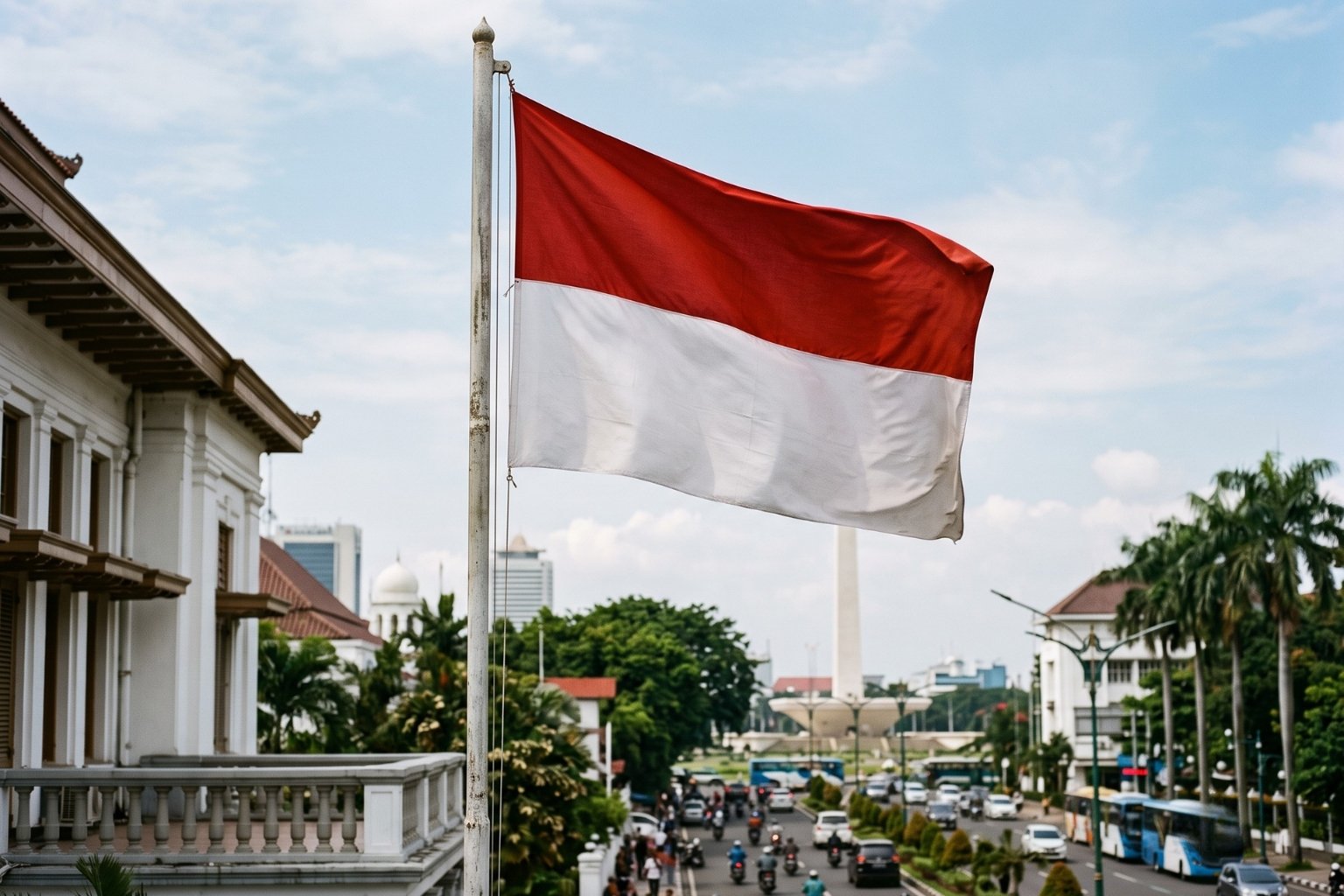

Two horizontal stripes, red above white, no crest, no stars, nothing to explain at a glance. Yet the Indonesia flag carries an empire, a colonial rupture, a proclamation shouted from a modest house in Jakarta, and a place at the table you would not expect. If you plan to travel through the archipelago, understanding what flies above every school, port and village hall will change how you read the country.
A Simple Design With No Single Official Meaning
The Sang Saka Merah Putih, as it is officially named, is a bicolor flag with a red band on top and a white band below, in a ratio of 2 to 3. Nothing more, nothing less. What is less known is that Indonesia has never written down, in law or constitution, exactly what red and white are supposed to mean. The country left that question to tradition, and tradition offers at least three answers.
The Courage and Purity Reading
The most common explanation, repeated at school and in most references, ties red to courage and white to purity. It fits the flag’s own history well, a nation that fought for its independence and wanted a symbol as direct as the fight itself.
The Body and Soul Reading
Sukarno himself, the country’s first president, offered a more philosophical version. In his reading, red represents the physical body, the material part of a person, while white stands for the soul. Together, the two bands form a complete human being, a fairly poetic way to describe a national flag.
The Earth and Sky Reading
A third interpretation comes from older Javanese belief. Red is linked to the earth and to the mother, white to the sky and the father. Some accounts even connect this to birth itself, red for the blood of the mother, white for the father’s contribution, a duality that predates the modern state by centuries.
The Majapahit Legacy: Where Red and White Come From
Long before anyone spoke of independence, red and white were already flying over Java. The Majapahit Empire, which dominated the region from the 13th to the 16th century, used a banner in these same two colors as a mark of its power. Some records describe a Majapahit flag with nine alternating stripes, five red and four white, a pattern far busier than the modern version but built on the same palette.
The colors were not chosen for symbolism alone. They were what the land could produce. Red came from natural dyes extracted from teak leaves, from the small sour fruit known as belimbing wuluh, or from mangosteen skin. White needed no dye at all, since handwoven cotton was naturally pale. The flag, in other words, began as a practical choice before it became a political one.
Not Just Java: The Bugis, Acehnese and Batak Red and White Banners
Java was never the only source. In South Sulawesi, the Bugis kingdom of Bone flew a red and white banner known as Woromporang as a mark of royal strength. In North Sumatra, King Sisingamangaraja IX of the Batak people carried a red battle flag bearing a pair of crossed swords called Piso Gaja Dompak. During the Aceh War, between 1873 and 1904, Acehnese fighters flew a red banner marked with a star, a crescent, a sun and Quranic script.
Even Bali contributed its own variant, the royal banner of Badung, combining white, red and black in patterns believed to trace back to Majapahit influence. By the time Prince Diponegoro raised his own red and white banner during the Java War of the 1820s, the colors had already become shorthand for resistance across the archipelago, long before any single country called Indonesia existed.
From Colonial Banners to Independence
For more than three centuries, the flags flying over the islands were not Indonesian at all. The Dutch East India Company’s colors flew starting in 1602, replaced later by the tricolor of the Dutch East Indies, red, white and blue in horizontal bands, which remained in place until the Japanese occupation began in March 1942. The red and white banner was explicitly forbidden under Dutch rule, which only sharpened its meaning for the nationalist movement quietly reviving it.
That revival started earlier than most people expect. Indonesian students living in the Netherlands, organized as the Indonesian Union, adopted the red and white symbol in 1922. The Indonesian Nationalist Party followed in 1928. When Japan’s occupation ended after World War II, the moment had already been prepared.
Fatmawati and the Bendera Pusaka
On 17 August 1945, at a modest house on Jalan Pegangsaan Timur in Jakarta, Sukarno and Mohammad Hatta proclaimed Indonesia’s independence. In front of that house flew a flag sewn by hand by Fatmawati, Sukarno’s wife, using cotton and wool yarn. That original flag became known as the Bendera Pusaka, the heirloom flag, and it was raised every Independence Day until 1968, when it was retired due to fragility and replaced by the replica still used today. The original is preserved as a national relic rather than flown.
Independence did not settle the matter overnight. The Netherlands refused to recognize the new republic for years, and only transferred sovereignty formally on 27 December 1949, after a long revolution. The flag never changed through any of it.
Sang Saka Merah Putih: What the Names Actually Mean
The flag carries several names depending on the context, each with its own shade of meaning.
- Sang Saka Merah Putih, the official constitutional name, translates roughly to the exalted red and white
- Bendera Merah Putih, the everyday name, simply means the red and white flag
- Sang Dwiwarna, an occasional nickname, means the bicolor
- Bendera Pusaka, reserved for the original heirloom flag, means the relic flag
None of these names describe any design element beyond color, which says something about how central red and white are to Indonesian identity. No crest was ever needed.
Not the Only Red and White: Monaco, Poland, Singapore
Indonesia’s flag is not unique in the world, a fact every visitor eventually notices. The closest match is Monaco, whose flag is almost graphically identical, with only a slight difference in the shade of red and in the ratio of the dimensions.
| Country | Colors and layout | Ratio | Distinguishing detail |
|---|---|---|---|
| Indonesia | Red top, white bottom | 2:3 | Deeper red shade |
| Monaco | Red top, white bottom | 4:5 | Lighter red, more square shape |
| Poland | White top, red bottom | 5:8 | Colors reversed |
| Singapore | Red top, white bottom | 2:3 | Crescent moon and five stars added |
Poland reverses the colors entirely, white above red. Singapore keeps the same proportions as Indonesia but adds a white crescent and five stars in the upper corner, a reminder that a shared palette can still produce very different flags once a country adds its own symbols.
Seeing the Flag as a Traveler
If you happen to be in Indonesia around 17 August, you will understand the flag differently than any article can explain. Independence Day turns entire neighborhoods into open air celebrations, with flag raising ceremonies at dawn, competitions like panjat pinang, where teams climb greased poles to reach prizes tied at the top, and red and white decorations covering doorways from Jakarta to the smallest village.
Outside of that one week, the flag still follows its own quiet etiquette. By custom, it is flown only between sunrise and sunset, and only raised at night under specific, formal circumstances. Notice it above a school in the morning and you are watching a small daily ritual most tourists walk past without a second look.
Red and White on the Table
Here is the detail most flag guides never mention. In Indonesian households, red and white are not confined to fabric. Around Independence Day, many families prepare bubur merah putih, a red and white rice porridge, one half colored naturally with palm sugar, the other left plain, served side by side in the same bowl as a small, edible echo of the national colors.
It is a modest dish, sweet, simple, and easy to make at home, but it captures something the flag alone cannot. In Indonesia, national identity is not only raised on a pole, it is also eaten, shared and passed around a table, which might be the most fitting way to understand a country you plan to visit through more than its history books.
