

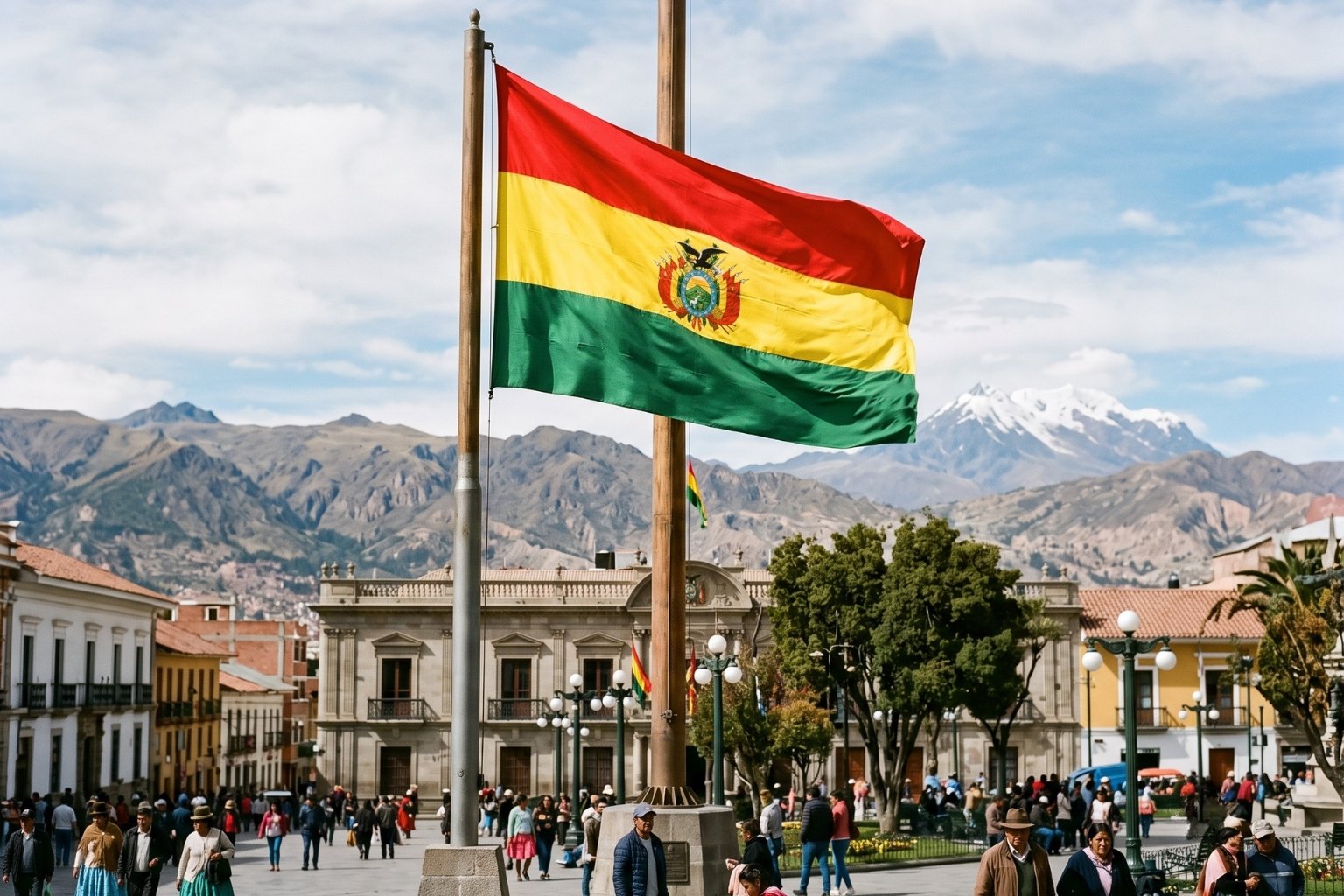

Red, yellow and green stripes are the most visible part of Bolivia’s identity, but they only tell half the story. Behind the tricolor lies a coat of arms packed with symbols, a rainbow legend involving a nineteenth century president, and a second official flag that most visitors never expect to see. Understanding the Bolivia flag means understanding a country that still argues, openly and passionately, about what unites it.
What the Bolivian Flag Looks Like Today
The Bolivian flag is a horizontal tricolor of three equal bands. Red sits on top, yellow in the middle, green on the bottom. It exists in two official versions.
The civil flag is the plain tricolor, used by ordinary citizens and businesses. The state flag adds the national coat of arms centered on the yellow band, and it’s the one flown by government buildings, the military, and diplomatic missions.
Official Specifications
| Element | Detail |
|---|---|
| Colors | Red, yellow, green (equal horizontal bands) |
| Proportions | 15:22, standardized in 2004 |
| Red | Pantone 485, RGB #DA291C |
| Yellow | Process Yellow, RGB #F4E400 |
| Green | Pantone 356, RGB #007A33 |
| Current design | In use since 1851, coat of arms formalized 1888 |
What Each Color Really Means
Red honors the bravery and bloodshed of the soldiers who fought for Bolivian independence. It’s the color most directly tied to the country’s founding conflict with Spain.
Yellow represents Bolivia’s mineral wealth, and specifically the silver that once made Potosí one of the richest cities on earth. Few national flags owe their color scheme so directly to a single mountain.
Green stands for the country’s fertility, its forests, and the vastness of land stretching from the Andes down into the Amazon basin.
What most flag explainers skip is that these three colors weren’t invented for the flag. The Aymara and Quechua peoples were already weaving red, yellow and green into textiles and ceremonial clothing long before Spanish colonization, so the tricolor carries a layer of meaning that predates the republic itself.
The Coat of Arms, Piece by Piece
The state flag’s coat of arms is dense with symbolism, and every element points to a specific chapter of Bolivian identity.
- Mount Potosí, rising in the background, representing the mineral wealth that shaped the colonial and early republican economy
- An alpaca, standing for Bolivia’s native wildlife and Andean agriculture
- A wheat sheaf and a bread tree, symbols of fertility and food production
- Crossed cannons and muskets, a direct reference to the war of independence
- An axe and a red Phrygian cap, classic symbols of liberty
- Ten stars, one for each of Bolivia’s departments
- An Andean condor perched on top, Bolivia’s national bird and a symbol of sovereignty
- A ribbon bearing the word BOLIVIA, framing the entire emblem
From Rainbow to Ratification: How the Flag Evolved
Bolivia’s flag didn’t arrive fully formed. It went through several distinct versions before settling into the design used today.
The first national flag appeared on August 17, 1825, just days after independence was declared. It used green and red stripes with stars and laurel branches, nothing like the flag Bolivians fly now.
On July 25, 1826, the colors changed to yellow, red and green, arranged in that order, with the coat of arms already present in the center.
The defining moment came in 1851. According to a story still told in Bolivia today, President Manuel Isidoro Belzu was riding on horseback between La Paz and Oruro when he spotted a vivid rainbow in the sky, its colors dominated by red, yellow and green. Inspired by the sight, he ordered the stripes reordered to red, yellow, green, the sequence still used today, officially adopted on October 31, 1851.
In 1888, the coat of arms was formally written into law, cementing the design that has represented Bolivia ever since.
Timeline at a Glance
| Year | Change |
|---|---|
| 1825 | First national flag, green and red with stars |
| 1826 | Colors shift to yellow, red, green |
| 1851 | Reordered to red, yellow, green after Belzu’s rainbow |
| 1888 | Coat of arms formally established by law |
| 2004 | Flag proportions standardized at 15:22 |
The Wiphala: Bolivia’s Other National Flag
Here’s what most articles about the Bolivian flag leave out entirely. Since 2009, Bolivia has had two official national flags, and the second one looks nothing like the tricolor.
The Wiphala is a square emblem made of a seven by seven checkerboard of rainbow colors, arranged diagonally. It represents the indigenous peoples of the Andes, particularly the Aymara and Quechua, and its patterns are linked to older Andean textile traditions.
When Bolivia adopted a new constitution in 2009 under President Evo Morales, the Wiphala was written into Article 6 as a national symbol with equal standing to the tricolor. It marked a formal recognition of Bolivia as a plurinational state, not a single homogeneous nation.
That recognition hasn’t been free of tension. During Bolivia’s 2019 political crisis, the Wiphala became a flashpoint, with some opposition figures treating it as a symbol of the previous government rather than the country as a whole, particularly in the eastern lowland regions. For many indigenous Bolivians, though, it remains a powerful and non negotiable marker of identity.
Travelers are most likely to see the Wiphala on police uniform patches, worn alongside the tricolor, in government offices in La Paz and El Alto, and during the Aymara New Year celebrations on June 21.
When and Where Bolivians Fly the Flag
August 6 is Independence Day, marking Bolivia’s declaration of independence from Spain in 1825. Expect parades, civic ceremonies, and flags on nearly every balcony.
August 17 is Flag Day, a holiday established by decree in 1924 to honor the anniversary of that very first 1825 flag. Schools and public institutions hold formal tributes, and it’s one of the more visible civic occasions on the calendar.
Beyond these dates, the flag has a steady daily presence outside government buildings, schools, and military installations, as is standard across Latin America.
If you’re traveling in Bolivia around either date, you’ll likely stumble into a parade or ceremony without planning for it. It’s worth pausing for. These aren’t tourist events, they’re genuinely local ones, and they offer a closer look at how seriously Bolivians take their national symbols.
Why Bolivia’s Flag Looks Like Ghana’s or Lithuania’s
If the Bolivian flag looks familiar, it’s not a coincidence you’re imagining. Ghana’s flag uses the same red, yellow and green palette, chosen independently as pan African colors, with red for the blood of independence, yellow for mineral wealth, and green for forests, a strikingly similar logic reached on a different continent.
Lithuania’s flag also uses yellow, green and red, though in a different order and with entirely unrelated symbolism rooted in its own national history. The visual overlap is real, but the meaning behind each flag stands on its own.
Quick Answers
Why does Bolivia have two official flags? The 2009 constitution granted the Wiphala equal status with the traditional tricolor, recognizing Bolivia’s indigenous peoples as a core part of national identity.
What do the colors of the Bolivian flag mean? Red for the bravery and blood of independence, yellow for mineral wealth, green for fertility and forests.
Is the Bolivian flag the same as Ghana’s? No. Both use red, yellow and green, but the stripe order and specific symbolism differ, and the resemblance is a coincidence of shared color logic rather than shared history.
When was the current Bolivian flag adopted? The red, yellow, green order dates from October 31, 1851, with the coat of arms formally added by law in 1888.
