

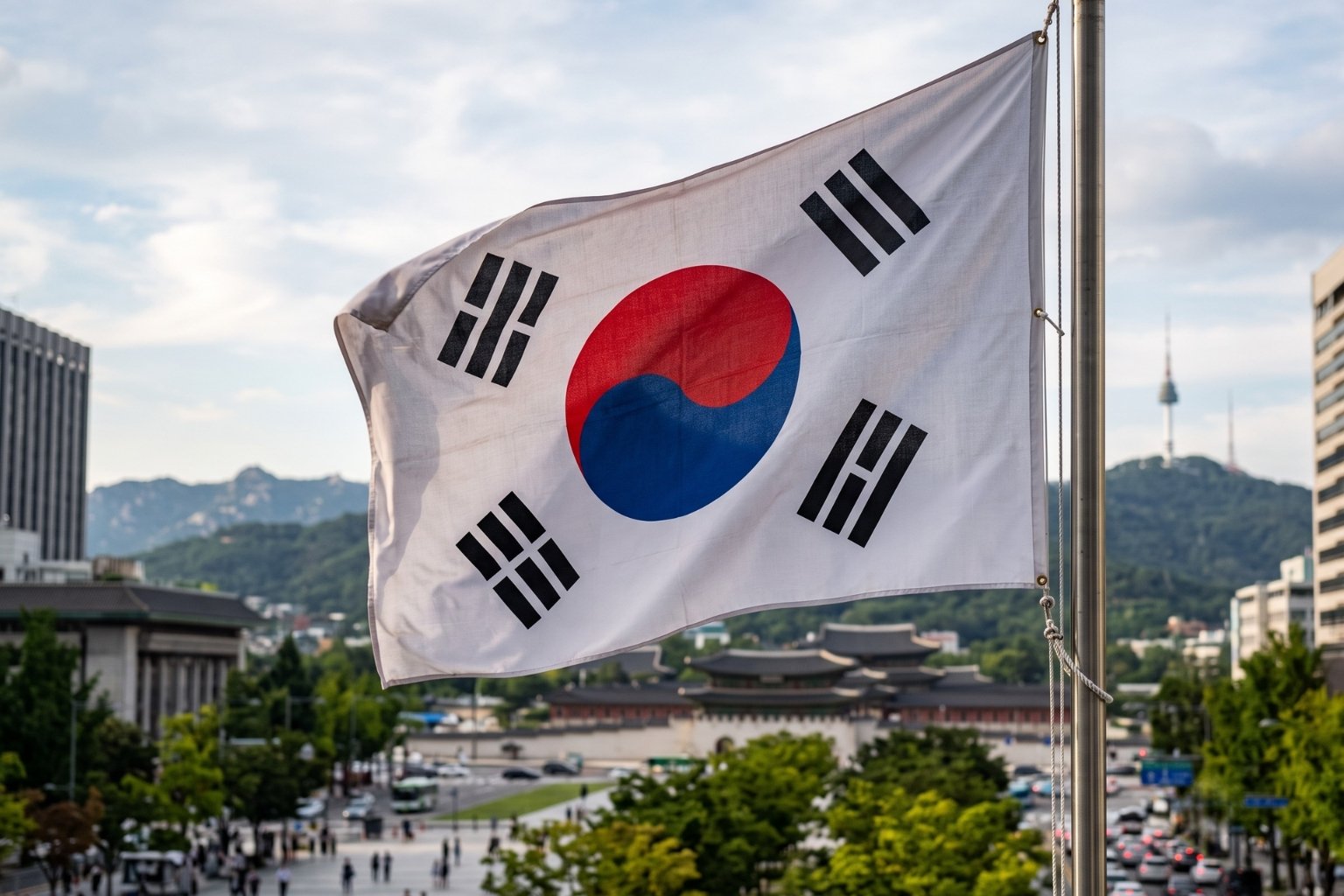

Walk through Gwanghwamun Plaza on any given morning and you will see it everywhere, on flagpoles, on lapel pins, printed onto paper cups during national holidays. The South Korea flag, known locally as the Taegeukgi, is one of the most philosophically loaded pieces of cloth flown by any nation today. Its colors, its central circle, and its four black bars each carry centuries of meaning, and once you know how to read them, the flag stops being decoration and becomes a small window onto Korean thought itself.
What Taegeukgi Actually Means
Koreans rarely say “the Korean flag.” They say Taegeukgi, a name built from taegeuk, the supreme ultimate of Chinese and Korean cosmology, and gi, simply meaning flag. So the literal translation is closer to “flag of the supreme ultimate” than to any generic national symbol. That distinction matters, because it tells you from the first syllable that this flag was never meant to be a mere marker of territory. It was designed as a statement about the nature of the universe.
The Colors and Symbols, Explained Properly
Most sources list the four colors of the Taegeukgi and stop there. The real interest lies in why those specific colors and shapes were chosen, and what they were meant to say about Korea.
The White Background
The white field is not decorative emptiness. It represents peace and purity, and it echoes the old poetic name for the country, sometimes translated as the Land of the Morning Calm. White was also the everyday color of 19th century Korean clothing, and it remains the dominant shade of the traditional hanbok you will still see rented out by the hour in Bukchon Hanok Village or worn proudly during Chuseok. In other words, the flag’s background is not an abstract idea borrowed from philosophy books. It is the color Koreans actually wore.
The Taegeuk Circle
At the center sits the taegeuk, the red and blue circle familiar to most people as the yin and yang symbol, though Koreans call it um yang. The upper red half represents yang, active and positive cosmic energy. The lower blue half represents um, its receptive counterpart. Together they are meant to show that opposites are not enemies but partners, locked in a permanent, balanced motion that creates and sustains everything in the universe. It is a strikingly elegant way to summarize an entire worldview in two interlocking shapes.
The Four Black Trigrams
Surrounding the circle are four sets of black bars, known as trigrams, drawn from the I Ching, the ancient Chinese classic used across East Asia for divination and philosophy. Only four of the original eight trigrams appear on the flag, chosen specifically to represent the four classical elements, the four cardinal directions, and the four seasons.
| Trigram | Korean Name | Element | Direction | Season |
|---|---|---|---|---|
| Three unbroken lines | Geon | Heaven | Northeast | Spring |
| Three broken lines | Gon | Earth | Southwest | Summer |
| Broken, unbroken, broken | Gam | Water | North | Winter |
| Unbroken, broken, unbroken | Ri | Fire | South | Autumn |
Together, these trigrams frame the taegeuk the way four corner stones frame a building. They are not filler. They are the flag quietly explaining how the balance of yin and yang plays out across nature itself.
Where the Flag Comes From: 1882 and the Treaty That Forced Korea’s Hand
Before 1876, Korea simply had no national flag. Kings had royal standards, but the country as a whole did not think one necessary, until diplomacy made it a problem. During negotiations for the Japan Korea Treaty of 1876, Japanese delegates arrived with their national flag on display. Korea had nothing to show in return, and the absence became a genuine diplomatic embarrassment.
It took another six years for that gap to close. In 1882, during talks around the Korea United States Treaty, the politician Park Yeonghyo presented a working design built around a white field, a red and blue taegeuk, and black trigrams. Credit for the underlying design is often shared with Lee Eungjun, Kojong’s court, and the Chinese diplomat Ma Jianzhong, who reportedly influenced the final coloring. By 1883, King Gojong formally proclaimed it Korea’s national flag.
Banned and Reborn: The Flag Under Japanese Occupation
When Japan annexed the Korean peninsula in 1910, the Taegeukgi was outlawed almost immediately. For thirty five years, simply displaying it could mark someone as a resistor rather than a patriot in the eyes of the occupying government. That suppression did the opposite of erasing the flag from Korean identity. It turned the Taegeukgi into the emblem of the independence movement, carried by the Provisional Government in exile and smuggled into protests inside the country.
That history is worth sitting with, because it explains something modern visitors often miss. The Taegeukgi is not simply a state symbol handed down from above. It is a flag Koreans fought to keep, which is part of why it still carries such emotional weight at protests, sporting events, and public ceremonies today.
Official Adoption and Standardization
Korea regained independence in 1945, and the Taegeukgi returned immediately, though its final modern form was not locked in overnight.
1948, the Birth of the Republic of Korea
On 12 July 1948, the Constituent National Assembly formally adopted the Taegeukgi as the national flag of the newly established Republic of Korea. A National Flag Correction Committee followed the next year, tasked with standardizing a design that had drifted through several slightly different versions since 1882.
1984 and 1997, Locking Down the Details
For decades, exact proportions and colors were left surprisingly loose. That changed on 21 February 1984, when the government codified precise dimensional specifications for the flag. The color question took even longer to settle. On 15 October 1997, a presidential decree finally fixed the official shades using both the Munsell and CIE color systems, the same rigorous standards used in industrial design. Since then, every Taegeukgi produced officially in Korea follows an identical, legally defined red, blue, black, and white.
Where You Will Actually See the Taegeukgi Today
Reading about a flag is one thing. Knowing where to actually encounter it changes how a trip feels.
Flag Flying Days and August 15
South Korea marks specific national days for flying the Taegeukgi, and the most significant by far is August 15, Liberation Day, commemorating the end of Japanese rule in 1945. If you are in Seoul that week, entire neighborhoods fill with flags hung from apartment balconies, a genuinely moving sight if you understand what the date represents.
The National Museum of Korea and Independence Hall
For travelers who want to see the flag’s earlier forms in person, the National Museum of Korea in Seoul holds historic Taegeukgi examples, including versions collected by 19th century foreign diplomats. Independence Hall of Korea, in Cheonan, goes further, dedicating entire exhibits to the flag’s role during the resistance against Japanese occupation. Both are worth building an afternoon around if flags and modern history genuinely interest you.
The Unification Flag at Sporting Events
One detail almost every competing article gets muddled: the Unification Flag, a plain blue silhouette of the Korean peninsula on a white field, occasionally used when North and South Korean athletes march or compete together, is not a variation of the Taegeukgi. It is a completely separate flag with its own political history, created specifically to represent both Koreas without favoring either national symbol. If you spot it at an international event, you are looking at something entirely different from the flag flying over government buildings in Seoul.
Flag Etiquette Worth Knowing Before You Visit
Korean flag etiquette is not something tourists need to memorize, but a little awareness goes a long way. The Taegeukgi is generally flown right side up with the trigrams in their fixed positions, never as decoration on clothing or products in a way that could read as disrespectful. On mourning days, the flag is lowered to half the height of the pole rather than flown fully raised. If you happen to attend an official ceremony where it is presented or folded, treat it the way you would treat any national flag in a formal setting, with quiet attention rather than casual handling.
Frequently Asked Questions
Is Taegeukgi the same as the Korean flag? Yes. Taegeukgi is simply the Korean name for the national flag of South Korea, used far more commonly inside the country than the generic English phrase.
Why does the flag use only four trigrams instead of the traditional eight? The four chosen trigrams, heaven, earth, water, and fire, were considered enough to represent the essential balance of nature and the cardinal directions without cluttering the design. Adding all eight would have crowded the composition and diluted its symbolism.
How is the South Korea flag different from the North Korea flag? North Korea’s flag, adopted in 1948 as well, abandons the taegeuk and trigrams entirely in favor of a red star on a red and blue field, a design rooted in Soviet influenced communist symbolism rather than traditional Korean cosmology. The two flags share no visual elements beyond their use of red and blue.
When was the Taegeukgi’s color officially standardized? The exact legal color specifications were only fixed on 15 October 1997, through a presidential decree using the Munsell and CIE color systems, more than a century after the flag’s original 1882 design.
