

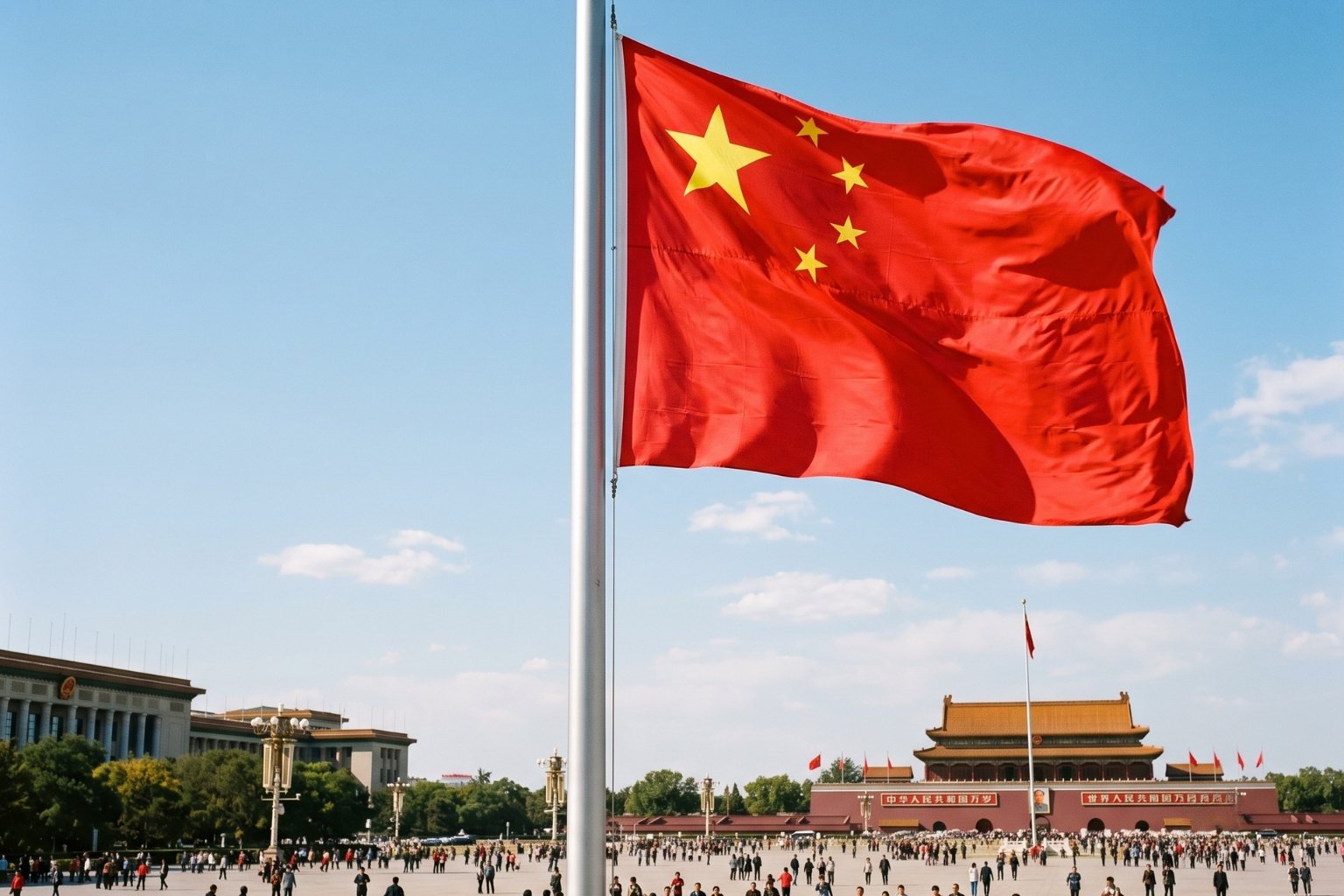

Red, gold, and five stars. That’s the entire visual vocabulary of the Chinese flag, yet each element carries nearly a century of upheaval behind it. Before you spot it snapping over Tiananmen Square or folded neatly at a border crossing, it helps to know what you’re actually looking at. The flag flying over China today looked completely different a hundred years ago, and even fifty years before that.
What the Chinese Flag Looks Like Today
The Five Star Red Flag (五星红旗, wǔxīng hóngqí) is a plain red field with five gold, five pointed stars grouped in the upper left corner. One star is noticeably larger than the other four, and the smaller stars sit in a slight arc, each with one point angled toward the center of the big star.
There’s no crest, no text, no dragon, nothing beyond color and geometry. That simplicity is deliberate.
The Five Stars and What They Represent
The large star stands for the Chinese Communist Party. The four smaller stars were originally meant to represent the four social classes recognized at the founding of the People’s Republic: the working class, the peasantry, the urban middle class, and so called patriotic capitalists.
Over time, as that class based framing faded from official language, the four stars came to be read more broadly as a symbol of national unity around the Party’s leadership.
Official Colors and Proportions
China’s National Flag Law sets exact specifications, right down to the sRGB values used for digital reproduction.
| Element | Color | Represents |
|---|---|---|
| Field | Red | Revolution, the Han majority, good fortune |
| Large star | Gold | The Communist Party |
| Four small stars | Gold | Unity of the people |
| Flagpole (on cloth flags) | White | Visual separation from the red field |
| Ratio | 3:2 | Fixed by the 1990 National Flag Law |
What Each Element Actually Means
Why the Flag Is Red
Red carries a double meaning here. It’s the color of the revolution that brought the Communist Party to power in 1949, and it’s also the traditional color of the Han, China’s largest ethnic group, long associated with celebration and good luck rather than politics.
That overlap is part of why red works so well as a national symbol. It reads as both ideological and cultural at once.
Why the Stars Are Gold
Gold, or imperial yellow, has centuries of weight in Chinese symbolism, historically reserved for emperors and associated with wisdom and glory. On the flag, gold stars against a red field were chosen partly for visibility and partly to echo that older association with authority and light.
The Four Small Stars, One Ongoing Debate
Ask five sources what the four smaller stars mean and you’ll often get five slightly different answers. Some point to the original 1949 explanation, the four social classes. Others connect them to Chinese numerology, where five has long marked completeness, as in the five cardinal directions, the five elements, and the five classical virtues.
Both readings coexist in how the flag is taught and discussed in China today, and neither one has fully replaced the other.
Before the Red Flag, China’s Earlier National Flags
China didn’t have a formal national flag for most of its imperial history. Flags were mostly military or ceremonial, tied to specific dynasties rather than the country as a whole.
The Yellow Dragon Flag (1862 to 1912)
The Qing dynasty adopted China’s first true national flag in 1862, largely under pressure to identify Chinese ships in an era of international shipping law. It showed a blue dragon chasing a red pearl across a yellow field, yellow being the Manchu ethnic color and the imperial color of the ruling house.
The Five Colored Flag (1912 to 1928)
When the Qing fell and the Republic of China was founded in 1912, the new government adopted five horizontal stripes: red, yellow, blue, white, and black. Each stripe stood for one of China’s five major ethnic groups at the time, Han, Manchu, Mongol, Hui, and Tibetan.
Sun Yat sen reportedly disliked the design, arguing that stacking colors in horizontal bands implied a hierarchy among the ethnicities rather than genuine equality.
The Blue Sky, White Sun, Red Earth Flag (1928 to 1949)
After the Nationalist government’s Northern Expedition unified most of the country in 1928, it adopted a red flag with a blue canton and a white sun, a design originally created for the Revive China Society decades earlier. This flag governed mainland China until 1949, and it never actually disappeared.
1949, the Birth of the Five Star Red Flag
Zeng Liansong, the Designer Almost No One Noticed
In July 1949, the newly forming government opened a public competition for a national flag design. Nearly three thousand entries poured in from across the country, most from artists, officials, and public figures.
The winning design came from Zeng Liansong, a Shanghai based economist with no formal design background. His submission was initially overlooked in the early rounds of judging, and only rose to the top after later revisions removed a small emblem from the original sketch, leaving the cleaner field of stars we see today.
A Detail Worth Knowing
Zeng later described the moment the design came to him as almost instinctive, drawing on an old Chinese expression for staring hopefully at the night sky, the kind of longing that comes with wishing on something distant. It’s a small, human detail that most retellings of this history skip straight past.
October 1, 1949, First Raised Over Tiananmen Square
The flag was formally approved in September 1949 and raised for the first time on October 1, 1949, during the ceremony announcing the founding of the People’s Republic of China in Tiananmen Square. It has flown as the national flag ever since, unchanged in design.
China’s Flag vs Taiwan’s Flag, Clearing Up a Common Mix Up
A lot of confusion online comes from the fact that China had two competing national flags in the twentieth century, and one of them is still in official use today, just not on the mainland.
| Mainland China (PRC) | Taiwan (ROC) | |
|---|---|---|
| Flag name | Five Star Red Flag | Blue Sky, White Sun, Red Earth |
| Adopted | 1949 | 1928 |
| Design | Red field, five gold stars | Red field, blue canton, white sun |
| Symbolizes | Communist Party leadership | Sun Yat sen’s Three Principles of the People |
After the Nationalist government lost the Chinese Civil War in 1949, it retreated to Taiwan and kept using its existing flag, while the new government on the mainland adopted the five star design. Both flags trace back to the same revolutionary period, they just split in different directions after 1949.
Chinese Flag Etiquette Travelers Should Know
- The flag is raised at dawn and lowered at dusk in Tiananmen Square in a public ceremony, and it’s genuinely worth an early alarm if you’re in Beijing.
- Government buildings, schools, airports, and train stations are legally required to display the flag.
- China’s National Flag Law makes it a punishable offense to damage, deface, or publicly disrespect the flag, with penalties that can include fines or jail time.
- National Day, October 1, brings flags out on balconies, storefronts, and family homes nationwide, making it one of the most visually striking times to be traveling in China.
- If you pick up a flag as a souvenir, treat it with basic care. Locals notice, and the flag’s legal protections carry real weight domestically, even if the rules feel unfamiliar to a visitor.
Quick Answers About the Chinese Flag
What do the five stars on the Chinese flag mean? The large star represents the Communist Party, and the four smaller stars originally stood for China’s four social classes, now more commonly read as a symbol of national unity.
Why is the Chinese flag red? Red marks both the 1949 revolution and the traditional color of the Han, China’s majority ethnic group, giving the flag a double layer of meaning.
Who designed the Chinese flag? Zeng Liansong, an economist from Shanghai, won a nationwide competition in 1949 with a design that beat out close to three thousand other entries.
Is China’s flag related to Vietnam’s flag? Not directly, though both use a red field with gold stars tied to Communist symbolism, a visual language shared by several twentieth century socialist states rather than a direct copy of one another.
