

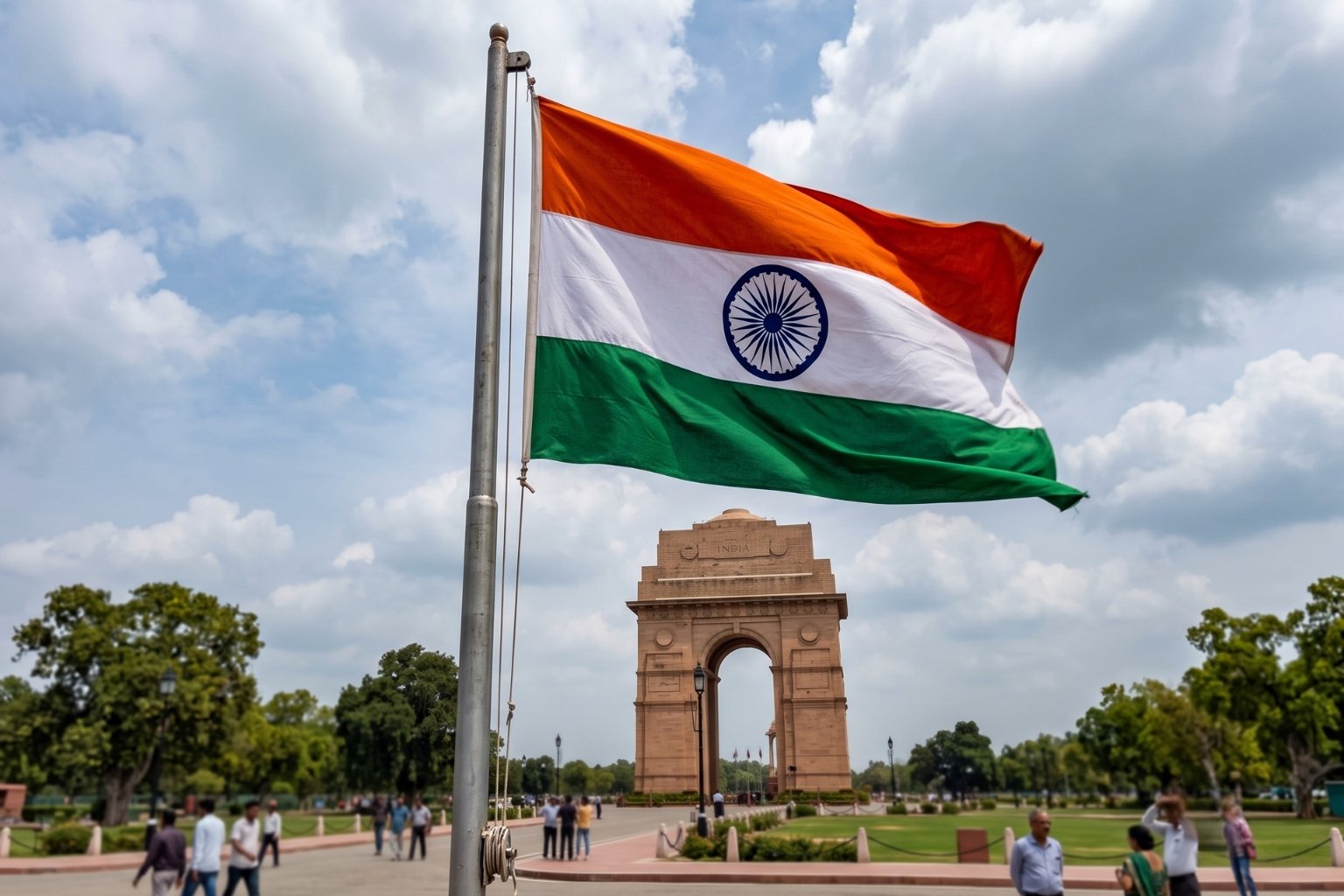

Every morning across India, saffron, white and green rise together on flagpoles from village schools to the ramparts of the Red Fort. The India flag carries a story that runs from a British era protest square to a spinning wheel and finally to the wheel of a Buddhist emperor. Once you know what each color means and how close the design came to looking completely different, you will never look at the Tiranga the same way again.
What the Indian Flag Looks Like Today
The India flag is a horizontal tricolor. A band of deep saffron sits on top, pure white runs through the middle, and a rich green closes the bottom. At the center of the white band spins the Ashoka Chakra, a navy blue wheel with 24 spokes.
The flag’s official proportions follow a fixed 2:3 ratio, meaning the length is one and a half times the height. Indian law also requires the flag to be woven from khadi, the hand spun cotton or silk that Mahatma Gandhi turned into a symbol of independence. Only one facility in the country, the Karnataka Khadi Gramodyoga Samyukta Sangha in Hubli, is authorized to manufacture it.
Colors and Specifications
| Element | Detail |
|---|---|
| Top band | Deep saffron (kesari), hex FF9933 |
| Middle band | White, hex FFFFFF |
| Bottom band | India green, hex 138808 |
| Wheel | Ashoka Chakra, navy blue, hex 000080, 24 spokes |
| Ratio | 2:3 (length to height) |
| Material | Khadi, hand spun cotton or silk |
What Each Color of the Indian Flag Really Means
The government of India has never spelled out one single fixed meaning for each color. What exists instead is a widely accepted interpretation that took shape as the flag evolved, moving away from its early religious associations toward something every citizen could claim as their own.
Saffron, Courage and Sacrifice
Saffron sits at the top for a reason. It represents strength, courage and the willingness to sacrifice, values drawn directly from the freedom struggle that produced the flag in the first place. In Hindu and Buddhist tradition, saffron also carries connotations of renunciation, of letting go of material comfort for a greater purpose.
White, Peace and Truth
The white band symbolizes peace and truth, and it is not decorative. Gandhi insisted on adding it specifically so the flag would represent every religious community in India, not only the two the original design had in mind. It also happens to be the perfect backdrop for the Chakra, giving the wheel visual weight at the very center of the flag.
Green, Fertility and Faith
Green closes the flag with a nod to the land itself, standing for fertility, growth and the agricultural foundation the country was built on. Some interpretations extend this to faith and chivalry as well. Together, the three colors move from struggle at the top to hope at the bottom, with truth holding the center.
Here is what most explanations skip. Pingali Venkayya’s original 1921 design used red for Hindus and green for Muslims, a color scheme meant to represent India’s two largest religious communities. Independence leaders deliberately reworked that meaning during the 1931 revision, replacing red with saffron and removing the explicit religious symbolism so the flag could belong to a secular nation rather than any single faith.
The Ashoka Chakra, More Than a Wheel
The wheel at the center of the flag is not the wheel Gandhi originally proposed. His version featured a charkha, the traditional spinning wheel he used as a symbol of Indian self reliance under British rule. When the Constituent Assembly finalized the flag in 1947, the charkha was replaced with the Dharma Chakra, an image lifted from the Lion Capital of Ashoka, carved in the third century BCE at Sarnath.
The 24 spokes are often read as a reference to constant motion, the idea that a nation, like a wheel, survives through progress rather than stillness. In Buddhist thought, the wheel represents dharma itself, the moral order that governs right action. It remains one of the only national wheel emblems of its kind among the world’s flags.
From Freedom Movement to National Symbol, the History of the Flag
The flag India flies today is the result of roughly four decades of trial, protest and revision. Understanding that path makes the final design feel less like a government decision and more like the outcome of an entire movement.
The First Flags
The earliest version widely credited as a national flag was raised in Calcutta on August 7, 1906, at Parsee Bagan Square. It carried three horizontal stripes of green, yellow and red, along with lotus flowers and a Vande Mataram inscription. A year later, exiled revolutionary Bhikaji Cama unfurled a similar design at an international conference in Stuttgart, Germany, giving the independence movement its first real presence on a world stage.
Pingali Venkayya’s 1921 Design and Gandhi’s Involvement
In 1921, a lecturer and agriculturalist named Pingali Venkayya presented Gandhi with a two color flag, red for Hindus and green for Muslims. Gandhi asked for a white band to be added so every other religious community in India would see itself represented too, and Lala Hans Raj Sondhi suggested placing Gandhi’s spinning wheel at the center. That flag, carried by thousands during the 1923 protests in Nagpur, became the unofficial banner of the independence movement for the next decade.
The 1931 Karachi Committee and the Shift to Saffron
A seven member committee meeting in Karachi in 1931 formally adopted the tricolor as the flag of the Indian National Congress. Red became deep saffron, and the committee took care to state that the colors no longer carried any religious meaning, a deliberate move to keep the flag above the sectarian divisions of the time.
Independence and the Final Design
On July 22, 1947, just weeks before independence, the Constituent Assembly approved the flag in its current form, replacing the spinning wheel with the Ashoka Chakra. It became the official flag of a sovereign India on August 15, 1947, and has not changed since.
Where to See the Flag Come Alive
Reading about the flag is one thing. Watching it move through a crowd is another experience entirely, and India offers a handful of moments where that happens on a scale worth planning a trip around.
- Republic Day, January 26, when the flag leads a full military and cultural parade down Delhi’s Kartavya Path.
- Independence Day, August 15, when the Prime Minister hoists the flag over the ramparts of the Red Fort in Delhi, a ceremony broadcast nationwide.
- The Beating Retreat at Wagah, on the border with Pakistan, where the daily flag lowering ceremony draws crowds who come as much for the theatrical marching as for the flag itself.
- Hubli, Karnataka, home to the only facility legally allowed to weave the official khadi flag, a worthwhile detour for travelers curious about textile traditions.
Flag Code Basics Every Visitor Should Know
Until 2002, only government buildings could fly the India flag outside a handful of national holidays. A Supreme Court ruling that year, prompted by a private citizen’s appeal, opened the door for ordinary people to display it year round, provided they follow the Flag Code of India.
A few rules matter if you plan to buy, fly or photograph one respectfully. The flag should never touch the ground or water, should never be flown upside down, and should carry no lettering or images of its own. It should also come down at sunset unless properly illuminated, since flying it in darkness without lighting is considered a violation.
Quick Facts
- The flag’s official name is the Tiranga, meaning tricolor.
- Its dimensions must follow a fixed 2:3 ratio.
- It is one of the only national flags in the world built around a wheel of this kind.
- Insulting the flag is a criminal offense under the Prevention of Insults to National Honor Act of 1971.
- Subhas Chandra Bose flew a version of this flag, without the spinning wheel, during his World War II campaigns.
Frequently Asked Questions
Who designed the India flag?
Pingali Venkayya, a freedom activist and agriculturalist, is credited with the core design that eventually became the national flag, though the final 1947 version reflects input from Gandhi and the Constituent Assembly.
What does the India flag’s tricolor mean?
Saffron stands for courage and sacrifice, white for peace and truth, and green for fertility and faith, with the Ashoka Chakra at the center representing dharma and constant progress.
Does the flag have religious meaning?
Not officially. Early designs did assign colors to specific religions, but that symbolism was deliberately removed during the 1931 revision so the flag could represent the entire nation rather than any single faith.
When did the current design become official?
The Constituent Assembly adopted the present design on July 22, 1947, and it became India’s official flag on August 15, 1947.
Can tourists legally buy and take home an India flag?
Yes, though travelers should treat it with the same respect the Flag Code asks of citizens, avoiding uses the law considers disrespectful, such as printing it on disposable items.
