

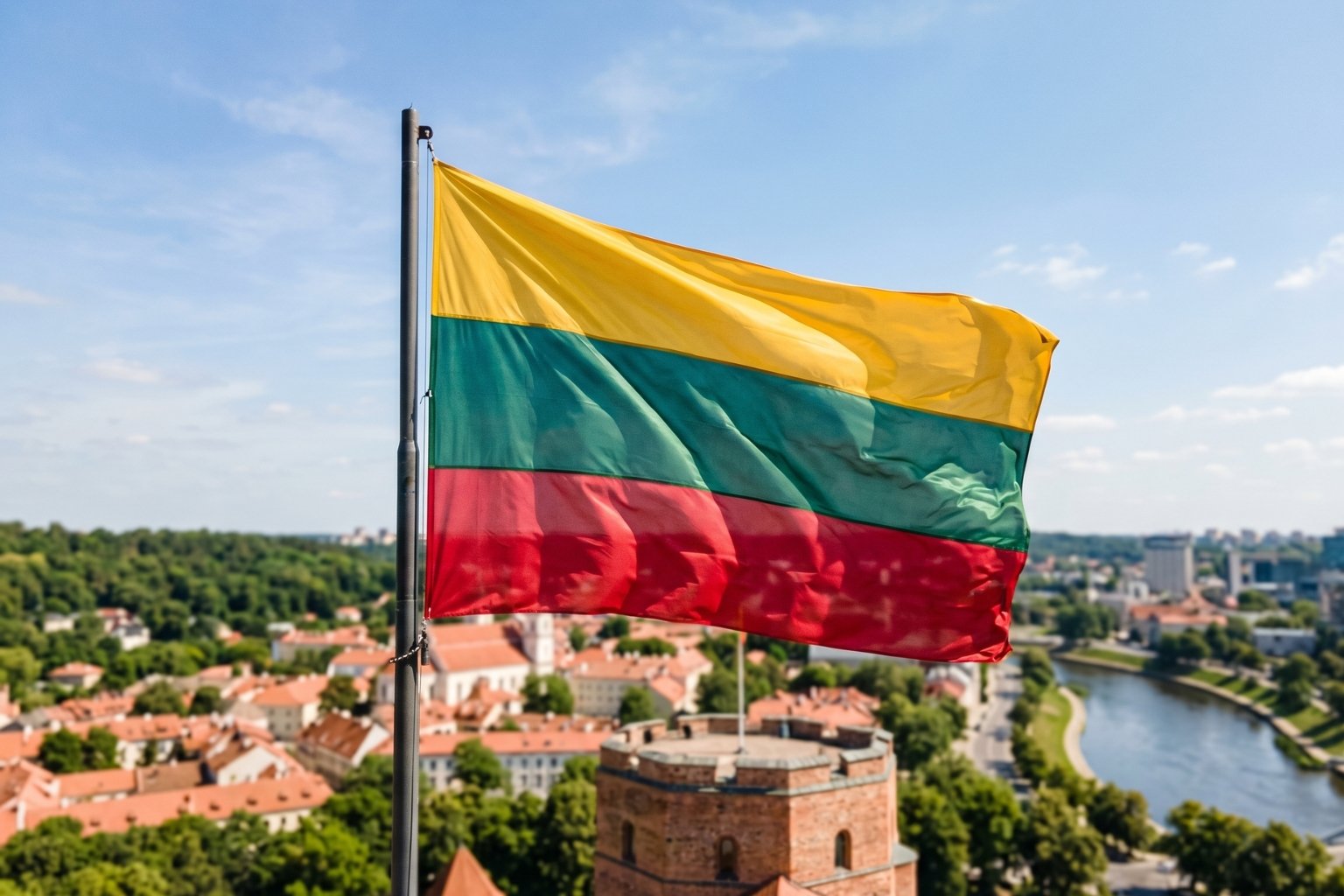

Three horizontal bands. Yellow, green, red. A flag so simple it could belong to any country, yet so loaded with history that Lithuanians who lived under Soviet rule still speak of it with a certain catch in the voice. The Lithuanian flag was banned for nearly fifty years. People were punished for displaying it. It came back anyway. Understanding what those three colors mean requires understanding what it cost to keep them alive.
What Does the Lithuanian Flag Look Like?
The national flag of Lithuania consists of three equal horizontal stripes: yellow on top, green in the middle, and red at the bottom. The current proportions follow a 3:4 ratio, adjusted in 2004 from the earlier 1:2 format used since 1918.
In Lithuanian, the flag is called the Trispalvė, meaning simply “the three-colored one.” The name is unassuming, almost affectionate. It reflects how deeply embedded the flag is in everyday national identity rather than in formal ceremony.
No emblem sits on the tricolor. No coat of arms, no star, no symbol of any kind. Just three bands of color, clean and unadorned. That restraint was a deliberate choice in 1918, and it still communicates something important: this flag belongs to the people, not to a dynasty or a state apparatus.
The Meaning of Each Color
Yellow: The Sun Above a Cloudy Country
Yellow occupies the top stripe and officially represents the sun, light, and prosperity. It evokes fields of ripening wheat and the idea of abundance, a life freed from want.
There is a small irony worth noting. Lithuania sits in the northern Baltic region, where overcast skies are the norm for a good part of the year. It is one of the cloudier countries in Europe. Yellow as the color of the sun is, in this sense, as much an aspiration as a description.
What makes the choice historically interesting is that yellow was the last of the three colors to be confirmed. The painter and art historian Tadas Daugirdas, one of the three men on the 1918 design commission, argued that a yellow stripe placed between green and red would evoke the colors of dawn: the earth below, the sky above, and the light breaking between them. After considerable debate, the commission agreed.
Green: The Color That Fits
Green, the middle stripe, represents forests, meadows, hope, and freedom. Of the three colors, it is the one that requires the least explanation to anyone who has spent time in Lithuania.
Roughly 33 percent of Lithuania’s land area is forested. The country has a long and rooted agricultural tradition. Green is not a symbolic abstraction here. It is a literal description of the landscape you see from any window outside the capital. The European Union has consistently recognized Lithuanian forestry management as among the best-practiced on the continent.
Green also carries the quieter meaning of renewal. For a nation that spent decades under foreign occupation, hope was not a vague sentiment. It was a political act.
Red: The Weight at the Bottom
Red anchors the flag at the base and carries the heaviest symbolic load: courage, sovereignty, and the blood shed for independence. The placement is significant. Red does not frame the flag or dominate it. It grounds it.
Lithuania lost hundreds of thousands of people across two occupations in the twentieth century, first Soviet, then Nazi German, then Soviet again. The red stripe is not decorative. It is a form of memory.
The Origins: Folk Textiles and a Nation in Exile
The three colors of the Lithuanian flag did not appear for the first time in 1918. They were already present in Lithuanian folk weaving and traditional dress, where yellow, green, and red had been combined for generations in sashes, textiles, and ceremonial garments. The colors were embedded in material culture long before they were embedded in politics.
During the nineteenth century, while Lithuania was absorbed into the Russian Empire and its language was officially suppressed, a diaspora community of Lithuanian exiles and intellectuals living in Europe and the United States kept the cultural flame alive. These were the people who began associating the folk colors with national identity, with resistance, with the idea of a Lithuania that still existed even if no map acknowledged it.
The Great Seimas of Vilnius in 1905 was the first major organized expression of Lithuanian national consciousness. It was there that activists formally proposed the yellow, green, and red tricolor as the flag of the Lithuanian people, choosing it over the Vytis, the medieval heraldic symbol of the Grand Duchy. The Vytis, championed by the historian Jonas Basanavičius, was rejected not because it lacked prestige but because the assembled delegates wanted a flag that looked forward, toward a modern nation-state, rather than backward toward a medieval empire that had encompassed many other peoples besides Lithuanians.
The Flag Is Born: April 1918
After Lithuania declared independence on February 16, 1918, a special commission was formed to design the national symbols. Three men were appointed: Jonas Basanavičius, the grand old figure of Lithuanian national revival; Tadas Daugirdas, the painter who had argued for yellow; and Antanas Žmuidzinavičius, an artist and curator.
The deliberations were not simple. The question of color order provoked genuine disagreement. Should yellow go on top or on the bottom? Should red precede green or follow it? Daugirdas eventually prevailed with his dawn argument, and the commission formally approved the design on April 19, 1918. The flag was officially adopted six days later, on April 25, 1918.
The first Lithuanian Republic lasted barely two decades. It was a turbulent period, marked by territorial disputes, the loss of Vilnius to Poland in 1920, and the rise of an authoritarian government under President Antanas Smetona from 1926. Despite the instability, the tricolor flew. It was on every public building, in every school, at every official occasion.
Then, in 1940, it disappeared.
Suppression: Five Decades Without the Trispalvė
The Soviet occupation of Lithuania in 1940 did not simply change the government. It systematically dismantled the symbols of Lithuanian statehood. The Trispalvė was banned. Displaying it was a criminal offense, punishable by imprisonment and, during the worst years of Stalinist rule, by deportation to Siberia.
What replaced it was the flag of the Lithuanian Soviet Socialist Republic: initially a plain red Soviet banner with the republic’s name, later modified in 1953 to include a narrow white stripe and a wider green band at the bottom, above which sat the hammer, sickle, and red star. It was a flag designed by committee in Moscow to look vaguely local while communicating absolute submission.
During Nazi German occupation between 1941 and 1944, the situation was no less oppressive. The tricolor had no official place in that regime either.
After the war, Soviet rule resumed and tightened. The Lithuanian flag survived in two places: in the memory of those old enough to remember it, and in diaspora communities abroad, particularly in the United States and Germany, where Lithuanian exiles displayed it freely and kept its legal and moral legitimacy alive on the international stage.
Inside Lithuania, owning a Trispalvė was an act of private defiance. Some families kept one folded at the bottom of a drawer, brought out only in secret. The physical object carried weight far beyond fabric and dye.
The Return: Sąjūdis and the Singing Revolution
The spring of 1988 brought the first serious cracks in Soviet control over the Baltic states. In Lithuania, the reform movement Sąjūdis began organizing public rallies, and at those rallies, yellow, green, and red began to reappear.
It was not a sudden eruption. It was a deliberate, collective reclamation. People showed up with Trispalvės they had kept hidden for decades. Others sewed new ones. The flag became the visual language of a movement that was making a claim so large it could barely be spoken aloud: that the Soviet occupation had always been illegal, and that Lithuania intended to end it.
On November 18, 1988, the Lithuanian Supreme Soviet, under pressure from Sąjūdis, officially reinstated the tricolor as the state flag. This was roughly eighteen months before Lithuania formally declared the restoration of independence on March 11, 1990, and nearly three years before the Soviet Union itself collapsed.
The night of January 13, 1991 is remembered across Lithuania as one of the most consequential of the independence struggle. Soviet troops moved on the Vilnius TV tower and the parliament building to crush the independence movement by force. Unarmed Lithuanian civilians formed a human barrier. Fourteen people were killed. Photographs from that night show Trispalvės everywhere, held in bare hands in the freezing dark.
The flag had not changed. What had changed was the willingness of an entire population to hold it in public and face whatever came next.
The Vytis: Lithuania’s Other Flag
The Vytis is the armored knight on horseback that has represented Lithuanian statehood since the fourteenth century. White knight, red background, the knight carrying a sword raised and a shield bearing a double cross. The word comes from the Lithuanian verb vyti, to chase or to pursue.
The Vytis originated as the personal seal of the Grand Duchy of Lithuania, one of the largest states in medieval Europe at its peak, stretching from the Baltic to the Black Sea. It evolved into the heraldic emblem of the duchy and remained in use through the Polish-Lithuanian Commonwealth until Russian annexation ended the state in 1795.
When independent Lithuania chose the tricolor over the Vytis in 1918, the knight did not disappear. It became the national coat of arms, displayed on official documents, government buildings, passports, and identity cards.
In 2004, Lithuania gave the Vytis a formal parallel status by designating it the Historical State Flag of Lithuania. It flies on specific occasions alongside the Trispalvė, particularly at the Presidential Palace and the War Museum in Kaunas. The two flags together represent two distinct but equally valid expressions of Lithuanian identity: the ancient sovereignty of the Grand Duchy and the modern sovereignty of a republic built by its own people.
The Lithuanian Flag Today
The Trispalvė is governed by Lithuanian law, specifically the Law on the State Flag, last amended in 2004. It defines the exact shade of each color, the permitted proportions, and the occasions on which the flag must be displayed.
Several official variants exist alongside the national tricolor:
- The Presidential Flag: a red banner bearing the Vytis at the center, surrounded by a gold border. It flies over the Presidential Palace whenever the President is in residence.
- The Naval Ensign: the tricolor with a blue anchor in the upper left canton, used by the Lithuanian Navy.
- The Historical State Flag: the Vytis on red, flown on designated national commemoration days.
For most Lithuanians and for the Lithuanian diaspora worldwide, estimated at close to a million people spread across the United States, the United Kingdom, Ireland, Germany, and beyond, the flag carries a meaning that no law can fully encode. It is the object that was forbidden and came back. It is the thing people held when they did not know if holding it would cost them everything.
Three bands of color. Yellow for the dawn that was promised. Green for the land that was always there. Red for everyone who did not see it come back.
