

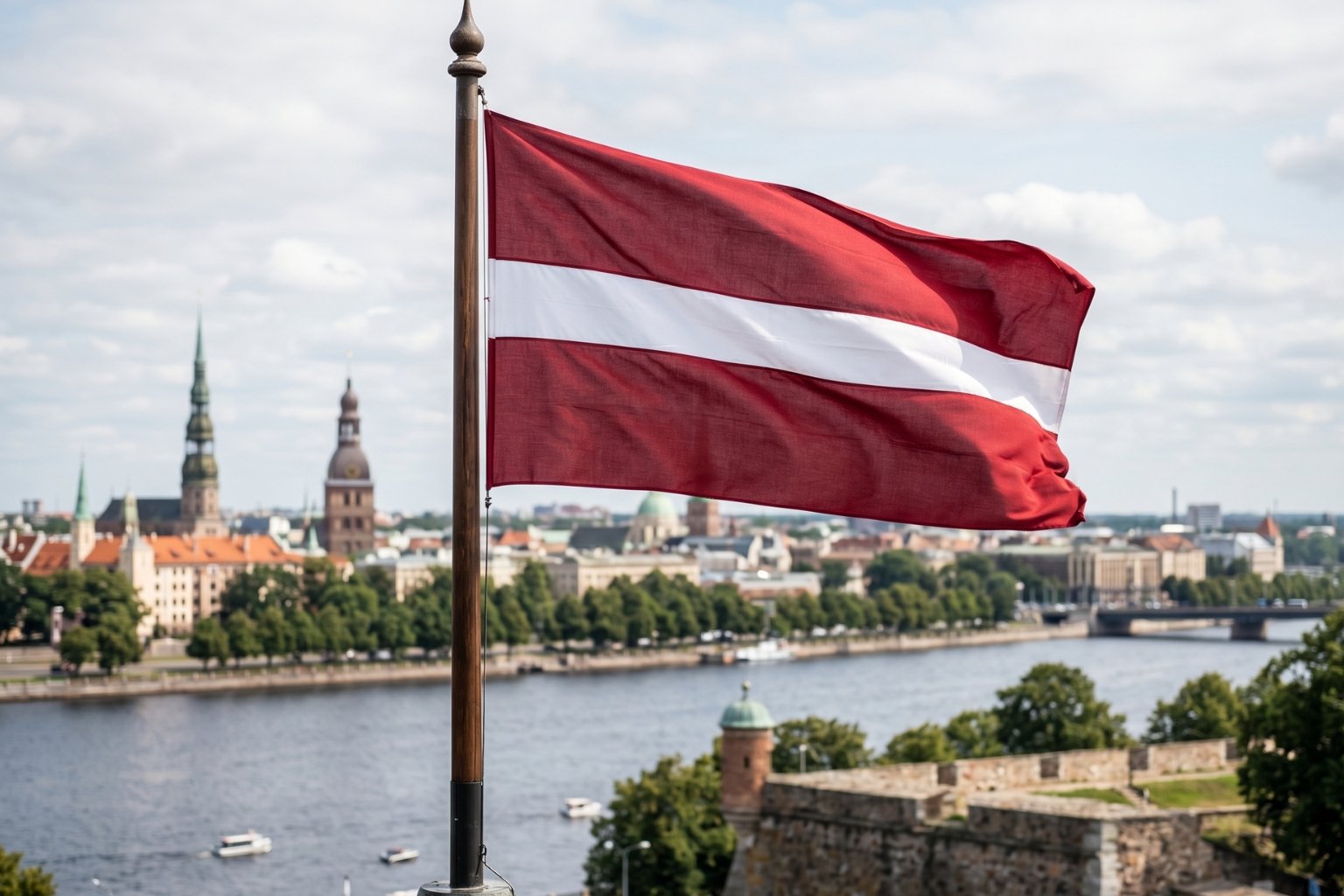

Few flags in the world carry a documented history stretching back to the 13th century. The Latvia flag does. Its three horizontal stripes in a deep, specific shade of crimson and white look deceptively simple. But behind that simplicity lives eight centuries of war, occupation, resistance, and stubborn national identity. This is not just a flag. It is a record.
What the Latvia Flag Looks Like
Design and Proportions
The Latvian flag is made of three horizontal stripes arranged in a 2:1:2 ratio: a wide carmine red band on top, a narrow white stripe in the center, and a second wide carmine red band at the bottom. The overall flag ratio is 1:2, meaning the flag is exactly twice as wide as it is tall.
The white stripe is deliberately narrow. This is not a standard equal tricolor. The off-balance proportion gives the flag an unusual visual weight, immediately distinguishable from the many red-and-white flags used across Europe.
The Official Color: “Latvian Carmine”
The red of the Latvian flag is not generic red. It has an official designation: Latvian carmine (karminssarkans in Latvian). This is a dark, warm, brownish crimson, noticeably deeper and richer than the bright scarlet of, say, the Swiss flag or the Danish Dannebrog.
That specificity matters. The color is not borrowed from a standard heraldic palette. It was codified because it corresponded to something real, a shade rooted in legend and then formalized by a state that wanted its identity to be precise, not approximate.
What the Colors Mean
The carmine red carries the meaning most flags assign to red, but with a distinctly Latvian weight: courage, sacrifice, and the blood shed across centuries of resistance to foreign rule. Crusaders, Swedish empire, Russian tsars, Soviet annexation. The list of occupations is long. The red acknowledges each of them.
The white stands for truth, purity, and the aspiration toward peace and freedom. It is the color of what Latvia wanted to be, not merely what it had endured.
What makes these meanings unusual is their origin. They were not assigned by a committee working from a heraldry manual. They emerged from folk legend, were carried by students and poets during a national awakening, and only later became official doctrine. The colors meant something to ordinary Latvians before any state existed to ratify them.
The Origin Story: A 13th-Century Chronicle
The earliest documented reference to the Latvian colors appears in a medieval manuscript known as the Livonian Rhymed Chronicle (Livländische Reimchronik), written in the 14th century but describing a battle in 1279 in which a Latvian militia unit carried a banner described as “red in colour, cut through with a white stripe.”
That single line, buried in a centuries-old chronicle, is the oldest known description of what would become a national flag.
The Two Founding Legends
Two folk legends explain how the design came to be. Both involve blood, a white cloth, and a dying warrior.
The first tells of a Latgalian chieftain wounded in battle against Crusaders. His men wrapped him in a white sheet. Where his body lay, the linen stayed pale. Where his blood ran to the edges, it turned deep crimson. His fighters carried the stained cloth into the next battle as a banner.
The second places a dying Latvian commander on a captured white enemy flag. His men swore over his body to fight until the last foreign soldier left their land. When they lifted the cloth, the center was still white and the edges were soaked red.
These are legends. Their historical accuracy is genuinely unclear. But they served a precise function when Latvian nationalists needed a story to anchor their identity to something ancient and unimpeachable.
Jānis Grīnbergs and the 19th-Century Rediscovery
The legends might have remained folklore if historian Jānis Grīnbergs had not gone looking in the archives. In the 19th century, while Latvia was firmly under Russian imperial rule, Grīnbergs rediscovered the chronicle reference and brought it to public attention. He gave the crimson and white colors a documented medieval pedigree at exactly the moment when Latvians needed one most.
From Folklore to National Symbol: The 19th-Century Revival
The 1860s and 1870s were years of carefully managed awakening in Latvia. Under Russian rule, Latvian language and culture were systematically suppressed. A generation of intellectuals, known as the Young Latvians (Jaunlatvieši), turned to history, folklore, and ancient chronicles to find the raw material for a distinct national identity.
In 1870, students at the University of Tartu adopted the crimson and white as their rallying colors, wearing ribbons in those shades on their hats as a quiet act of cultural defiance.
In 1873, the colors appeared at the first Latvian Song and Dance Festival, an event that would become one of the most important expressions of Latvian cultural continuity for generations to come. By the time the festival ended, carmine and white were not just a student symbol. They were a national declaration.
The flag design had already become an act of resistance before any Latvian state existed to fly it officially.
Official Adoption and the Republic
On November 18, 1918, Latvia declared independence. The carmine and white flag flew over Riga.
The modern standardized version of the flag was designed in 1917 by artist and designer Ansis Cīrulis, who adapted the medieval proportions and color references into a clean, reproducible format consistent with heraldic conventions. Historian and ethnographer Jānis Lapiņš contributed to refining the exact proportions and placement of the white stripe.
The flag was formally confirmed by the Latvian parliament on June 15, 1921, and fully codified into law by January 20, 1923. A young republic had given official state form to a symbol that had been alive in the culture for at least five decades.
Soviet Occupation and the Flag Underground
In 1940, the Soviet Union annexed Latvia. The carmine and white flag was banned. In its place, a Soviet-style banner appeared: red cloth, hammer and sickle, the Cyrillic letters ЛПСР marking a republic that had ceased, in name and in symbol, to be itself.
The flag did not disappear. It went underground.
Latvians in exile, primarily in Sweden, the United States, and Germany, kept flying it. Inside occupied Latvia, families hid handmade versions in attics, folded into books, or sewn into the linings of coats. To display the flag was to risk serious consequences. Many did it anyway.
In 1953, the Soviet Latvian flag was redesigned with a lighter wave pattern at the base, a small concession to “national form” within the Soviet system. The modification only sharpened the contrast with what Latvians actually considered their real flag.
The Restoration: 1990 and the Singing Revolution
What happened in the Baltic states between 1987 and 1991 is one of the more extraordinary episodes in modern European history. The Singing Revolution was not a military uprising. It was a cultural one: mass song festivals, human chains, and the systematic reappearance of banned national symbols.
In February 1990, Latvia restored its original flag ahead of the formal re-declaration of independence. The gesture was deliberate and precise. Flying the 1918 flag was a statement of legal and historical continuity: the Soviet decades were an illegal interruption, not a legitimate chapter. The republic of 1918 had never truly ceased to exist.
For Latvians who had grown up never seeing their flag displayed openly, or who had only known it folded and hidden, the moment carried a weight that is difficult to overstate.
Today the flag is central to the Song and Dance Festival, which takes place every five years and draws hundreds of thousands of participants and spectators. It flies in Latvian diaspora communities from Toronto to Melbourne. It appears on café tables during football matches and in apartment windows during independence commemorations. It is not a distant state symbol. It is something people reach for personally.
Latvia Flag vs. Similar Flags: How to Tell Them Apart
The carmine-white-carmine design can cause brief confusion, most often with the Austrian flag, which is also red-white-red in a horizontal arrangement.
| Feature | Latvia | Austria |
|---|---|---|
| Red shade | Dark carmine (brownish crimson) | Bright scarlet red |
| Stripe ratio | 2:1:2 | Equal thirds |
| Flag ratio | 1:2 | 2:3 |
| Origin | Medieval chronicle, 1279 | Medieval legend, similar era |
The shade alone is usually enough. Latvian carmine is unmistakably darker and warmer than the clean bright red of the Austrian flag. Once you have seen both together, you will not confuse them again.
Key Facts at a Glance
| Detail | Information |
|---|---|
| Colors | Latvian carmine and white |
| Stripe arrangement | Horizontal, 2:1:2 ratio |
| Flag proportions | 1:2 |
| Oldest known reference | 1279, Livonian Rhymed Chronicle |
| Modern design | Ansis Cīrulis, 1917 |
| Official adoption | June 15, 1921 (confirmed January 20, 1923) |
| Banned under Soviet rule | 1940 to 1990 |
| Restored | February 1990 |
| Official color name | Latvian carmine (karminssarkans) |
