

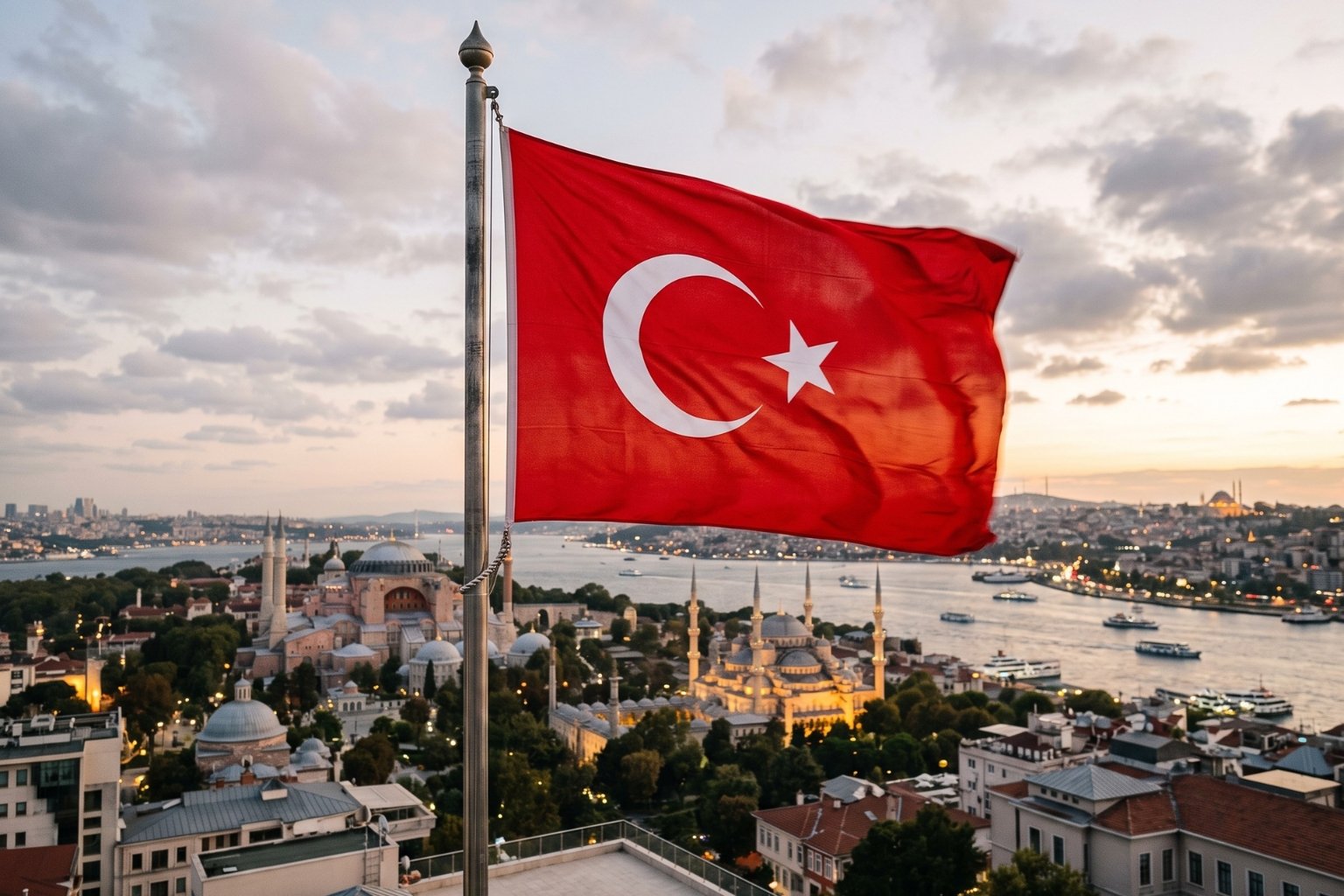

A red field, a white crescent, a single star tilted just off center. The Turkey flag is one of the most recognizable banners in the world, yet most travelers who see it fluttering over Istanbul or painted on a fishing boat in Bodrum have never really been told where the colors and symbols come from. Behind the design sits a mix of documented law, contested legend, and centuries of Ottoman and Byzantine history stacked on top of each other.
What the Turkish Flag Actually Looks Like
The flag is built from just two colors, a bright red background and a pure white crescent and star placed slightly toward the hoist side, the edge closest to the flagpole. Turks often call it al bayrak, meaning the red flag, a name that also appears in the national anthem as al sancak, the red banner.
Nothing about the design is left to interpretation. Turkish law fixes the exact shade of red, the size of the star, the curve of the crescent, and the proportions of the whole flag.
| Element | Official specification |
|---|---|
| Background color | Bright red, fixed by law |
| Symbols | White crescent and five point star |
| Width to length ratio | 2 to 3 |
| Star position | Centered just outside the crescent opening |
| Governing law | Turkish Flag Law No. 2893, dated 1983 |
The Meaning Behind the Colors and Symbols
Why the Flag Is Red
Red has been tied to Turkish identity for over 700 years, long before the modern republic existed. Popular belief in Turkey connects the color to the bloodshed of soldiers during the War of Independence, when Turkish forces fought colonial powers including Britain, France, Greece, and Russia. Officially, though, red was simply the color the Ottoman Empire had already chosen for its secular naval and state banners, distinct from the green historically used by religious institutions.
The Crescent and the Star, Older Than Most People Think
The crescent and star feel deeply Islamic today, and in modern Turkey they carry that association, yet the symbols existed long before Islam reached Anatolia. Ancient civilizations across the Middle East used the crescent moon as a religious emblem, and the city of Byzantium, later renamed Constantinople, dedicated itself to the moon goddess Diana. When Emperor Constantine made Christianity the empire’s official faith, a star linked to the Virgin Mary was added beside that crescent. Centuries later, when Turkic Muslim armies took Anatolia and eventually Constantinople itself, the same crescent and star passed into Ottoman, then Turkish, hands.
The Legends Turks Actually Tell About Their Flag
None of the popular stories about the flag’s origin can be verified, and Turks generally know it. That has not stopped the legends from becoming part of national identity.
- The blood of Kosovo. After the Battle of Kosovo in 1389, soldiers are said to have seen a crescent moon and star reflected in a pool of blood on the battlefield, a vision that inspired both the flag’s color and its symbols.
- The dream of Osman I. The founder of the Ottoman dynasty reportedly dreamed of a moon rising from the chest of a judge whose daughter he wished to marry, unfolding into a tree that shaded the whole world, a sign later read as a promise of empire.
From Ottoman Banner to National Flag
The design familiar today did not appear overnight. It took shape gradually, through naval decrees, sultans, and eventually a republic that inherited what came before it.
| Year | What happened |
|---|---|
| Before 18th century | Ottoman forces use a mix of banners, including green and blue versions |
| 1793 | Sultan Selim III adopts a red flag with an eight point star for the navy |
| 1844 | The star is reduced to five points during the Tanzimat reforms, fixing the modern design |
| 1923 | The newly founded Republic of Turkey keeps the last Ottoman flag unchanged |
| 1936 | The Turkish Flag Law standardizes proportions and the exact tone of red |
| 1983 | A revised Flag Law finalizes the legal specifications still used today |
How the Law Actually Defines the Flag
Turkey treats its flag as a legal object, not just a tradition. The 1936 Flag Law first set out the required proportions and shade of red, and follow up regulations in 1937 and 1939 explained how those rules should be applied in practice. The current version, Law No. 2893 of 1983, governs everything from the flag’s dimensions to how it must be displayed on public buildings, uniforms, and national holidays, leaving almost no room for informal variation.
The Flag As You Will Actually See It in Turkey
Travelers notice the flag almost immediately, and not only on flagpoles. It appears on classroom walls, ministry buildings, bridges, airports, and every state owned structure in the country. On military uniforms it sits on shoulder patches or helmets, and television channels place it beside a portrait of Atatürk during national holidays.
Republic Day and other commemorations bring the flag out in enormous numbers, carried through streets and hung from balconies. For anyone curious to see how the design evolved, the Istanbul Naval Museum and the Rahmi Koç Museum both display historic Ottoman flags alongside the modern version, a rare chance to trace the shift from green and blue banners to the red field known worldwide today.
Flags That Look Similar, and Why
The crescent and star were never exclusive to Turkey. Several nations with Turkic, Islamic, or historical Ottoman ties adopted comparable symbols, though none copy the Turkish design exactly.
| Country | Shared element |
|---|---|
| Azerbaijan | Crescent and star, Turkic heritage |
| Pakistan | Crescent and star, Islamic symbolism |
| Tunisia | Crescent and star inside a red field |
Quick Answers
Is the crescent and star a religious symbol
Not originally. The symbols predate Islam by centuries and were tied to Byzantine and older Middle Eastern traditions before becoming associated with the Ottoman Empire and, later, Islam more broadly.
What does al bayrak mean
It translates to the red flag, the common nickname Turks use for their national banner, while al sancak, the red banner, appears in the national anthem.
Why does Turkish law regulate the flag so precisely
Because the flag represents state sovereignty, Turkey treats its exact color, proportions, and display rules as legal matters rather than customs, enforced through the Flag Law of 1983.
When was the current design finalized
The five point star and red field date to 1844, the Republic kept that design in 1923, and the legal proportions used today were set in 1936 and refined in 1983.
