

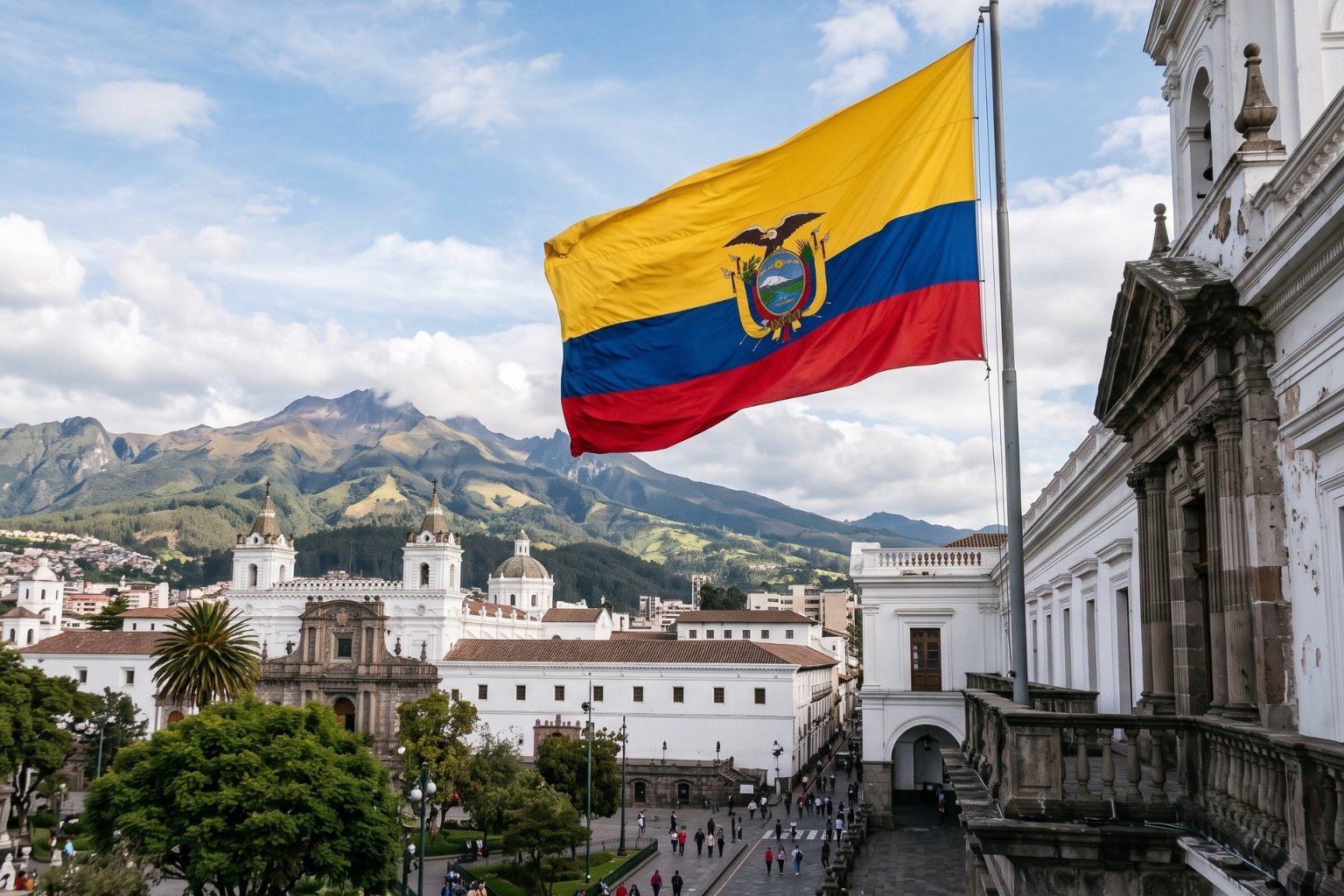

Fly over Quito and the first color you catch below the clouds crowning the Andes is a wide band of yellow. The Ecuador flag carries that yellow alongside a stripe of blue and a stripe of red, and behind that simple tricolor sits one of the more interesting national stories in South America. Every color was chosen with intent, the coat of arms at its center packs details most visitors walk past without noticing, and reading it properly changes how you see the country once you land.
What the Colors of the Ecuador Flag Actually Mean
The flag is built from three horizontal bands. The yellow stripe sits on top and takes up half the flag’s height, twice the width of the blue and red bands below it. The blue band runs through the middle, and the red band closes it out at the bottom. The official ratio is 1 to 2, so the flag is always exactly twice as long as it is tall.
Each color answers to something concrete rather than a vague national virtue.
- Yellow stands for the country’s fertile soil, its grain, and the mineral wealth pulled from Andean ground. Older readings tie it to the sun itself.
- Blue represents the sky over the mountains and the Pacific that shapes Ecuador’s coast, trade routes, and fishing economy.
- Red honors the blood spilled by the patriots who died fighting for independence from Spain.
When the flag flies over government buildings, it carries the national coat of arms at its center. Civilians flying the tricolor without the emblem are using what’s technically the civil flag, though in practice most Ecuadorian flags sold and displayed include the coat of arms.
Where the Colors Came From: Miranda, Goethe and a Ship Called the Leander
A Tricolor Born at Sea in 1806
The story starts nowhere near Ecuador. In 1806, the Venezuelan revolutionary Francisco de Miranda raised a yellow, blue, and red flag aboard his ship the Leander, off the coast of Jacmel in Haiti, while preparing an expedition against Spanish colonial rule. Miranda had discussed color theory with Johann Wolfgang von Goethe in Europe, and the palette he settled on was meant to carry a mood: warmth, energy, and defiance.
From One Man’s Flag to the Flag of Gran Colombia
Miranda’s colors didn’t stay his alone. They became the banner of Gran Colombia, the short lived republic that briefly united the territories of modern Ecuador, Colombia, Panama, and Venezuela under Simón Bolívar after independence from Spain. It’s the reason three separate countries today fly nearly identical tricolors, a detail that surprises a lot of travelers moving between Bogotá, Caracas, and Quito.
Why Ecuador Kept the Colors After 1830
Ecuador broke away from Gran Colombia in 1830 to become its own republic, but it never abandoned the yellow, blue, and red. The choice to keep the tricolor wasn’t sentimental leftover from a failed union. It was a deliberate statement that Ecuador still belonged to the same story of liberation, even while charting its own political path.
From Colonial Banner to National Flag: A Timeline
The tricolor didn’t arrive fully formed. It took roughly eighty years of revisions before the flag reached the version flown today.
| Period | What flew |
|---|---|
| 16th century to 1820 | The Cross of Burgundy, under Spanish colonial rule |
| October 9, 1820 | A flag of five light blue and white stripes with three stars, raised by patriots in Guayaquil |
| May 24, 1822 | General Antonio José de Sucre hoists Miranda’s yellow, blue, and red tricolor after victory at the Battle of Pichincha |
| 1822 to 1830 | Ecuador as part of Gran Colombia, flying the shared tricolor |
| 1830 to 1860 | Ecuador as an independent republic, with several competing flag designs, including the Marcista banner |
| September 26, 1860 | President Gabriel García Moreno restores the Gran Colombian tricolor as the national flag |
| October 31, 1900 | A legislative decree under President Eloy Alfaro fixes the definitive design, coat of arms included, with the yellow band set at double the width of the others |
That 1900 decree is the version still flying today, largely unchanged for over a century.
Reading the Coat of Arms: The Flag’s Hidden Story
This is where the Ecuador flag stops looking like its neighbors and starts telling its own story. The emblem at the center packs in geography, history, and even astronomy, and almost none of it is decorative filler.
The Condor
An Andean condor sits atop the shield with its wings fully spread. It’s not a generic bird of prey. The condor is the largest flying bird in the world and a genuine presence in the Andes, and here it stands for vigilance and the country’s readiness to defend itself.
Chimborazo and the Guayas River
Inside the shield, snow capped Mount Chimborazo rises over a winding river, the Guayas, which is the real river system that runs through Ecuador’s coastal lowlands. Chimborazo happens to be the point on Earth’s surface farthest from the planet’s center, thanks to the equatorial bulge, a fact most Ecuadorians know and most visitors never hear.
The Steamboat Guayas
A small steamship sails on that river, also named the Guayas. It commemorates the first steamship built anywhere in South America, launched from a Guayaquil shipyard in the 1840s, and its mast is shaped like a caduceus, the classical symbol of trade and navigation. The detail is a quiet nod to Ecuador’s ambitions as a commercial nation, not just an agricultural one.
The Sun and the Zodiac Band
Above the mountain sits a golden sun ringed by four zodiac signs, Aries, Taurus, Gemini, and Cancer. This is the detail almost nobody explains well: each sign marks a real date in Ecuador’s history rather than a horoscope reference.
- Aries, March, recalls the fall of the Flores government in 1845
- Taurus, April, marks the Battle of Tapi in 1822, a prelude to the decisive fight at Pichincha
- Gemini, May, honors the victory at Pichincha on May 24, 1822, which sealed independence from Spain
- Cancer, June, points to the Liberal Revolution of June 1895
Read that way, the sun and its ring aren’t ornamental. They’re a compressed timeline of the four moments that made the republic.
Laurel, Palm and the Four Flags
Branches of laurel and palm frame the shield, standing for victory and for the martyrs of independence. Four small Ecuadorian flags flank the emblem, and the whole composition rests on a bundle of ceremonial axes, a classical symbol borrowed from Rome to represent republican authority.
Ecuador, Colombia, Venezuela: Same Colors, Different Flags
Travelers moving through the Andes often do a double take between these three flags, and the resemblance is real, not a coincidence. All three inherited their colors from Miranda’s original tricolor and the flag of Gran Colombia.
| Country | Stripe order | Coat of arms | Length to width ratio |
|---|---|---|---|
| Ecuador | Yellow (double width), blue, red | Condor, Chimborazo, steamship, zodiac sun | 1 to 2 |
| Colombia | Yellow (double width), blue, red | Present on state flag only, absent on civil flag | 2 to 3 |
| Venezuela | Yellow, blue, red, equal widths | Eight stars on the blue band, coat of arms on state flag | 2 to 3 |
Ecuador is the easiest of the three to spot at a glance. It’s the only one that always shows the full coat of arms, even on flags flown by ordinary citizens.
The Flag in Ecuadorian Life
The Ecuador flag isn’t reserved for government buildings and border posts. Flag Day, Día de la Bandera, falls every year on September 26, marking García Moreno’s 1860 decree that brought the tricolor back as the national flag. Ecuadorian students take a formal oath to the flag on that date, usually recited at school ceremonies alongside the national anthem.
Independence Day, celebrated August 10, marks Quito’s first cry for independence in 1809 and fills the capital’s streets with flags, parades, and civic events. Outside these set dates, the tricolor shows up constantly in daily life, from school uniforms and taxi windshields to murals and market stalls, a visible thread running through a country that takes its national symbols seriously without making them feel distant or purely ceremonial.
Frequently Asked Questions
What do the three colors of the Ecuador flag mean? Yellow represents fertile soil and mineral wealth, blue stands for the sky and the Pacific Ocean, and red honors the blood of the patriots who died fighting for independence.
Why do Ecuador, Colombia, and Venezuela have similar flags? All three inherited their yellow, blue, and red palette from Francisco de Miranda’s 1806 tricolor, which became the flag of Gran Colombia, the short lived republic that once united their territories.
What is on the Ecuador flag’s coat of arms? A condor with spread wings, Mount Chimborazo and the Guayas River, a steamboat named Guayas, and a sun ringed by four zodiac signs that mark key dates in Ecuador’s independence history.
When was Ecuador’s current flag officially adopted? The definitive design, including the coat of arms and the yellow band set at double the width of the other stripes, was fixed by legislative decree on October 31, 1900.
