

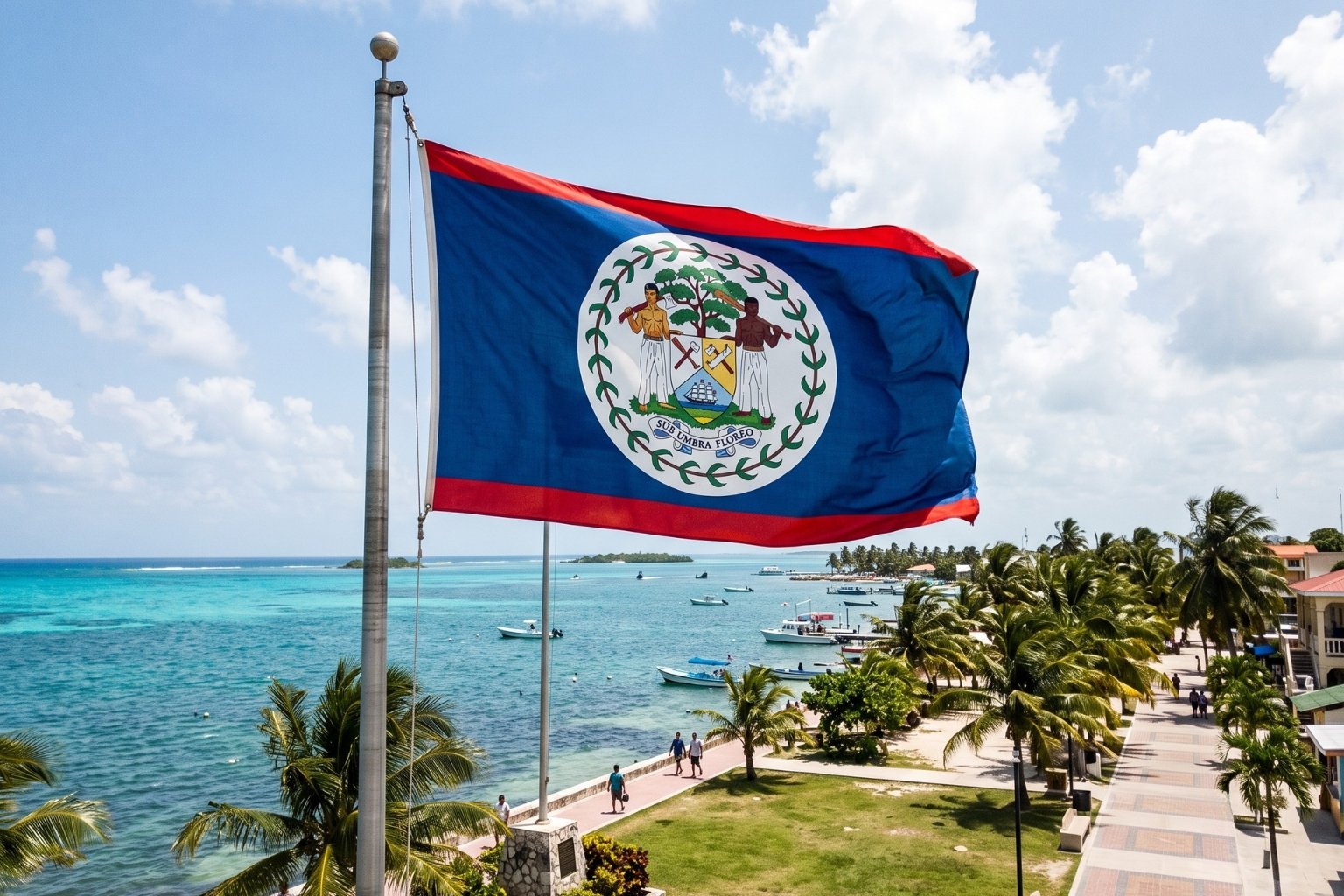

The Belize flag was not designed in a studio. It was negotiated between two rival political parties, and that single fact explains almost everything about it, from the colors to the red stripes added at the last minute before independence. Understanding this flag means understanding how a small nation turned a political compromise into a national symbol.
A Flag Born From a Political Compromise
Before independence, the People’s United Party (PUP), the driving force behind the independence movement, already flew an unofficial blue and white flag bearing the national coat of arms. That flag had been in informal use since 1950.
By the time independence approached, this created a problem. A flag too closely tied to a single party could not represent the whole nation. The United Democratic Party (UDP), the main opposition, pushed for two narrow red stripes to be added at the top and bottom of the flag, as a sign of unity between both sides. This revised version was raised for the first time on September 21, 1981, the day Belize gained independence.
The Colors of the Belize Flag and What They Mean
Three colors make up the flag: blue, red and white. Each one carries a piece of the country’s political story.
| Color | Origin | Meaning |
|---|---|---|
| Royal blue | Historical color of the People’s United Party | Represents the party that led the country to independence |
| Red stripes | Added at the request of the United Democratic Party | Symbolize national unity and the compromise between parties |
| White | Central disk holding the coat of arms | Reflects neutrality and the harmony among Belize’s diverse communities |
Royal Blue, the People’s United Party’s Legacy
Blue dominates almost the entire flag. It comes directly from the unofficial flag the PUP flew starting in 1950, at a time when the push for self government was only beginning to take shape against British colonial rule.
Red Stripes, the Price of National Unity
Without these two stripes, Belize would likely have raised a single party’s flag on the day of its independence. Adding them made the design acceptable across the political spectrum, opposition included.
White, the Neutral Ground at the Center
The white disk holds the national coat of arms and does exactly what its color suggests. It creates a neutral space, set apart from the partisan colors, to display a symbol that belongs to every Belizean, not to one side of the political divide.
Inside the Coat of Arms, Belize’s Most Detailed National Symbol
Belize is one of the few countries in the world whose flag features human figures. The coat of arms, tucked inside the white disk, deserves a closer look, since it tells the country’s economic history long before its political one.
The Mahogany Tree and Belize’s Logging Economy
At the top of the shield stands a mahogany tree, the very reason British settlers first established themselves in the region back in the eighteenth century. Logging remained the territory’s only real economic engine for generations, long before tourism or agriculture entered the picture.
The Two Woodcutters, an Image That Evolved
Two figures flank the shield, each holding a woodcutter’s tool: an ax on one side, a paddle once used to guide felled logs downriver on the other. In the earliest versions of the coat of arms, dating to the early twentieth century, both figures were shown as men of African descent. The current design shows one man of mestizo origin and one of Creole origin, a change that reflects the country’s diverse population.
A Shield in Three Sections: Paddle, Saw, Ship
The shield itself splits into three parts. The first, on a white background, shows a crossed paddle and mallet. The second features a two handed saw crossed with an ax. The third depicts a ship sailing over open water, a direct nod to the maritime timber trade that sustained the country for generations.
The Wreath of 50 Leaves
A circular wreath made of 50 leaves frames the entire coat of arms. The number is not decorative. It refers directly to 1950, the year the movement against British rule truly took shape.
Sub Umbra Floreo, a Motto Rooted in the Forest
Beneath the shield runs the national motto, in Latin: Sub Umbra Floreo, usually translated as “I flourish in the shade.” It refers to the country’s forest cover, but also, more broadly, to the idea that Belize managed to thrive first under British protection, then on its own once that shade lifted.
From the Union Jack to Independence: the Full History
British Honduras and the Colonial Flag (1907 to 1950)
Before it was called Belize, the country was known as British Honduras. Under colonial rule, the Union Jack flew officially, with the territory’s coat of arms placed in the flag’s canton. That coat of arms, granted in 1907, still forms the basis of the central symbol on today’s flag.
1950, an Unofficial Flag Carries the Hope for Independence
In 1950, the PUP introduced its own flag: blue, with a white central disk, no red stripes. This unofficial flag accompanied the entire independence movement, and it even flew over public buildings after internal self government was established in 1964.
September 21, 1981, Independence and the Red Stripe Compromise
On independence day, the Union Jack came down over Belize City for the last time. The new flag, now completed with the two red stripes demanded by the UDP, was raised for the first time as the country’s official national flag.
2019 and the 2025 Law: Standardizing the Design
In 2019, Belizean authorities formally specified the exact colors, proportions and measurements of every element on the flag, to guarantee consistent reproduction across the country. In 2025, the National Symbols Act reinforced this legal framework, fixing the official proportion and regulating flag use, including penalties for misuse of the symbol.
Official Specs: Proportions and Colors
Several sources online give conflicting information about the flag’s proportions. The legal source, confirmed by the National Symbols Act, settles the question.
| Feature | Official value |
|---|---|
| Width to length ratio | 3 to 5 |
| Width of each red stripe | One fifth of the flag’s total height |
| Background color | Royal blue |
| Central element | White disk with the national coat of arms |
| Date of adoption | September 21, 1981 |
| Legal standardization | 2019, reinforced by the National Symbols Act of 2025 |
When You’ll Actually See the Flag Fly
For a traveler, a handful of dates are worth planning a trip around, simply to watch the Belize flag take over public life.
- September 21, Independence Day, the most symbolic date on the calendar, marked by parades and official ceremonies nationwide.
- September 10, St. George’s Caye Day, which commemorates a historic battle and opens a nationwide season of celebrations.
- The September Celebrations period, running from September 10 to 21, when the flag is everywhere: on houses, in the streets, and at local boat races.
- March 9, Baron Bliss Day, honoring British benefactor Baron Bliss, celebrated with boat races where the flag flies on every vessel.
Facts Worth Knowing Before You Go
- The Belize flag is one of the few national flags in the world to feature human figures.
- Its level of detail makes it one of the most difficult flags to reproduce accurately, a real challenge for flag manufacturers.
- It serves as the civil, government and international flag alike, since Belize does not maintain separate versions for different uses.
- Respecting it while visiting means avoiding any unauthorized commercial use of the symbol, a rule taken seriously since the 2025 law.
Watching it fly over a public building in Belize City, or on a boat during Baron Bliss Day, this flag tells, in a single glance, the story of a small nation that had to bring two rival political camps together before it could even choose its own future.
