

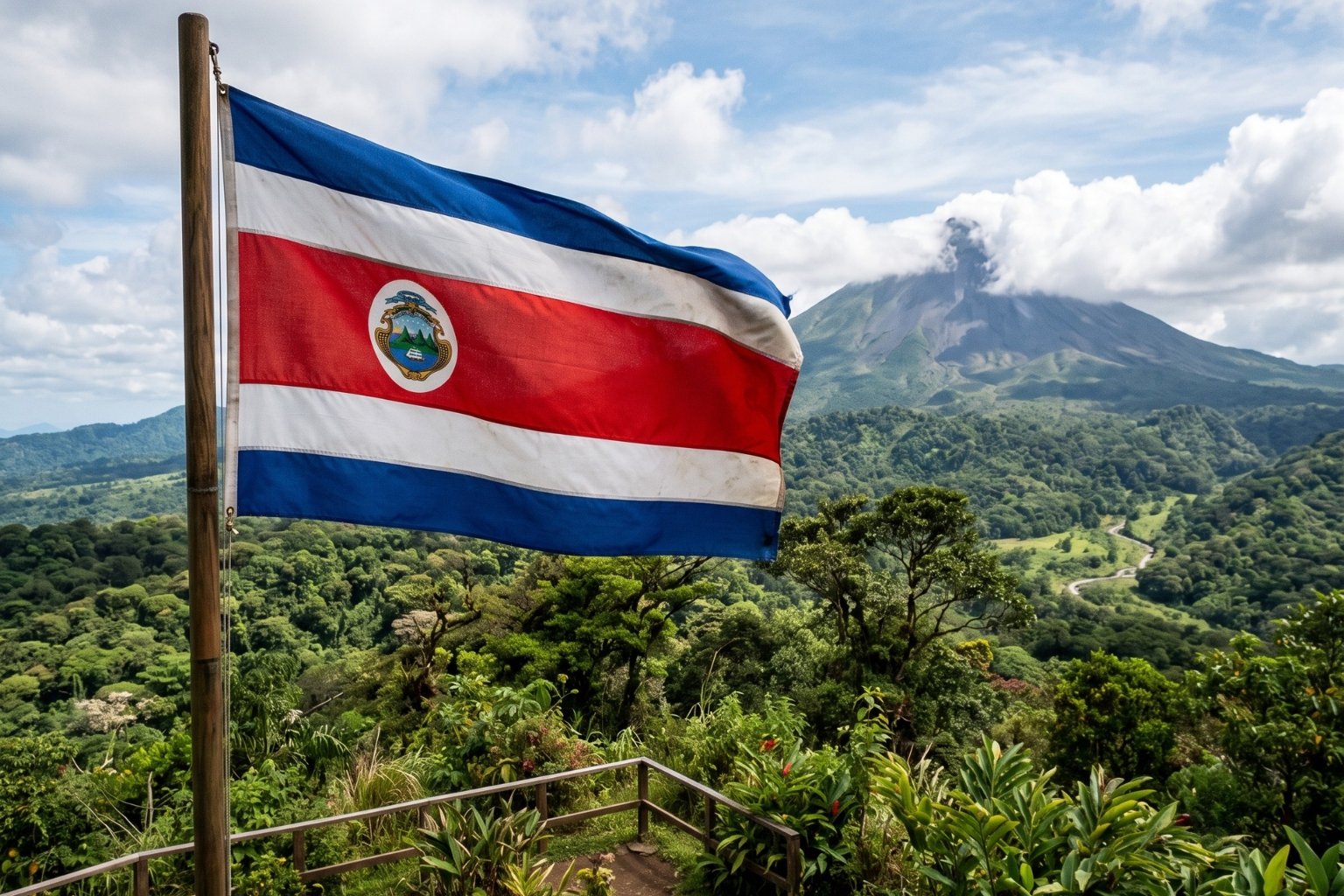

Every Costa Rica flag you see, from a schoolyard in San José to a surfboard sticker in Tamarindo, tells the same short story in five stripes. Blue, white, red, white, blue, with a red band twice as wide as the rest and a small coat of arms tucked on the left third. The design looks simple at first glance, but each choice behind it, down to the exact width of that central stripe, was made deliberately in 1848 and has barely moved since.
What the Costa Rica flag looks like
The flag is built from five horizontal stripes in this order: blue, white, red, white, blue. The red stripe sits in the middle and is exactly twice as wide as the other four, which each measure one sixth of the total height.
There are actually two official versions. The civil flag, called Bandera Nacional, is the plain striped version that private citizens fly on their houses and cars. The state flag, called Pabellón Nacional, adds the national coat of arms inside a white oval on the left side of the blue stripe, and it is reserved for government buildings, embassies and official ceremonies. Almost nobody outside Costa Rica knows this distinction exists, yet it explains why the flag you see on a government building looks slightly different from the one flying over a private home.
| Detail | Description |
|---|---|
| Stripe order | Blue, white, red, white, blue |
| Stripe proportions | Each stripe is one sixth of the total height, except red, which is two sixths |
| Civil version | Bandera Nacional, stripes only |
| State version | Pabellón Nacional, stripes plus coat of arms |
| Designer | Pacífica Fernández Oreamuno |
| First raised | San José, November 1848 |
Why the colors were chosen
Blue, the sky and the reach for something bigger
Blue was chosen to represent the sky above Costa Rica, along with opportunity, perseverance and the kind of intellectual idealism that shaped the country’s founding generation. It sits at both edges of the flag, framing everything else, which fits a color meant to represent a horizon rather than a single fixed idea.
White, peace as a national choice
White stands for peace, clear thinking and wisdom. That meaning gained real weight in 1949, a century after the flag’s design, when Costa Rica abolished its army entirely and redirected that budget toward education and healthcare. Few flags anywhere can point to a policy decision that so directly backs up what a color is supposed to represent.
Red, sacrifice and the warmth of the people
Red is the widest stripe on purpose. It was meant to evoke the sun casting its first rays on an independent Costa Rica, and it also honors the people who died defending the country. Today Ticos tend to read it more personally, as a symbol of warmth, generosity and the everyday spirit summed up in the phrase Pura Vida.
Where the design actually came from
Before 1848, a borrowed federation flag
Costa Rica separated from Spain in 1821 and briefly joined the United Provinces of Central America. During that period the country flew the federation’s flag, with light blue stripes at the top and bottom and a yellow stripe through the middle, a design with no distinctly Costa Rican identity of its own. Between 1821 and 1848 the flag changed several times as the young country worked out what it wanted to represent.
Pacífica Fernández Oreamuno and the French influence
The current design traces back to one person: Pacífica Fernández Oreamuno, wife of President José María Castro Madriz. An admirer of the revolutionary movements sweeping France in 1848, she proposed adding a red stripe to the existing blue and white design, doubling it in width and placing it at the center. The idea was to capture the same spirit of liberty, equality and progress that defined the French Revolution, translated into a Central American context.
From first raising to final form
The new flag was raised for the first time in San José’s main square in November 1848, and the striped pattern has not changed since. What has changed is the coat of arms that appears on the state version, revised in 1906, 1934 and again in 1964 to reflect the country’s growing number of provinces and its evolving national symbols. A more recent update in 2022 standardized usage rules and official color specifications, proof that a flag this old is still actively maintained rather than frozen in the nineteenth century.
The coat of arms, piece by piece
Look at the coat of arms the way a Costa Rican would, left to right, and it reads almost like a landscape painting rather than a list of symbols.
- Three volcanoes release steam in the background, standing for the mountain ranges that run through the country.
- A green valley sits between them, representing the central valley where most Costa Ricans live.
- Two oceans flank the scene, the Pacific and the Atlantic, each with a small merchant ship as a nod to the country’s trading history.
- Seven gold stars arc above the volcanoes, one for each province: Alajuela, Cartago, Guanacaste, Heredia, Limón, Puntarenas and San José.
- A rising sun glows behind the volcanoes, echoing the same idea of dawn and independence carried by the red stripe.
- Two ribbons frame the scene, a blue one reading “América Central” and a white one reading “República de Costa Rica.”
Why it gets confused with other flags
Ask someone to draw the Costa Rica flag from memory and there is a decent chance they will accidentally sketch North Korea’s instead. Both follow the exact same stripe order, blue, white, red, white, blue, which is rarer than it sounds and explains most of the mix ups.
| Country | Stripe order | What actually sets it apart |
|---|---|---|
| Costa Rica | Blue, white, red, white, blue | No emblem on the civil flag; coat of arms appears only on the state version, inside a white oval |
| North Korea | Blue, white, red, white, blue | A red star inside a white circle sits directly in the center of the red band |
| Thailand | Red, white, blue, white, red | Colors reversed, and it is the blue stripe, not red, that is doubled in width |
How and when the flag is used today
Costa Rican schoolchildren line up in front of the flag each morning to sing the national anthem, a routine that starts the association with the flag long before most people think about what the colors mean. The flag also anchors the country’s biggest civic date, Independence Day on September 15, when the evening of September 14 fills with farolito lantern parades in towns across the country.
Flag etiquette follows the civil and state distinction described earlier. Government buildings, embassies and official events display the Pabellón Nacional with the coat of arms, while private citizens fly the plain Bandera Nacional on their homes, businesses and vehicles, especially through the patriotic month of September when the whole country turns visibly red, white and blue.
