

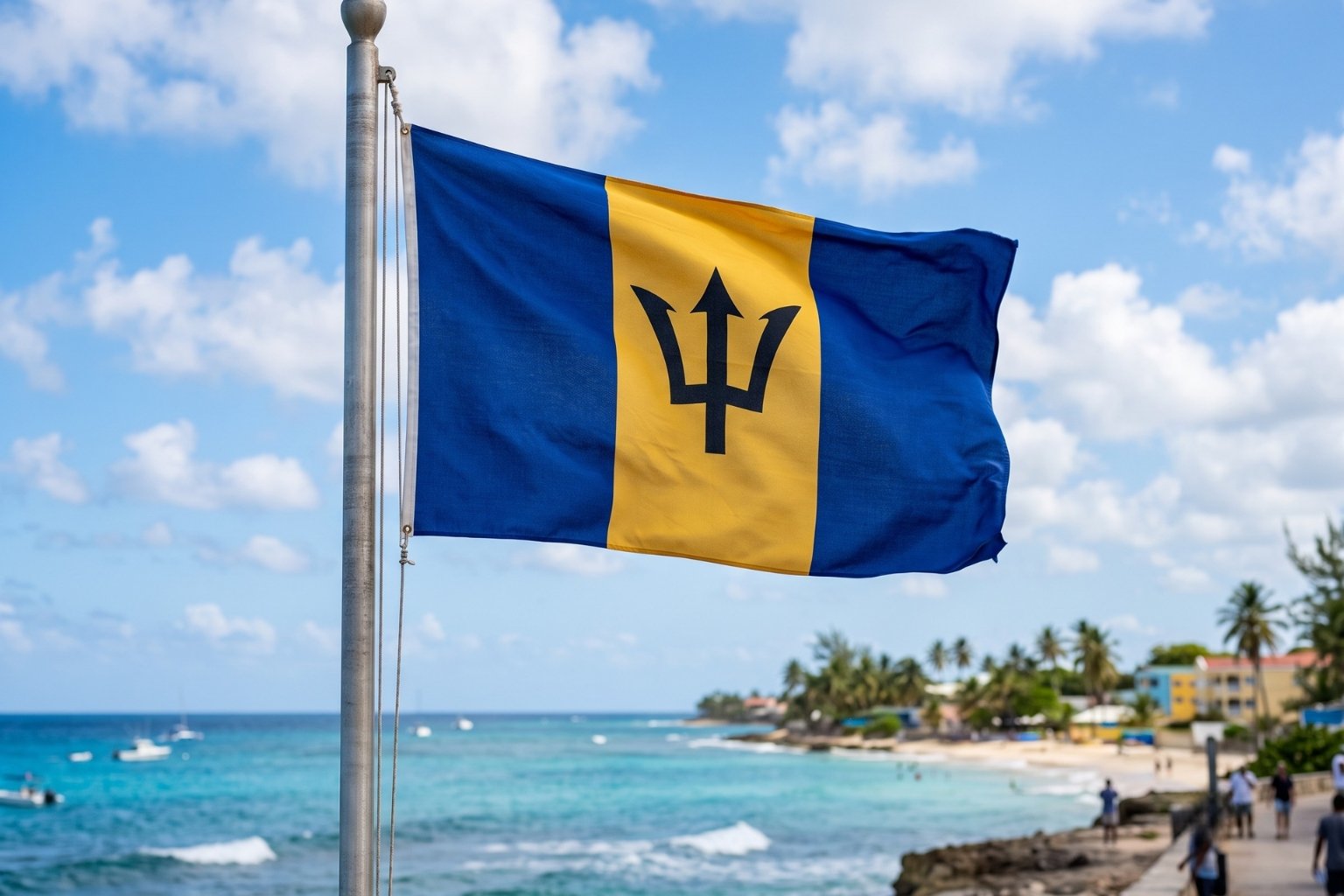

Step off a plane in Bridgetown and the first thing you notice is not the heat. It is the flag snapping against a hard blue sky, gold at its center, a black trident with no handle. The Barbados flag is one of the few in the Caribbean built entirely from a single idea, a nation quietly telling you it broke from something and kept only what mattered. Behind the three stripes sits a story of a teacher, a competition, and a country choosing its own symbols for the first time.
A Flag Born on Independence Day
On November 30, 1966, Barbados raised a new flag for the first time, on the same morning it stopped being a British colony. The old flag, a Blue Ensign carrying an image of Britannia gripping a trident, came down for good. In its place rose a design nobody in government had drawn.
The government had opened a public competition months earlier, and more than a thousand people submitted ideas. The winner was Grantley W. Prescod, a secondary school art teacher rather than a professional designer or politician. His entry, three vertical bands with a broken trident at the center, beat out the entire field and became the country’s new national flag. Lieutenant Hartley Dottin hoisted it for the first time, marking a country choosing its own symbol rather than inheriting one.
What the Colors of the Barbados Flag Mean
Strip away the history and the palette itself is simple, three panels, three ideas. Two panels of ultramarine flank a single band of gold, and each color points straight at the island’s geography rather than at any abstract virtue.
Ultramarine Blue, Sea and Sky
The two outer bands use ultramarine, a deep, saturated blue that stands for both the Caribbean Sea surrounding Barbados and the open sky above it. Barbadians rarely separate the two visually, since on the island the horizon line between ocean and air often disappears into the same shade.
Gold, the Island’s Beaches
Between the blue panels sits a wide gold band, representing the pale sand that lines beaches like Crane and Accra. Officially the flag’s gold reads closer to a warm amber than a bright yellow, a detail most souvenir versions get wrong.
| Color | Official meaning | Where you will see it |
|---|---|---|
| Ultramarine blue | Sea and sky surrounding Barbados | National cricket uniforms, government buildings, Independence Day bunting |
| Gold | The island’s sandy beaches | Crop Over festival costumes, rum labels, tourism branding |
| Black | The broken trident | Coat of arms, official seals, national emblem reproductions |
The Broken Trident, Barbados’ Most Distinctive Symbol
The trident is what makes the Barbados flag impossible to mistake for any other. It sits centered on the gold band, stripped of its handle, and it carries more history than the colors around it.
Under British rule, Barbados’ colonial badge showed Britannia holding a full trident, a weapon associated with Poseidon in Greek mythology and with Neptune in Roman mythology, two names for the same sea god figure. When Prescod redesigned the emblem for an independent nation, he kept the trident but broke its shaft, removing the part Britannia had gripped. The message was direct. The tool of control stayed, but the hand holding it did not.
Barbadians commonly read the three remaining prongs as government of the people, for the people, and by the people, though that interpretation came after the design rather than as a rule written into it officially.
Vertical Stripes in a Region of Diagonals and Sunbursts
Compare the Barbados flag to its neighbors and one choice stands out immediately. Several Caribbean nations favor diagonal bands, crosses, or sunburst patterns, while Barbados settled on a plain vertical triband. The result reads clean and graphic from a distance, part of why it photographs so well against Bridgetown’s colonial architecture or a cricket ground packed with fans.
The official proportions sit at two to three, meaning the flag is exactly one and a half times wider than it is tall, a ratio it shares with several other national flags without ever being advertised outside vexillology circles.
From Colonial Ensign to National Flag, a Quick Timeline
| Period | Flag | Design |
|---|---|---|
| 1885 to 1966 | Barbados Colony flag | British Blue Ensign with a badge showing Britannia holding a trident |
| 1958 to 1962 | West Indies Federation flag | Blue field with four wavy white lines and a golden sun, representing sunlight on the sea |
| 1966 to today | National flag of Barbados | Ultramarine and gold vertical triband with a black broken trident |
Barbados briefly flew the Federation flag while it belonged to the short lived West Indies Federation between 1958 and 1962, before that alliance dissolved and each island moved toward independence on its own terms.
The Coat of Arms Is Not the Flag
Search results often blur the flag and the coat of arms into a single image, but they are separate emblems granted separately. The coat of arms arrived first, in February 1966, months ahead of the flag itself.
Designed by Neville Connell, it centers on a gold shield bearing two Pride of Barbados flowers and a bearded fig tree, the plant early settlers used to name the island. A dolphin and a pelican support the shield, standing in for the fishing industry and coastal wildlife, while an arm above the crest holds two crossed sugar cane stalks, a nod to the economy that once ran the island. Underneath sits the national motto, Pride and Industry.
Where You Will Actually See the Flag in Barbados
Land at Grantley Adams International Airport and the flag is already waiting, mounted at arrivals and along the terminal. From there it follows the island’s calendar rather than staying still on a pole.
Independence Day on November 30 turns Bridgetown into a sea of blue and gold, with a formal parade at the National Stadium and flags hung from balconies across the capital. Emancipation Day on August 1 carries its own weight, and Crop Over, the island’s biggest cultural festival, borrows the same palette for costumes and stage sets even though the festival itself predates the flag by centuries.
How Barbadians Honor Their Flag
Barbadian law treats the flag as a protected national symbol rather than a decoration. Public buildings fly it daily between 6am and 6pm, and reproductions used in schools or official settings follow strict rules about proportion and color, part of why the shade of gold on cheap souvenir flags rarely matches the real one.
Barbados became a republic in 2021, replacing the monarch with an elected president as head of state. The flag never changed through that transition, a detail that surprises visitors who assume every political shift comes with a new design.
Quick Questions About the Barbados Flag
What do the colors of the Barbados flag mean? Ultramarine blue stands for the sea and sky surrounding the island, and gold represents its beaches.
Who designed the Barbados flag? Grantley W. Prescod, a secondary school art teacher, won a national design competition with over a thousand entries.
Why is the trident on the flag broken? It represents Barbados breaking away from British colonial rule, since the original trident belonged to Britannia on the colonial badge.
When was the Barbados flag adopted? November 30, 1966, the same day Barbados became independent.
What is the flag’s official ratio? Two to three, meaning it is one and a half times wider than it is tall.
