

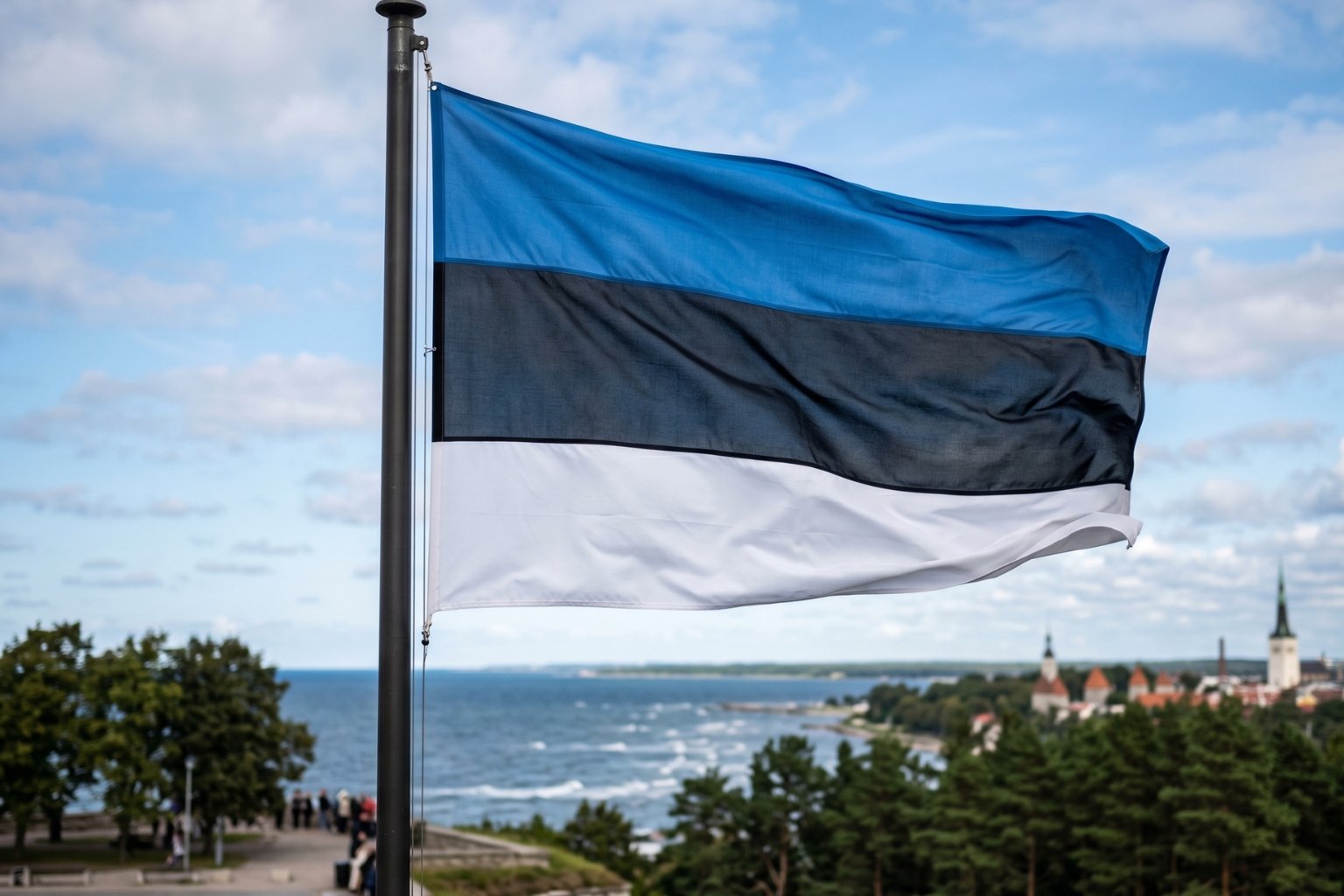

Three horizontal stripes. Blue, black, white. At first glance, the Estonia flag reads almost like a landscape held still: sky above, earth in the middle, snow below. But behind that apparent simplicity sits one of the most charged national stories in European history, a flag that was born in secret, sewn by hand in a kitchen, hidden on a farm for nearly half a century, and eventually raised again as a million people held hands across three countries.
What Does the Estonia Flag Look Like?
The Estonian national flag, known in Estonian as sinimustvalge (literally “blue-black-white”), consists of three equal horizontal stripes arranged from top to bottom: blue, black, and white. The flag follows a width-to-length proportion of 7:11.
The name sinimustvalge carries no symbolic weight of its own. It is simply a description, three color words compressed into one compound noun, the kind of directness the Estonian language does well.
The Colors of the Estonian Flag and Their Meaning
The symbolism attached to the three colors was never decreed from above. It evolved organically during the national awakening of the late 19th century, shaped by poets, students, and ordinary people looking at their own landscape and history.
Blue
Blue is the color most often linked to faith, loyalty, and devotion. It also reflects the physical world Estonians live in: the sky, the Baltic Sea, and the country’s thousands of freshwater lakes. There is a specific shade involved here too. The original color was described as cornflower blue, and that detail would later take on a life of its own under Soviet occupation.
Black
Black points in two directions at once. It represents the dark, fertile soil of the Estonian homeland, the ground that fed generations of peasant farmers. It also carries the weight of centuries of suffering under German Baltic nobility and Russian imperial rule. One reading connects it directly to the traditional black coat of the Estonian peasant, a garment that became, over time, a quiet emblem of identity.
White
White holds the most layered meaning of the three. It stands for purity and virtue, for the drive toward education and enlightenment that fueled the national awakening. It also speaks in images: winter snow, the white bark of birch trees, the pale light of summer nights when the sun barely sets. All of these are Estonia, compressed into a single stripe.
The Origin of the Estonian Flag: A Student Society and a Secret Ceremony
The flag did not emerge from a government or a military campaign. It came from a university town, a circle of students determined to hold on to a culture that was being systematically erased.
The National Awakening and the Birth of Vironia
The 1860s and 1870s marked what Estonians call the ärkamisaeg, the awakening period. After centuries of domination by Baltic German landowners and the Russian imperial administration, a generation of Estonians began to assert their language, their literature, and their sense of collective identity. Fraternities and student societies became the engine of this movement.
In 1870, a student organization was founded in Tartu (Estonia’s intellectual capital) that would later become the Estonian Students’ Society, known in its early years as Vironia, a Latinized form of the Estonian word for the province of Viru. The city of Tartu, home to its major university, was the right place for this kind of quiet defiance.
The Poem, the Colors, and the First Flag
In 1881, a theology student named Jaan Bergmann wrote a poem that praised a flag of cornflower blue, black, and white. The poem circulated through the society and laid the foundation for what came next. On September 29, 1881, at the founding meeting of the Estonian Students’ Society, the three-color combination was formally adopted.
The first physical flag was sewn in the spring of 1884 by Paula Hermann, wife of Dr. Karl August Hermann, an honorary member of the society. She made it by hand in the kitchen of the Hermanns’ house on Veskee Street in Tartu.
Flying it there was out of the question. Estonia was under imperial Russian rule, and the authorities had no tolerance for symbols of Estonian national identity.
The Consecration at Otepää
On June 4, 1884, the flag was blessed at a semi-secret church service in Otepää, a small town in southern Estonia. The ceremony ended with the congregation singing “Mu isamaa, mu õnn ja rõõm” (“My Native Land, My Pride and Joy”), the song that would eventually become the Estonian national anthem. Nobody in that church could have known that.
June 4 is now celebrated each year as Estonian Flag Day.
From Student Symbol to National Flag
Through the 1890s and into the early 20th century, the tricolor spread beyond student circles. It appeared during the 1905 Russian Revolution, when Estonian nationalism briefly found room to breathe. Over the following decade, as the Russian Empire crumbled and a window for independence opened, the flag was ready.
On February 24, 1918, Estonia declared independence. The blue-black-white tricolor served as the national flag from that first moment. On December 12, 1918, it was raised for the first time over Pikk Hermann, the tall tower of Toompea Castle in Tallinn, the location that has since become its most symbolic home.
The flag’s official legal status was confirmed by the Estonian parliament (Riigikogu) on July 16, 1922.
The Flag Under Soviet Occupation: Banned, Hidden, Defiant
The summer of 1940 brought the Soviet annexation of Estonia. On June 21, 1940, the tricolor was taken down from Pikk Hermann. By July 27, it had been replaced entirely by the Soviet flag. The use of the blue-black-white combination, any part of it, was now punishable by Soviet law.
The original 1884 flag survived only because of one man. Karl Aun, the then-chair of the Estonian Students’ Society, took the flag from the society’s premises and hid it on his home farm. It remained concealed there from 1940 to 1988, its location known to almost no one.
Meanwhile, the cornflower, whose particular shade of blue gave the flag its original color, became an unofficial symbol of resistance. Soviet authorities eventually banned representations of cornflowers as well.
People still found ways. From time to time, the tricolor appeared on a rooftop, at the top of a chimney, in a window. Each sighting was an act of real courage. The Estonian government-in-exile and the diaspora abroad kept the flag in continuous official use throughout those decades, refusing to acknowledge its suppression as legitimate.
The Return of the Flag and the Singing Revolution
The atmosphere began to shift in the late 1980s with perestroika. On October 20, 1988, Estonian authorities officially permitted the use of the blue-black-white flag again. The Singing Revolution, the extraordinary nonviolent independence movement that expressed itself through mass gatherings and collective song, adopted the tricolor as its most visible emblem.
On the evening of February 23, 1989, the Soviet flag was taken down from Pikk Hermann for the last time. On the morning of February 24, the 71st anniversary of Estonian independence, the blue-black-white flag rose in its place.
The flag was officially re-adopted as the national flag on August 7, 1990. Full independence was restored on August 20, 1991.
The Estonia Flag Today
The original flag, sewn by Paula Hermann in a Tartu kitchen in 1884 and hidden through decades of occupation, is now preserved at the Estonian National Museum in Tartu.
At Pikk Hermann in Tallinn, the flag is raised each morning at dawn (no earlier than 7:00 AM) and lowered at sunset (no later than 10:00 PM). The rhythm is unhurried and deliberate, a daily act that carries more history than most morning routines.
The flag’s use is regulated by the Estonian Flag Act, passed on March 23, 2005 and in force since January 1, 2006. Any Estonian has the right to display it, as long as it is done with respect for the traditions it carries.
Three stripes. One very long story.
