

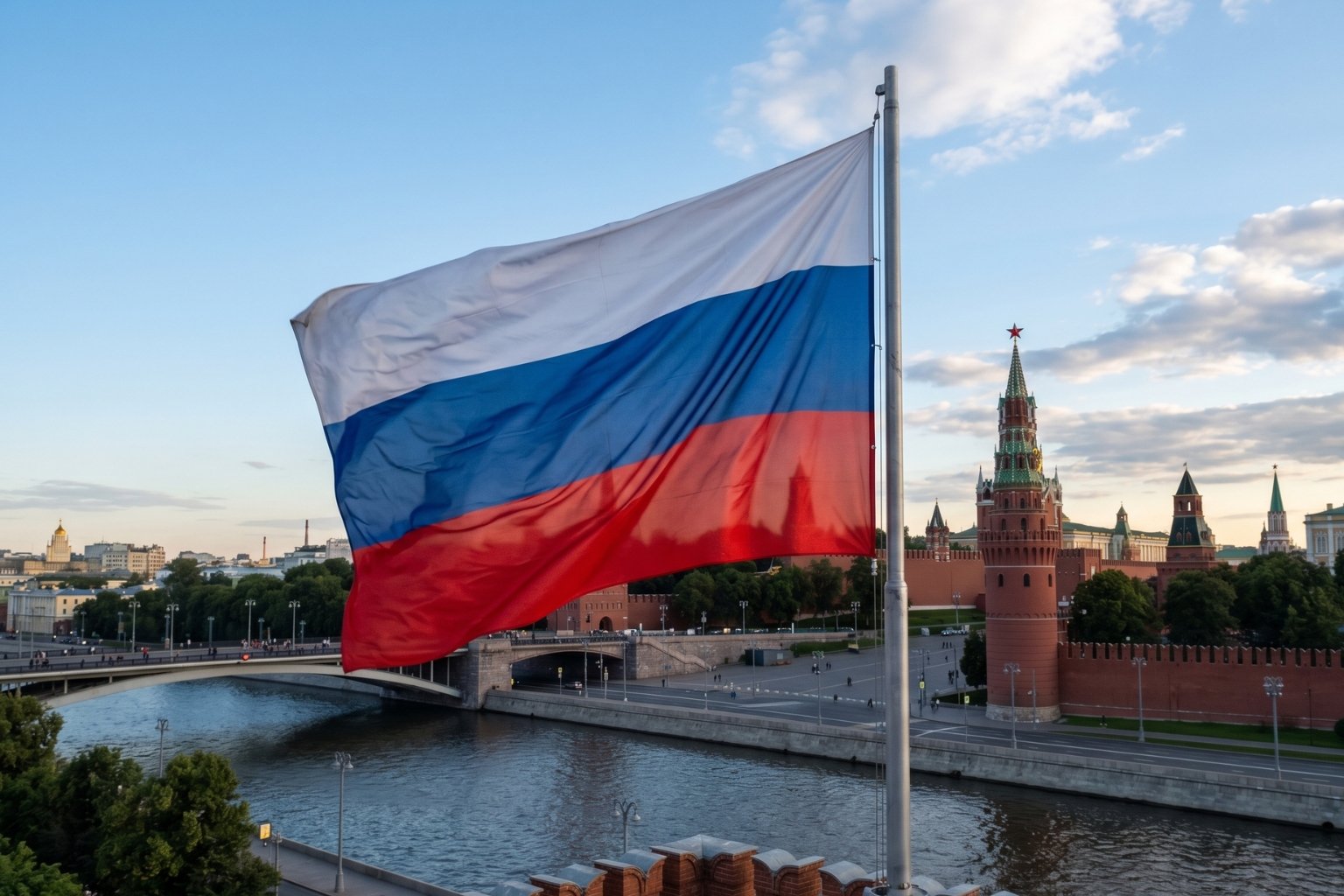

Three horizontal stripes. No emblem, no coat of arms, no ornament. The Russian flag looks almost austere next to the heraldic complexity of its neighbors. But behind that apparent simplicity lies three centuries of political upheaval, competing identities, and a symbolism that Russia itself has never fully agreed on.
What the Russian Flag Looks Like
The current flag of the Russian Federation is a rectangular cloth with three equal horizontal stripes: white at the top, blue in the middle, and red at the bottom. Its proportions are 2:3 (height to width), a standard adopted by decree in 1993.
There is no central emblem on the national flag. The double-headed eagle, Russia’s coat of arms, appears on official state documents and presidential standards, but not on the flag itself. That deliberate restraint sets the tricolor apart from many of the world’s national flags.
What the Colors of the Russian Flag Mean
White, Blue, Red: A Symbolism With No Official Answer
Here is something most articles skip over: Russia has no official interpretation of its flag’s colors. None. No government decree has ever settled the question. What exists instead is a layered, sometimes contradictory set of historical readings, each reflecting the era it came from.
The most widely cited interpretation dates to the era of Peter the Great, when the tricolor first took shape. Under this reading:
- White stands for freedom and independence
- Blue is the color of the Virgin Mary, venerated as Russia’s divine protector
- Red represents the power and sovereignty of the Russian state
A second interpretation, rooted in the 19th-century pan-Slavic movement, reads the three stripes as a map of empire. White symbolizes White Russia (present-day Belarus), blue represents Little Russia (Ukraine), and red stands for Great Russia itself. This reading has become politically charged in ways its originators could not have anticipated.
More recently, a simpler civic reading has gained ground: white for peace and purity, blue for faith and loyalty, red for courage and the blood shed for the homeland. It is vague enough to be universal, and that is perhaps the point.
The absence of an official interpretation is not an oversight. It reflects something real about Russian political culture: the flag is allowed to mean different things to different people, and the state has never seen fit to close that conversation.
The Origin of the Russian Flag
A Dutch Inspiration, Deliberately Reordered
The story of the Russian tricolor begins not in Moscow but in the Netherlands, at the end of the 17th century.
In 1697, Tsar Peter I traveled to Western Europe on what history calls the Grand Embassy, a diplomatic and educational mission during which the young tsar worked incognito in Dutch shipyards, determined to understand how the great naval powers of the era were built. He returned with more than shipbuilding techniques. He returned with a flag.
The Dutch tricolor, red over white over blue, was already one of the most recognized maritime flags in Europe. Peter adapted it for Russia, keeping the three colors and reordering them: white, blue, red from top to bottom. In 1699, he adopted this arrangement for Russian merchant ships. On January 20, 1705, he issued a formal decree making the tricolor mandatory on all Russian trading vessels, and sketched the stripe order with his own hand.
The choice was practical before it was symbolic. Ships needed a recognizable flag. The Dutch model was respected, well-known, and easy to distinguish at sea from a distance. Russia had found its colors.
Before Peter: The Oryol and the First Russian Warship
The tricolor did not emerge from nothing. Even before Peter’s decree, the colors had appeared in Russian waters.
In 1667, under Tsar Alexei Mikhailovich (Peter’s father), the Oryol was launched. It was the first Russian warship, built with Dutch assistance on the Oka River. The flag it flew was a quartered design of white and red with a blue cross, an early arrangement of the same three colors that would define Russia’s national identity decades later.
Peter did not invent the palette. He formalized it.
A Turbulent History
The Forgotten Imperial Flag (1858 to 1896)
By the mid-19th century, Russia’s visual identity was pulled in a different direction.
In 1858, under Tsar Alexander II, a new civil flag was decreed for use during official celebrations. It was a horizontal tricolor of black, orange (golden yellow), and white. Black and gold were the colors of the Romanov imperial arms, borrowed from the heraldic tradition of the double-headed eagle. The white stripe was added to distinguish it from the Austrian imperial flag, which used only black and yellow.
The man behind this redesign was Bernhard Karl von Koehne, a German-born heraldist who had been appointed head of the Heraldry Department and who applied Germanic heraldic logic to Russian state symbols. The result was historically coherent but politically tone-deaf.
The black-orange-white flag was deeply unpopular. Russians did not recognize themselves in it. It felt imposed, foreign, and cold. The white-blue-red tricolor, never officially abolished, continued to fly on ships, at markets, and in the streets. The population had simply voted with their eyes.
By 1883, the government surrendered to public sentiment. The white-blue-red tricolor was officially authorized for use on land during celebrations, and the black-orange-white flag began its quiet retreat. Tsar Nicholas II formally buried it in 1896, restoring the tricolor as the unambiguous national flag just before his coronation.
The black-orange-white combination did not disappear entirely. It resurfaced in the 20th century as a symbol of Russian imperial nationalism, and it remains visible today in certain political contexts, a ghost of the flag that Russia never wanted.
WWI and the Imperial Canton
At the outbreak of World War I, a brief modification was introduced. A golden yellow canton bearing the imperial arms was added to the upper hoist corner of the white-blue-red flag. The intent was to express the unity of the ruling dynasty and the Russian people in a moment of national mobilization.
The modification was short-lived. The February Revolution of 1917 swept away the Romanov dynasty, and with it the canton. For a brief period, the plain tricolor became the de facto flag of the new Russian provisional government.
The Soviet Red Banner (1917 to 1991)
The Bolshevik Revolution of October 1917 ended the tricolor’s moment entirely.
The new Soviet state replaced it with the Red Banner, a tradition rooted in the French Revolution and, further back, in peasant uprisings across Europe. Red was the color of revolution, of the working class, of blood and transformation. After the formation of the Soviet Union in 1922, the official flag carried a gold hammer and sickle alongside a gold-bordered red star in the upper hoist corner, symbols of the unity of workers and peasants under communist ideology.
For 74 years, this was the flag the world associated with Russia. It flew over the Kremlin, over Olympic delegations, over embassies on every continent. It represented a superpower that stretched across 11 time zones and 8.65 million square miles at its peak.
On Christmas Day 1991, the red Soviet flag was lowered over the Kremlin for the last time. The USSR was dissolving. What would fly in its place was already decided.
1991: The Tricolor Reborn
On August 22, 1991, in the chaotic aftermath of the failed coup against Mikhail Gorbachev, demonstrators brought the white-blue-red tricolor into the streets of Moscow. That same day, the Supreme Soviet of the Russian SFSR issued a decree restoring it as the national flag.
The symbolism was deliberate. Choosing the tricolor was a statement of rupture with the Soviet past and a reconnection with pre-revolutionary Russian identity. Boris Yeltsin, Russia’s first president, designated August 22 as National Flag Day in 1994, a holiday observed every year since.
A final technical adjustment came on December 11, 1993, when Yeltsin signed the decree formally defining the flag: the original azure blue was replaced by a standard blue, the blood-red became a cleaner red, and the proportions were fixed at 2:3. The tricolor that flies today is, in its essential form, the flag Peter the Great sketched three centuries ago.
Russia’s Flag and the Pan-Slavic Colors
One of the most underappreciated legacies of the Russian tricolor is its influence on other national flags.
At the Prague Slavic Congress of 1848, delegates seeking a visual symbol of Slavic solidarity looked to the most powerful Slavic nation for inspiration. The white, blue, and red of the Russian flag were adopted as the Pan-Slavic colors, a palette that would go on to shape the flags of newly forming Slavic nations across Central and Eastern Europe.
The connection is visible today: Serbia, Slovakia, and Slovenia all carry variations of the same three colors, each adding a coat of arms to distinguish themselves from one another and from Russia. The flags of Croatia and the Czech Republic also draw from this shared chromatic tradition.
It is a quiet form of cultural export that most travelers never notice, even as they move from capital to capital across a region where white, blue, and red appear on nearly every flagpole.
Russia’s Flag vs. Similar Flags
The Russian tricolor is frequently confused with those of neighboring or historically related nations, particularly for observers unfamiliar with the exact stripe order.
| Country | Colors (top to bottom) | Key Difference |
|---|---|---|
| Russia | White, Blue, Red | No emblem on national flag |
| Netherlands | Red, White, Blue | Inverted order; darker blue |
| Luxembourg | Red, White, Light Blue | Lighter blue; narrower flag (1:2) |
| Serbia | Red, Blue, White | Inverted order; coat of arms on left |
| Slovakia | White, Blue, Red | Same order; coat of arms on left |
| Slovenia | White, Blue, Red | Same order; coat of arms on left |
The simplest rule: Russia’s white stripe is always at the top. The Netherlands and Luxembourg invert the order, starting with red. Serbia mirrors Russia’s colors but reads them from the opposite direction. Slovakia and Slovenia share Russia’s exact order but always display a coat of arms, making confusion unlikely on an actual flag.
For a traveler standing in front of an embassy or watching a flag ceremony, the white-on-top rule is the one to remember.
