

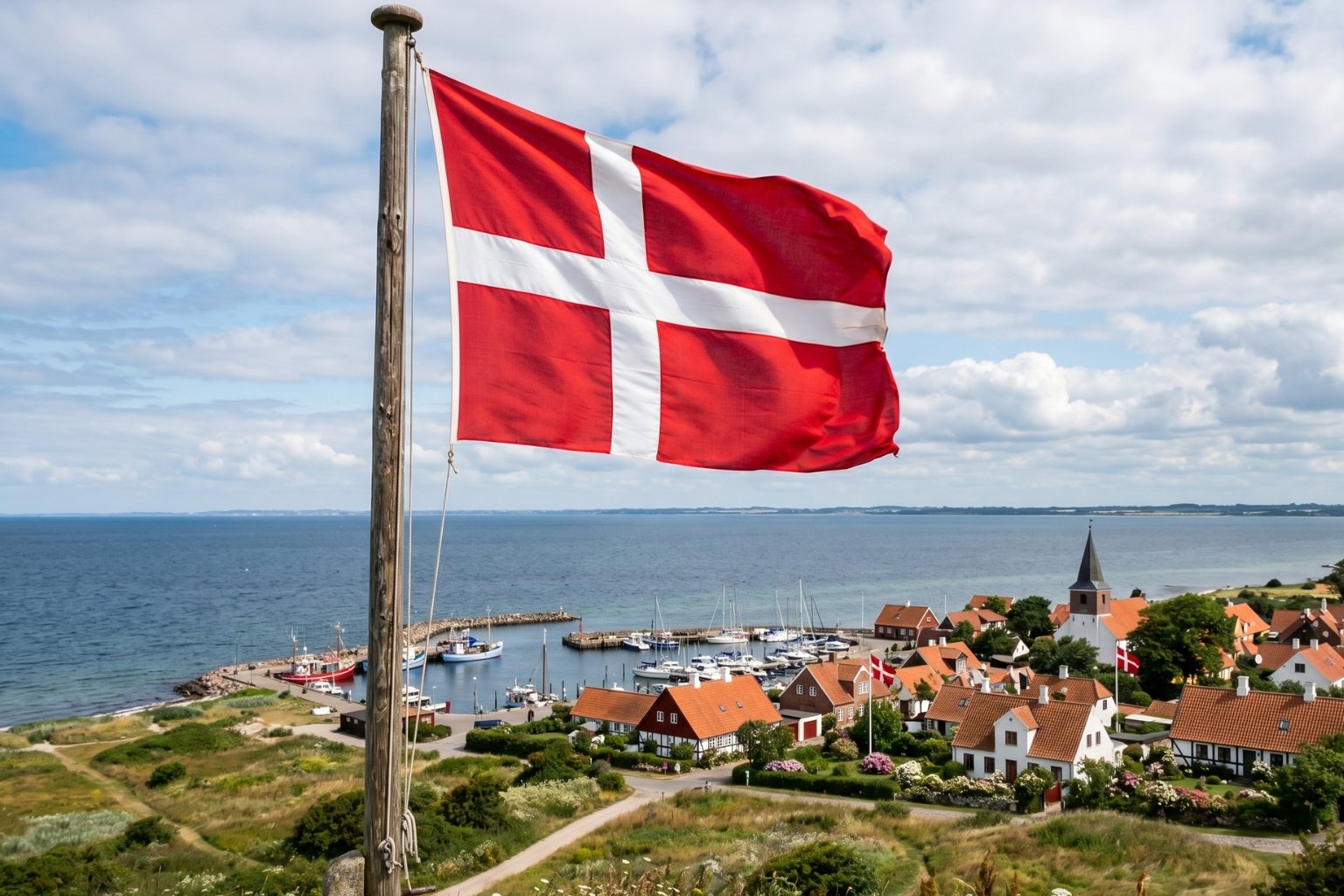

In Denmark, the national flag appears on birthday cakes. Not as a political statement, not as a show of nationalism, but as a simple expression of joy. That tells you almost everything you need to know about the Dannebrog and the country it belongs to. Of all the flags in the world, few have had a stranger, longer, or more intimate relationship with the people who fly them.
What Does the Denmark Flag Look Like?
A White Cross on a Red Field
The Denmark flag is one of the most recognizable in the world precisely because it refuses to be complicated. A deep red field, a white cross, four rectangles. That is the entire design.
What makes it structurally distinct is the position of the cross. The vertical bar sits closer to the left edge of the flag rather than at the center. This offset, common to all Nordic cross flags, was not a stylistic accident. It made the design easier to read from a distance at sea, where the swinging motion of a centered cross could make the flag look like a plain red square.
The cross extends all the way to the edges of the flag on all four sides. There are no borders, no additional symbols, no coat of arms.
The Official Colors
The precise shade of red on the civil flag is known as Dannebrog red. For the royal house flag and the military battle flag, a slightly darker version called madder red is used instead.
The proportions were not officially defined until 1748, when a naval regulation established the correct ratio of the two outer rectangles as 12 by 21 units, with the white stripes measuring 4 units wide. A police directive issued on 1 May 1893 further clarified acceptable proportional variations for public use.
| Element | Specification |
|---|---|
| Background color | Dannebrog red |
| Cross color | White |
| Cross width | 4 units |
| Outer rectangle ratio | 12 x 21 units |
| Inner square ratio | 12 x 12 units |
What Do the Colors of the Denmark Flag Mean?
Here is where honesty matters more than a clean answer: there is no official state interpretation of the Denmark flag’s colors. The Danish government has never issued a formal definition of what red and white mean on the Dannebrog.
What exists instead is a constellation of cultural associations that have settled around the flag over centuries. Red is widely understood to represent courage, strength, and the blood shed in battle. White carries associations with purity, faith, and the Christian tradition that shaped Scandinavian civilization through the medieval period.
The white cross is the more consistent symbol. Across all Nordic flags, the cross explicitly references Christianity, and Denmark is no exception. The cross design was already a marker of Christian kingdoms and crusading armies before it became specifically Danish.
The absence of an official meaning is itself revealing. The Danes have never felt the need to legislate what their flag represents. It means what it means to the people who live with it every day, which turns out to be quite a lot.
The Origin of the Dannebrog: Legend vs. History
The Battle of Lyndanisse, 1219
The founding story of the Dannebrog is one of the great origin myths of European heraldry. According to the legend, on 15 June 1219, during the Battle of Lyndanisse in present-day Estonia, Danish forces under King Valdemar II were losing ground against a coalition of pagan Estonian tribes.
At the critical moment, a red flag bearing a white cross fell from the sky. The Danes took it as a divine sign, rallied, and won the battle. The flag was understood as a gift from God, a material token of Christian approval for the Danish campaign.
The story lodged itself deep in Danish national memory. It is vivid, specific, and tied to a real historical event. Whether it happened as described is another matter entirely.
What Historians Actually Know
The legend of 1219 cannot be verified by contemporary sources. The earliest written record connecting the Dannebrog to that battle dates from the 14th century, roughly a hundred years after the supposed event.
What is documented with more confidence is that a white cross on a red field was in use as a symbol of Christian military authority across northern Europe during the Crusades of the 11th to 13th centuries. The Holy Roman Empire used similar iconography. The kings of Denmark appear in heraldic records using a white-on-red cross from at least the 1300s.
The name itself points toward a prosaic origin. Dannebrog combines the Old Danish word for “Danes” with brok, meaning cloth or piece of cloth. The flag of the Danes. Functional, direct, unglamorous.
The World’s Oldest National Flag in Continuous Use
The Dannebrog holds a Guinness World Record as the oldest continuously used national flag. The word “continuously” carries weight here.
There was one significant interruption. Between 1397 and 1523, Denmark was part of the Kalmar Union, a political alliance of Scandinavian kingdoms whose shared symbol was a red cross on a yellow background. During this period, the Dannebrog was not the primary official symbol of the Danish state.
After the union dissolved, the red and white flag returned and has remained unchanged ever since. No other national flag currently in use can make the same claim with the same weight of evidence behind it.
A Brief History of the Dannebrog
For most of its early existence, the Dannebrog was a military and maritime symbol, not a civic one. Ordinary Danes had no particular relationship with it. It flew on warships and over army camps. It was not flown at homes, markets, or celebrations.
In 1748, the first official regulation governing the flag’s design was issued, establishing the proportions that remain standard today. The flag was still understood primarily as state property.
Then came a surprising reversal. In 1834, private use of the Dannebrog was formally banned. The Danish crown restricted its display to official contexts only. The ban lasted two decades.
It was lifted in 1854, the same year the Dannebrog was officially declared the national flag of Denmark. The timing was not coincidental.
The 19th century transformed how Danes related to their flag. Romanticism swept across Europe, prompting nations to look backward for symbols of identity and continuity. Denmark was in active territorial conflict with its German neighbors over the Schleswig region, and the Dannebrog became a rallying point for Danish patriots who needed a visible, unambiguous symbol of who they were and what they stood for.
This is when the flag moved from battlefields to birthday parties. The nationalist revival of the 1800s permanently rewired the emotional charge of the Dannebrog, turning a state emblem into a personal one.
In 2019, Denmark celebrated the 800th anniversary of the Lyndanisse legend with national events and renewed attention to the flag’s cultural role. More recently, the Dannebrog’s unique place in Danish everyday life has been put forward as a candidate for UNESCO Intangible Cultural Heritage status, a recognition that its significance extends beyond politics or history into lived culture.
The Denmark Flag and the Nordic Cross Family
The Dannebrog did not stay uniquely Danish for long. Its design became the template for every other Nordic national flag.
As Scandinavian nations established or formalized their own identities, they each adapted the offset cross motif to their own colors, creating a visual family that is immediately legible across the region.
| Country | Background | Cross color | Year adopted |
|---|---|---|---|
| Denmark | Red | White | 14th century |
| Sweden | Blue | Yellow/Gold | 16th century |
| Norway | Red | Blue outlined in white | 1821 |
| Finland | White | Blue | 1918 |
| Iceland | Blue | Red outlined in white | 1944 |
The shared design does more than signal historical connection. It makes the Nordic identity visually coherent in a way that goes beyond politics or language. When you see any of these flags, you know roughly where you are in the world and what kind of civilization shaped it.
Greenland, notably, is the one part of the Danish realm that chose not to follow the cross pattern. Its flag, adopted in 1985, features a white and red circle on a divided background, a deliberate departure that reflects Greenlandic identity as something distinct from Scandinavian tradition.
How the Danes Actually Use Their Flag
No other country in the world has a relationship with its national flag quite like Denmark’s.
In most nations, the flag is a formal object. It flies at government buildings on national holidays. It drapes coffins at state funerals. It appears at sports events. Outside of these contexts, displaying it too enthusiastically can read as aggressive nationalism.
In Denmark, the Dannebrog appears on birthday cakes. Cut into paper garlands, it decorates Christmas trees alongside baubles and candles. It is waved at airport arrivals to welcome someone home from a long trip. It is hung outside houses on the birthdays of family members. Shopkeepers put small flags in their windows during sales periods. Graduates receive them from friends and family as tokens of celebration.
This informal, affectionate use of the flag is directly connected to the Danish concept of hygge, the untranslatable word for a particular quality of cozy, communal warmth. The Dannebrog, in Danish hands, is not a political declaration. It is a gesture of belonging, an expression of something felt rather than argued.
There are rules governing its use, and they matter to Danes. The flag must never touch the ground. It should not be flown after dark without illumination. It should be lowered at sunset. These are not laws enforced by police; they are points of shared etiquette, understood and generally observed without being demanded.
The flag also flies at half-mast for funerals, including private ones. It is a common sight outside a family home on the day of a burial, a public acknowledgment of grief that requires no explanation to anyone passing by.
What makes this all genuinely unusual is the absence of political weight. In many countries, citizens who display their national flag prominently risk being read as nationalists or populists. In Denmark, flying the Dannebrog at a child’s birthday party is simply what you do. The flag has been so thoroughly domesticated, so completely absorbed into the rhythms of ordinary life, that it has escaped the ideological charge that tends to accumulate around national symbols elsewhere.
That may be the most remarkable thing about the Denmark flag: not its age, not its legend, not its elegant geometry, but the fact that after eight centuries, it still belongs to everyone.
