

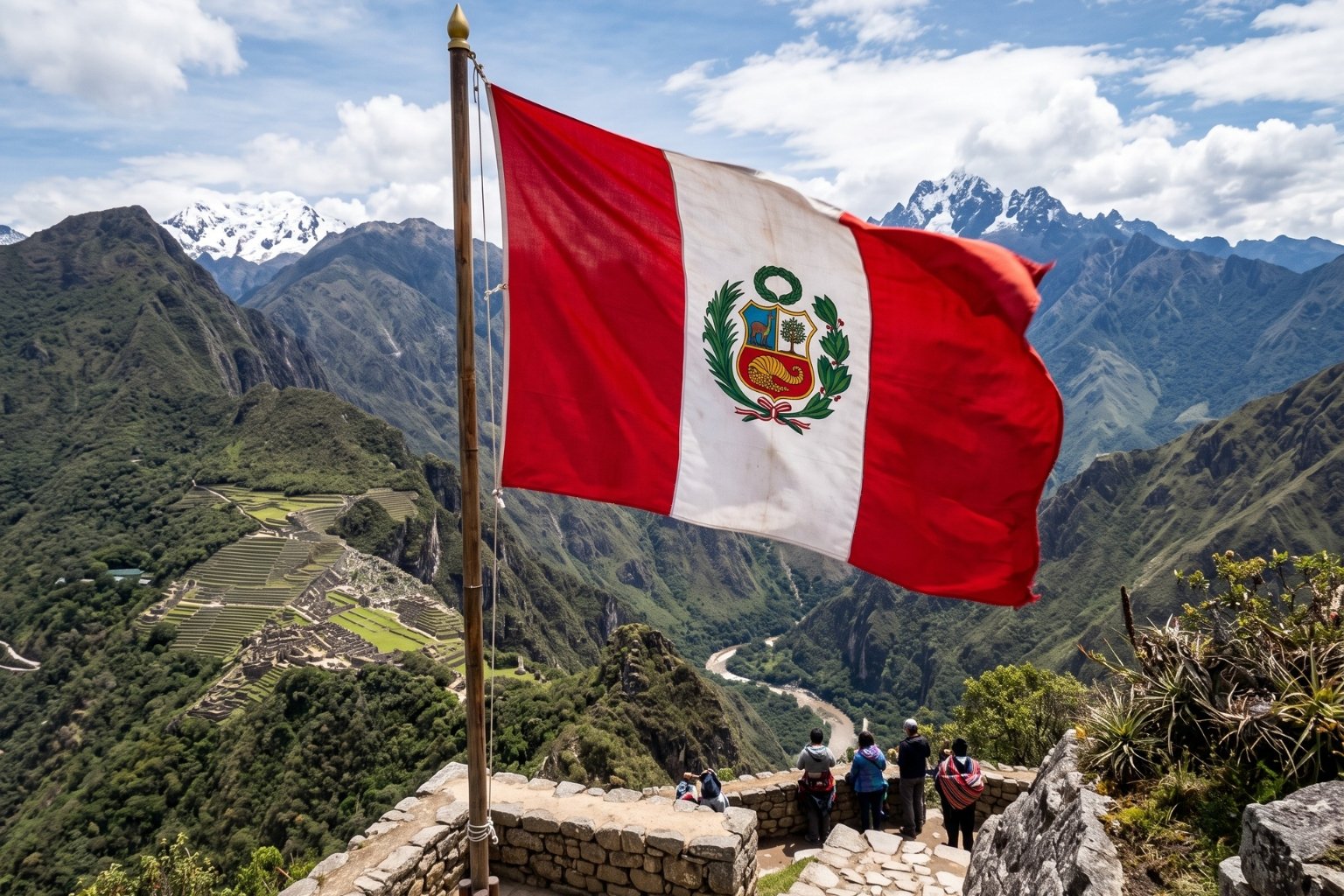

Fly into Lima and the first thing you will likely notice, before the ceviche or the mountains, is a wall of red and white hanging from balconies and government buildings. The Peru flag is one of the simplest looking national flags in South America, and one of the most loaded with meaning. Behind the two colors and the small shield in the center sits a story that runs from a general’s vision on a beach in 1820 to a legal decree signed more than a century later.
What the Peru Flag Looks Like
The flag itself is simple to describe. Three vertical bands run across it, red on each side and white through the middle. That is the version most people picture, and it is technically called the civil flag, the one flown by ordinary citizens, businesses, and private homes.
The official version used by the state carries one more element. A small coat of arms sits centered on the white band, packed with symbols that took decades to settle into their final form. We will get to what is actually inside that shield in a moment, but first, the colors themselves deserve their own story.
What Do the Red and White Actually Mean
Ask several Peruvians why their flag is red and white and you will likely get several different answers. Historians do not fully agree either, and honestly, that uncertainty is part of what makes the story interesting rather than a source of embarrassment.
The most commonly repeated explanation traces back to General José de San Martín, the Argentine liberator who led Peru’s independence campaign. Tradition holds that San Martín rested near Pisco in September 1820 and either dreamed of or watched a flock of parihuana, the red and white flamingos native to the Peruvian coast, and drew the flag’s colors from what he saw.
A second, more civic reading treats the colors symbolically rather than literally. Red stands for the courage and the blood spilled by those who fought for independence. White stands for peace, purity, and justice, the values the new republic hoped to build itself on.
A third theory, favored by some Peruvian historians, ties red back even further, to the Inca tradition of associating the color with victory and royal power, long before San Martín ever arrived.
No single explanation has ever been made official, and that is worth saying plainly rather than picking one version and presenting it as settled fact.
| Theory | Origin | What it claims |
|---|---|---|
| The flamingo story | Attributed to San Martín, 1820 | Red and white came from the parihuana flamingos he saw near Pisco |
| The civic reading | Common republican interpretation | Red represents courage and sacrifice, white represents peace and purity |
| The Inca reading | Historian Jorge Fernández Stoll | Red descends from Inca royal and war symbolism, white was added later as a civic value |
The Coat of Arms, Peru’s Story Told in a Shield
Peruvian law is oddly specific about the coat of arms, right down to which color occupies each section of the shield. Adopted by Congress on February 25, 1825, the design splits into three fields, each representing a different kind of national wealth.
The Vicuña
In the upper left corner, set against a pale blue background, stands a vicuña, a wild, slender relative of the llama that still roams the high Andes. It represents Peru’s animal kingdom and carries a second layer of meaning too, standing for freedom and national pride, since the vicuña has never been fully domesticated the way its cousins have.
The Cinchona Tree
The upper right corner holds a cinchona tree on a white field. This might be the most quietly important symbol on any national flag anywhere. Cinchona bark is the original source of quinine, the compound that gave the world its first real treatment for malaria, and it grows almost nowhere outside the tropical Andes.
The Cornucopia
The bottom section, set against red, shows a cornucopia spilling gold and silver coins. It stands for Peru’s mineral wealth, the same resources that shaped much of the country’s colonial and postcolonial economy.
The Civic Crown
Above the shield sits a civic crown, a ring of oak leaves shown from the side. In Peruvian heraldry it signals victory and glory, a small flourish placed above symbols that are otherwise entirely about the land itself.
From San Martín’s Landing to the Flag You See Today
The flag did not arrive fully formed. It went through several versions in just five years, each one a response to something practical or political.
1820, the First Design
San Martín decreed Peru’s first national flag not long after landing near Pisco with his Liberating Expedition. That early version leaned on diagonal stripes and suns rather than the clean vertical bands used today, and it borrowed heavily from the flag of Argentina, San Martín’s home country and the country whose army he led.
1822, a Redesign for the Battlefield
Under José Bernardo de Tagle, who briefly served as interim president, the flag was redesigned in 1822. The original had a habit of being confused with Spanish colors on the battlefield, never a small problem in the middle of a war, so the layout shifted before settling toward the vertical version that followed.
1825, Congress Sets the Pattern
On February 25, 1825, under Simón Bolívar’s administration, Peru’s Constituent Congress ratified the design still used today: three vertical bands with the coat of arms centered on the white one. This is the version that stuck, and the one every Peruvian flag since has been built from.
1950, Splitting Civil and State Use
By the mid twentieth century, the flag needed a legal cleanup. Under President Manuel A. Odría, a 1950 decree formally separated the plain civil flag from the official state version carrying the coat of arms, along with military and naval variants. That is the legal basis for the two flags still seen flying side by side in Peru today.
Civil Flag, State Flag, and War Flag
If you spend any time in Peru, you will notice the flag does not always look the same, and that is intentional rather than inconsistent.
| Version | Who uses it | What it looks like |
|---|---|---|
| Civil flag (Bandera Nacional) | Private citizens, businesses, homes | Plain red, white, red vertical bands, no coat of arms |
| State flag (Pabellón Nacional) | Government buildings, official ceremonies | Same bands, with the coat of arms centered on the white band |
| War flag | Peru’s armed forces | Coat of arms version, used in military contexts |
Where You Will Actually See the Flag in Peru
The flag is not just a background detail during a trip to Peru, it shows up on a real calendar with real weight behind it.
June 7 marks Flag Day (Día de la Bandera), commemorating the Battle of Arica. July 28 is Independence Day, the anchor of the Fiestas Patrias celebrations that stretch across the country, when Lima’s Plaza Mayor raises one of the largest flags you will see anywhere in Peru. Outside these dates, the flag is simply part of daily life, hanging from balconies, painted on taxi doors, worn as a small rosette pinned to a lapel throughout the month of July.
Quick Facts
| Fact | Detail |
|---|---|
| Colors | Red and white |
| Current design ratified | February 25, 1825 |
| Legal split between civil and state flag | 1950, under President Manuel A. Odría |
| Nickname | La Bicolor |
| National animal on the coat of arms | Vicuña |
| National tree on the coat of arms | Cinchona |
| Similar flags elsewhere | Canada, Austria, Poland, each built on red and white, arranged differently |
Next time you spot those two colors snapping in the wind over Lima or folded into a small rosette during July, you will know there is a shield’s worth of history behind them, not just a pattern.
