

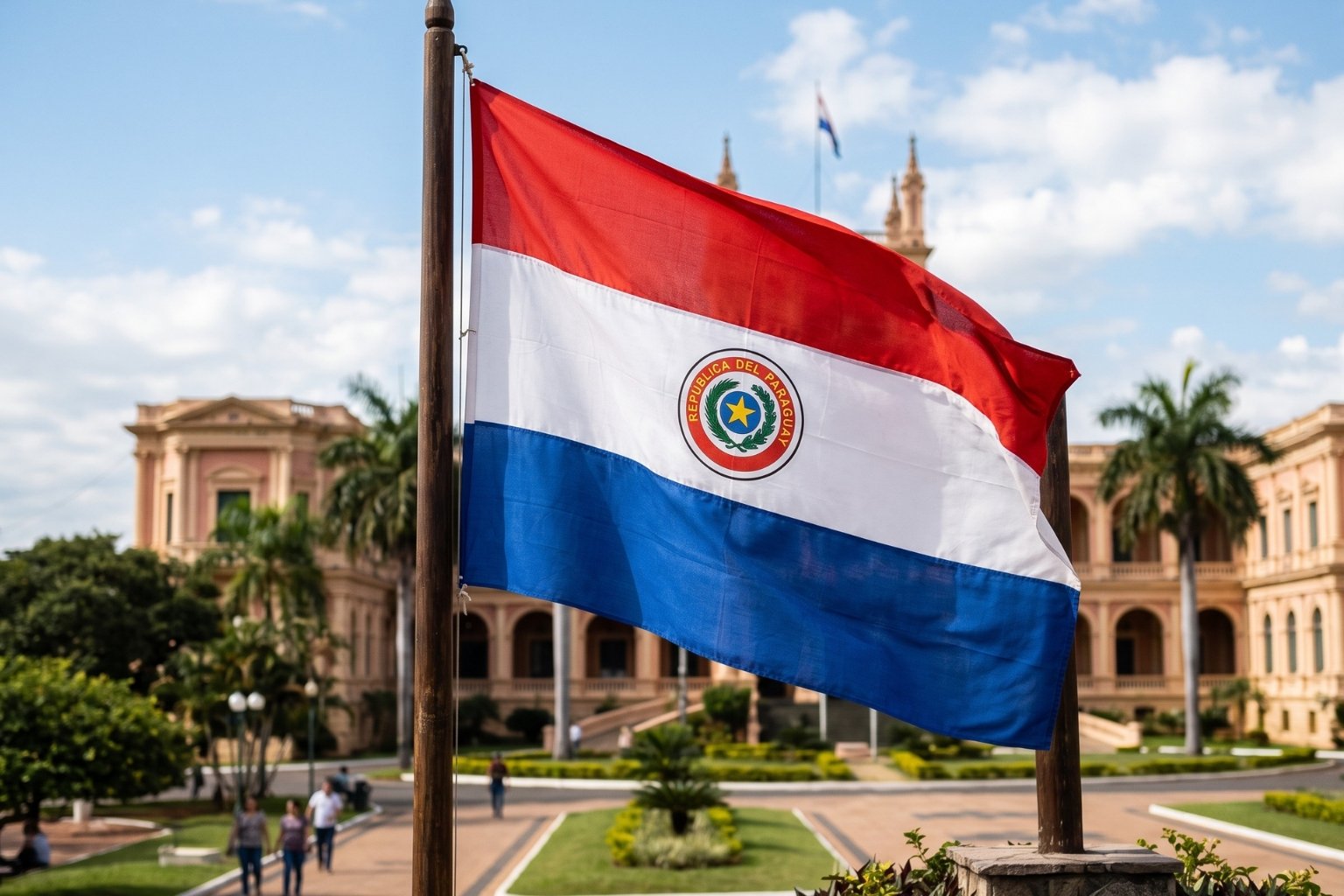

Paraguay’s flag looks like a simple tricolor from a distance, red, white and blue stripes in three equal bands. Flip it over and the illusion breaks. The front carries the national coat of arms, the back carries a completely different treasury seal, making Paraguay’s flag the only one in the world that genuinely changes meaning depending on which side you’re looking at. That single design choice tells you almost everything about how this small landlocked nation understands its own history.
A Flag With Two Faces
Most flags that appear to have a front and a back are actually just mirror images, adjusted so any text on them reads correctly no matter which way the wind turns the fabric. Paraguay’s flag works differently. The obverse displays the national coat of arms, and the reverse carries the seal of the treasury, two entirely separate emblems telling two separate stories.
This makes it unique among the world’s roughly 200 national banners. Moldova and Saudi Arabia are sometimes mentioned alongside Paraguay for having distinct sides, but in both cases the reverse is simply a mirrored version of the same design. Paraguay is the only country whose flag carries two fully independent official symbols.
The Colors and What They Actually Stand For
The tricolor itself, three equal horizontal bands of red, white and blue, was directly inspired by the French Tricolore, adopted during a period when Paraguay’s early leadership looked to French revolutionary ideals as a template for independence.
- Red honors the courage and the blood shed by those who fought for independence from Spain.
- White represents peace, integrity and the unity Paraguayans sought after decades of political upheaval.
- Blue stands for liberty and justice, values tied closely to the republic the country tried to build for itself.
None of these meanings were invented afterward for tourism brochures. They trace back to the actual congressional debates of the early 1800s, when Paraguay was carving out an identity separate from both Spain and its much larger neighbors.
Reading the Two Emblems
The National Coat of Arms on the Obverse
Hold the flag with the front facing you and you’ll see a golden five pointed star at the center, framed by a wreath of olive and palm branches, encircled by the words República del Paraguay.
The star isn’t decorative filler. It represents the morning star that, according to national tradition, lit the sky over the events of May 1811, when Paraguay’s independence movement took shape. It’s a symbol of hope tied to a specific date, not an abstract ideal.
The Treasury Seal on the Reverse
Turn the flag around and the coat of arms disappears entirely. In its place sits a golden lion resting beneath a staff topped with a red Phrygian cap, ringed by the words Paz y Justicia, meaning peace and justice.
The pike beside the lion stands for warrior virtue, and the Phrygian cap stands for liberty, a freedom Paraguayans defended at enormous cost during two of the deadliest conflicts in South American history, the War of the Triple Alliance (1864 to 1870) and the Chaco War (1932 to 1935). Locals don’t see these as abstract emblems. They read as shorthand for national sacrifice.
| Side | Emblem | What it represents |
|---|---|---|
| Obverse (front) | National coat of arms | Independence and hope, tied to May 1811 |
| Reverse (back) | Treasury seal | Liberty and justice, tied to the wars fought to defend them |
How the Flag Came to Be
The First Flags of Independence (1811 to 1812)
Paraguay’s flag history moved quickly and messily in its earliest years. On May 15, 1811, the country raised a plain blue flag bearing a white six pointed star, a color chosen because blue was associated with depictions of the Virgin Mary tied to Asunción’s founding. It lasted barely a month.
On June 17, 1811, it was replaced by a red, yellow and blue tricolor created by the Primera Junta Superior de Gobierno, the governing body led by Fulgencio Yegros, Fernando de la Mora and Pedro Juan Caballero. That flag flew until August 1812.
On August 15, 1812, the first version resembling today’s design was raised: three equal bands of red, white and blue, but with no emblem at the center. Historians treat this as the true first flag of the Republic, since that same year’s General Congress formally declared Paraguay a republican government rather than a Spanish province.
The Blue Flag Years Under Rodríguez de Francia
Between 1814 and 1840, dictator José Gaspar Rodríguez de Francia, an admirer of Napoleon, complicated matters further. A blue flag bearing a white star circulated alongside the existing tricolor at various points during his rule, since not every garrison in the country had access to a proper flag and consistency was hard to enforce.
1842: Congress Makes the Tricolor Official
The confusion ended on November 25, 1842, when the Extraordinary Congress formally decreed that only the tricolor of August 15, 1812 could be used going forward, now carrying two national emblems on the central white band, the coat of arms on one side and the treasury seal on the other. That resolution is the direct ancestor of the flag Paraguayans fly today.
What Changed Since Then
The design has stayed remarkably stable since 1842. Its use is now regulated under Decree No. 10,665 of 1957 and later resolutions, which set out how the flag must be displayed and protected, and it received a final technical update in 2013, when Congress standardized the exact specifications still in use today.
Why August 14 Matters to Paraguayans
Every August 14, Paraguay observes Día de la Bandera, its national Flag Day. The date was proposed in 1913 by the country’s teachers association specifically so it would fall the day before August 15, the anniversary of Asunción’s founding, giving the flag its own dedicated moment instead of sharing the spotlight.
Schools, government buildings and military units mark the day with ceremonies, and it’s one of the rare occasions when the symbolism behind the lion, the star and the Phrygian cap gets explained publicly to a new generation. Travelers passing through Paraguay in mid August will notice the flag stop being background scenery and become the center of attention for a week.
Where the Flag Still Speaks Loudest in Paraguay
For a traveler who wants to see the flag’s meaning rather than just its colors, a few places in Asunción carry real weight. The National Pantheon of the Heroes, in the heart of the capital, honors the same wars referenced by the pike and Phrygian cap on the treasury seal, and flags are displayed here with a formality you won’t find at a souvenir stand.
The Plaza de la Independencia and the buildings surrounding it mark the ground where the events of May 1811 actually unfolded, the same events symbolized by the star on the coat of arms. Walking through it with that context turns a pleasant square into something closer to a history lesson felt underfoot.
Quick Facts
| Detail | Information |
|---|---|
| Adopted | November 25, 1842, with technical specifications updated in 2013 |
| Proportions | 3:5 |
| Colors | Red, white, blue |
| Obverse emblem | National coat of arms, star and wreath |
| Reverse emblem | Treasury seal, lion and Phrygian cap |
| Motto on reverse | Paz y Justicia, Peace and Justice |
| National Flag Day | August 14 |
| Unique trait | The only national flag with two fully different emblems |
