

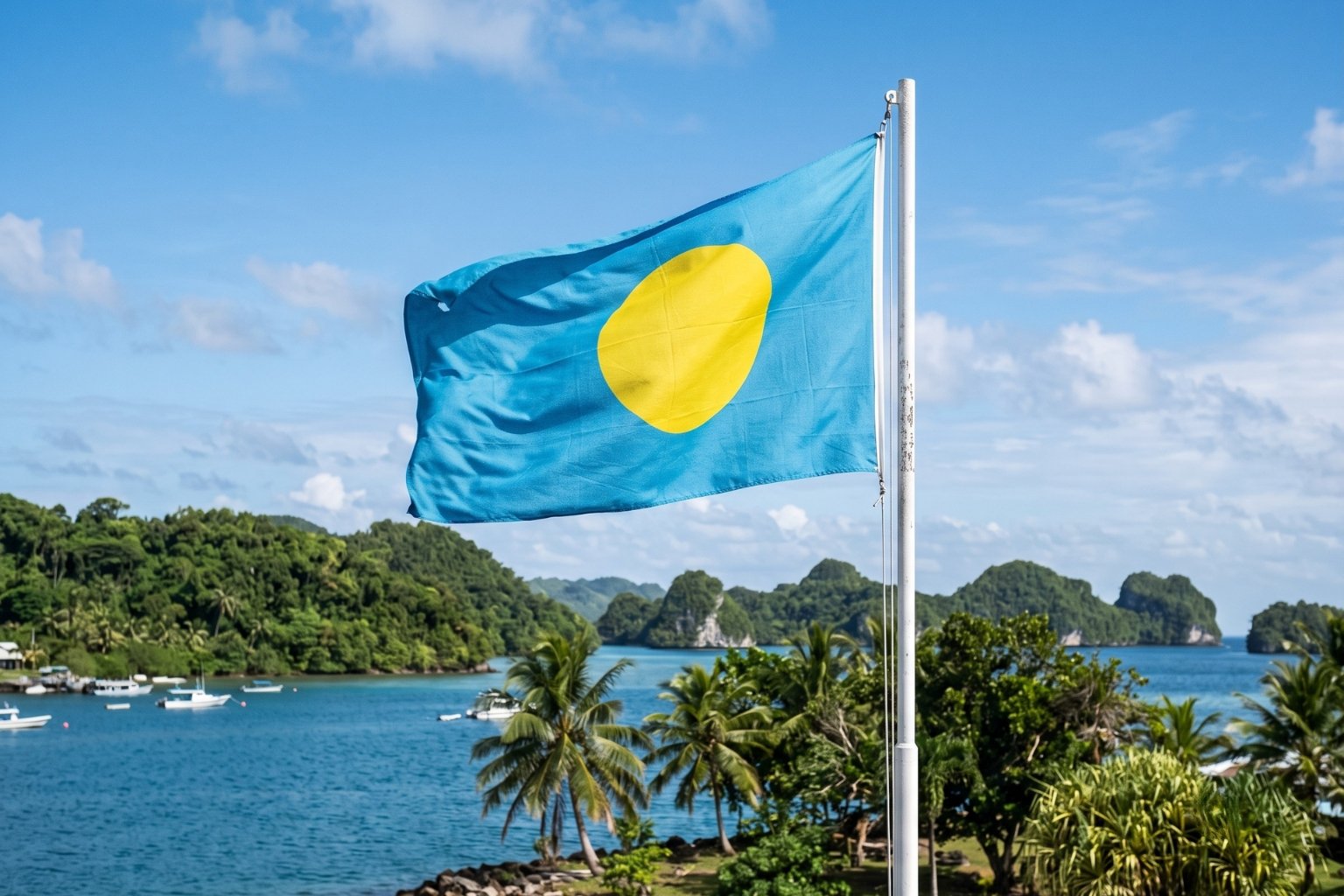

A golden disc sitting slightly off center on a sky blue field. The flag of Palau looks unlike anything else in the Pacific, and yet it is one of the youngest national flags in the world, adopted only in 1981. Behind its quiet simplicity sits a story of colonization, a nationwide design contest, and a symbolism that experts themselves still do not fully agree on.
What the Palau Flag Looks Like
The flag is a light blue field carrying a large golden yellow disc. Its official proportions are 5 to 8, and the disc sits slightly toward the hoist side rather than dead center.
No single official color standard has ever been published by the Palauan government. Several vexillological references (Album des Pavillons, the Flags and Anthems Manual, Vexilla Mundi) each give slightly different Pantone and CMYK equivalents. Here are the values most commonly used for digital work.
| Color | Hex | RGB | CMYK | Approximate Pantone |
|---|---|---|---|---|
| Blue | #0085CA | 0, 133, 202 | 100, 15, 0, 6 | Process Blue / 299 C |
| Yellow | #FFD100 | 255, 209, 0 | 0, 5, 100, 0 | 109 C |
For web or branding work, the hex codes above are more than enough. For print work where accuracy really matters, it’s worth confirming directly with an official Palauan source.
The Meaning Behind the Colors
The Golden Moon
The yellow disc represents the full moon, a central reference point in traditional Palauan culture. The full moon was once considered the best time for fishing, planting, harvesting, and holding major community gatherings.
It also carries a gentler meaning, tied to warmth, tranquility, peace, love, and domestic unity. It is as much a symbol of rhythm and pace of life as it is a marker on a calendar.
The Blue Field, a Debate Nobody Settles
Most sources describe the blue as a simple nod to the Pacific Ocean surrounding the archipelago. It’s the most common explanation, and it makes sense given how tightly Palau’s identity is tied to the sea.
But another reading exists, drawn from Palau’s own constitutional documents as cited by Encyclopædia Britannica. In this version, the blue does not represent the ocean at all. It refers instead to the final departure of the foreign power that once administered the territory. Both interpretations circulate, and no official source clearly favors one over the other.
Why the Moon Isn’t Centered
The disc’s shift toward the hoist side isn’t a random design choice. It is generally read as a picture of movement, a country stepping forward into its future rather than a symbol frozen at the exact center of the cloth.
A Flag Shaped by Five Colonial Eras
The current flag only makes full sense once you know the archipelago’s turbulent past. For nearly three centuries, Palau had no flag of its own.
Starting in 1710, Spanish ships brought the Cross of Burgundy into the region. Spain later sold its Pacific holdings to Germany after its defeat in the Spanish American War, opening a German administration that ran from 1899 to 1914, marked by the black, white, and red flag of the German Empire.
Japan then took control of the territory, before the United Nations placed it under United States administration after the Second World War, as part of the Trust Territory of the Pacific Islands. That territory grouped Palau together with the Marshall Islands and the future Federated States of Micronesia, under a blue flag carrying six stars.
When independence finally came, Palau chose a different path from its neighbors, who went on to form the Federated States of Micronesia with their own four star flag. That political split largely explains why Palau wanted a flag that was entirely its own, rather than a variation on a shared regional symbol.
The 1979 Contest and the Man Who Designed the Flag
In 1979, while Palau was still part of the Trust Territory, the incoming government launched a nationwide contest to choose a flag. More than a thousand designs were submitted by the public.
Blau Skebong won with a design built on real restraint. His flag was officially approved by the government on October 22, 1980, then raised for the first time on January 1, 1981, the day Palau formally separated from the Trust Territory.
Skebong’s design is tied to the phrase “Olbiil era Kelulau,” roughly translated as rule by the people. That phrase captures the flag’s real spirit better than its visual alone ever could. It isn’t just a national symbol, it’s a declaration of self rule after centuries under foreign administration.
The Palau and Japan Question
One theory keeps resurfacing in vexillology circles, a quiet link between Palau’s flag and Japan’s. Japanese professor Futaranosuke Nagoshi proposed that Palau’s golden disc pays a subtle tribute to the red disc on Japan’s own flag, as a mark of friendship between the two countries.
Former Palauan president Kuniwo Nakamura once responded to that theory with dry, measured irony, never quite confirming it and never quite dismissing it either. The anecdote says something real about how a national symbol can carry more than one story at once, with no need for either to be declared the final answer.
Where You Still See the Flag Today
The flag exists in a few versions depending on use, civil, state, and presidential, all sharing the same proportions and colors but varying slightly by protocol. Private vessels typically fly a smaller format.
For visitors, the flag is easy to spot on government buildings in Koror, at local ceremonies, or raised on the handful of ferries connecting the islands. It’s a quiet symbol, but an ever present one, much like the country itself.
