

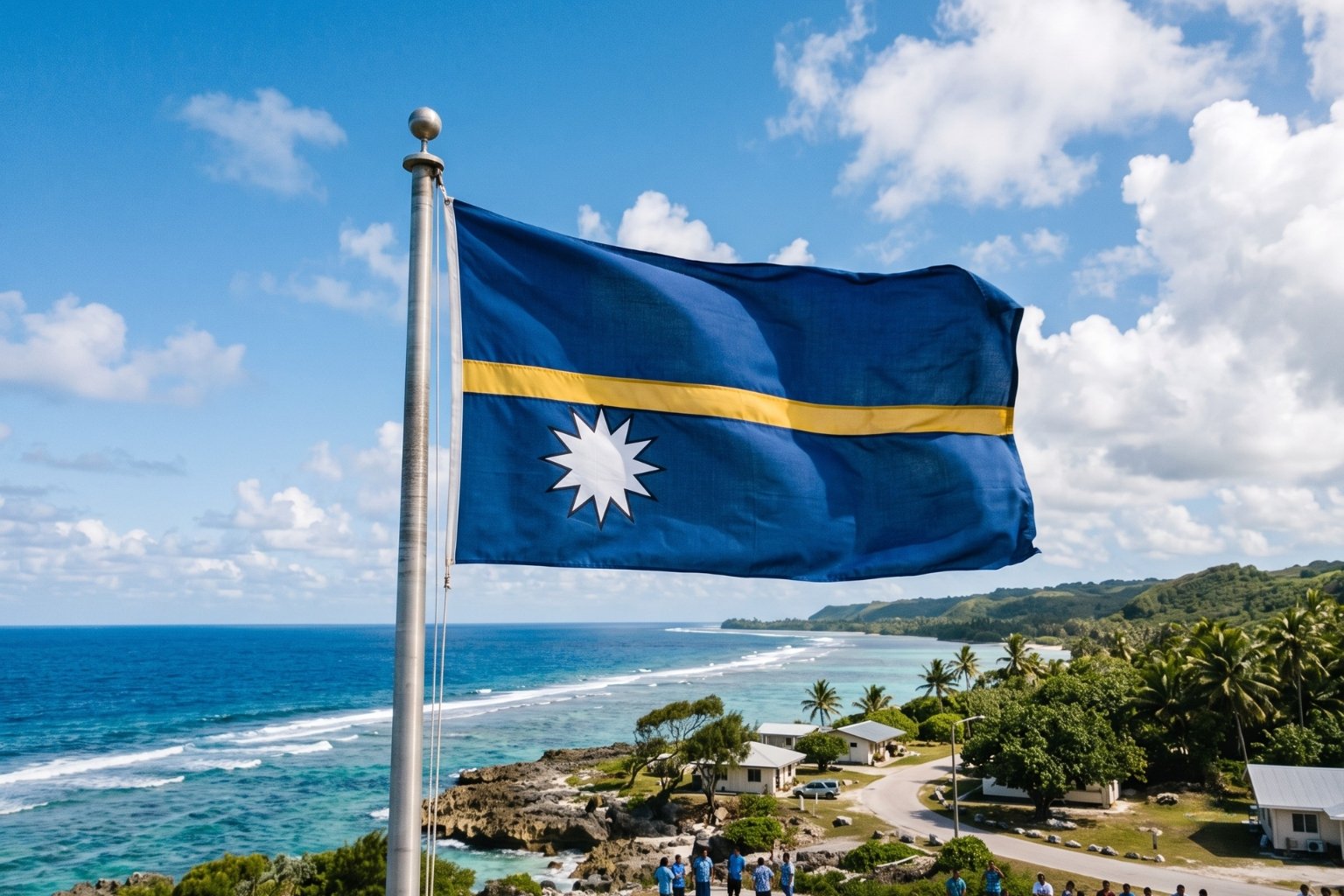

On a map, Nauru fits in the palm of a hand. Twenty one square kilometers lost in the central Pacific, the smallest republic on earth. Its flag still manages to carry a century of colonization, a war, a forced deportation, and the story of an island that was once the richest place on the planet per capita. Here is what each color, each line, and each point of its star actually means.
What the Colors and Symbols of the Flag Represent
The Nauru flag is strikingly simple. A navy blue field covers almost the entire surface, split exactly in the middle by a thin yellow stripe, beneath which sits a white star with twelve points.
Nothing here is decorative. Every element fixes a geographic fact or a piece of collective memory, with an almost cartographic precision.
The Blue Field: the Ocean That Defines the Island
The navy blue stands for the Pacific Ocean, which surrounds Nauru for thousands of kilometers in every direction. The nearest island, Banaba, sits more than 300 kilometers away. This color reflects an isolation that shaped the culture, the diet, and the history of the country long before Europeans ever arrived.
The Yellow Stripe: a Line Drawn Across the Equator
The horizontal yellow stripe, set at a ratio of 1 to 24 against the flag, marks the equator. Nauru sits at roughly 0°32′ south latitude, barely forty kilometers from that imaginary line.
The detail carries more weight than pure geography. The stripe splits the flag into two unequal halves, and that split is meant to evoke the dual origin of the island’s first inhabitants, who arrived in two separate waves of migration.
The Twelve Pointed White Star: Location, Ancestry and Phosphate
The white star, placed just below the yellow stripe, marks Nauru’s position south of the equator. Its twelve points refer to the twelve tribes that made up the island’s original population.
Its white color, though, has nothing to do with the peace or purity usually attached to that shade on other flags. It represents phosphate, long Nauru’s only real resource, and the material that briefly turned this tiny island into one of the wealthiest countries on earth per person.
| Element | Color | Meaning |
|---|---|---|
| Field | Navy blue | The Pacific Ocean |
| Horizontal stripe | Yellow | The equator |
| Twelve pointed star | White | The island’s position south of the equator, the twelve founding tribes, and phosphate |
The Twelve Tribes Behind the Star
Before Europeans arrived, Nauruan society was organized into twelve tribes, each speaking its own variant of Nauruan and occupying a distinct part of the island. Their names have survived the centuries and still shape the country’s national symbol today.
The twelve founding tribes were the following.
- Deiboe
- Eamwidara
- Eamwit
- Eamwitmwit
- Eano
- Eaoru
- Emangum
- Emea
- Irutsi
- Iruwa
- Iwi
- Ranibok
That tribal structure has largely disappeared from everyday life. Nauruans today identify more with the district they live in than with any of these twelve lineages, which gives the star on the flag an almost commemorative role, preserving in cloth a social structure that time has otherwise erased.
The Flags Nauru Lived Under Before Independence
The current flag is only the last in a long line of banners imposed on the island through successive occupations.
German Annexation and Its Black Lion
On October 2, 1888, an annexation ceremony took place on the island in the presence of the Nauruan king Auweyida. The German flag was raised, marking the start of colonial rule. From 1906, Nauru was administratively grouped with German New Guinea, alongside the Mariana Islands, the Marshall Islands, the Solomon Islands, and Palau. The flag of that period was a white field bearing the German flag in the canton and a black lion.
World War I and the Australian Takeover
In 1914, at the start of World War I, Australian forces seized the island, ending several decades of German rule.
Japanese Occupation and Deportation to the Caroline Islands
During World War II, Nauru fell under Japanese occupation. Part of the Nauruan population was deported to the Caroline Islands during this period, an episode the island still remembers as one of its darkest.
Trusteeship Under Australia, Britain and New Zealand
After the war, Nauru came under joint trusteeship of Australia, Britain and New Zealand. Phosphate mining resumed at full scale, becoming the island’s main source of income, while deported Nauruans gradually returned home. New schools and medical facilities were built, and by the 1960s a movement toward self determination had taken hold among local political leaders.
January 31, 1968: The Birth of the Current Flag
The flag known today was officially adopted on January 31, 1968, the day Nauru gained independence from Australia. It was designed by a local islander who worked for Evans, an Australian flag manufacturer.
The design packs a striking amount into one simple rectangle: two distinct migratory waves that populated the island, the ocean that isolates it, its exact position on the globe, and the resource that once made its fortune. Few flags manage to hold that much history in something so plain.
A Flag That Never Changed While Everything Else Did
Since 1968, the flag has gone through no modification at all, even as the country it represents went through enormous upheaval. In the 1970s, intensive phosphate mining pushed Nauru into the ranks of the wealthiest nations on earth per capita.
That prosperity collapsed as the deposits ran dry, leaving behind an island largely devastated by decades of extraction. In 1989, Nauru brought a case against Australia before the International Court of Justice seeking compensation. The matter was settled out of court: Australia paid 107 million Australian dollars plus 2.5 billion Australian dollars spread over twenty years to fund restoration of the island’s interior, while Britain and New Zealand jointly paid 12 million Australian dollars in 1993 to compensate for lost agricultural land.
The flag never moved. It remains the one visual constant of a country that lived through one of the fastest reversals of fortune in modern history.
Nauru’s Flag Within the Pacific Family
The choice of blue, a star, and a reference to the equator is not unique to Nauru. Several neighboring Pacific nations use similar visual codes, from Palau’s off center golden disc on a blue field to Kiribati’s stripes evoking a rising sun over the ocean. This shared visual language reflects a common regional habit of expressing island identity and geographic position through simple symbols rather than crowded scenes.
The Flag in Everyday Nauruan Life
Very few travelers ever set foot on Nauru, since the island is only served by a handful of flights from Brisbane or Nadi. Those who do make it there see the flag flying above government buildings in the Yaren district, the country’s de facto seat of government, as well as at the airport and during the January 31 independence day celebrations.
On the international stage, Nauru is often most visible through sport, particularly at the Commonwealth Games, where its weightlifters built the country’s sporting reputation. Nauru has also held a seat at the United Nations since 1999, where its flag flies alongside those of far larger nations.
Quick Answers
What do the colors of the Nauru flag represent? Blue stands for the Pacific Ocean, yellow for the equator, and the white of the star for phosphate, the country’s historic source of wealth.
Why does the star have twelve points? Each point represents one of the twelve tribes that made up Nauru’s original population.
When was the current flag adopted? On January 31, 1968, the day Nauru gained independence from Australia.
Has the flag ever changed? No, its design has remained identical since adoption, despite the economic and environmental upheavals the country has faced.
