

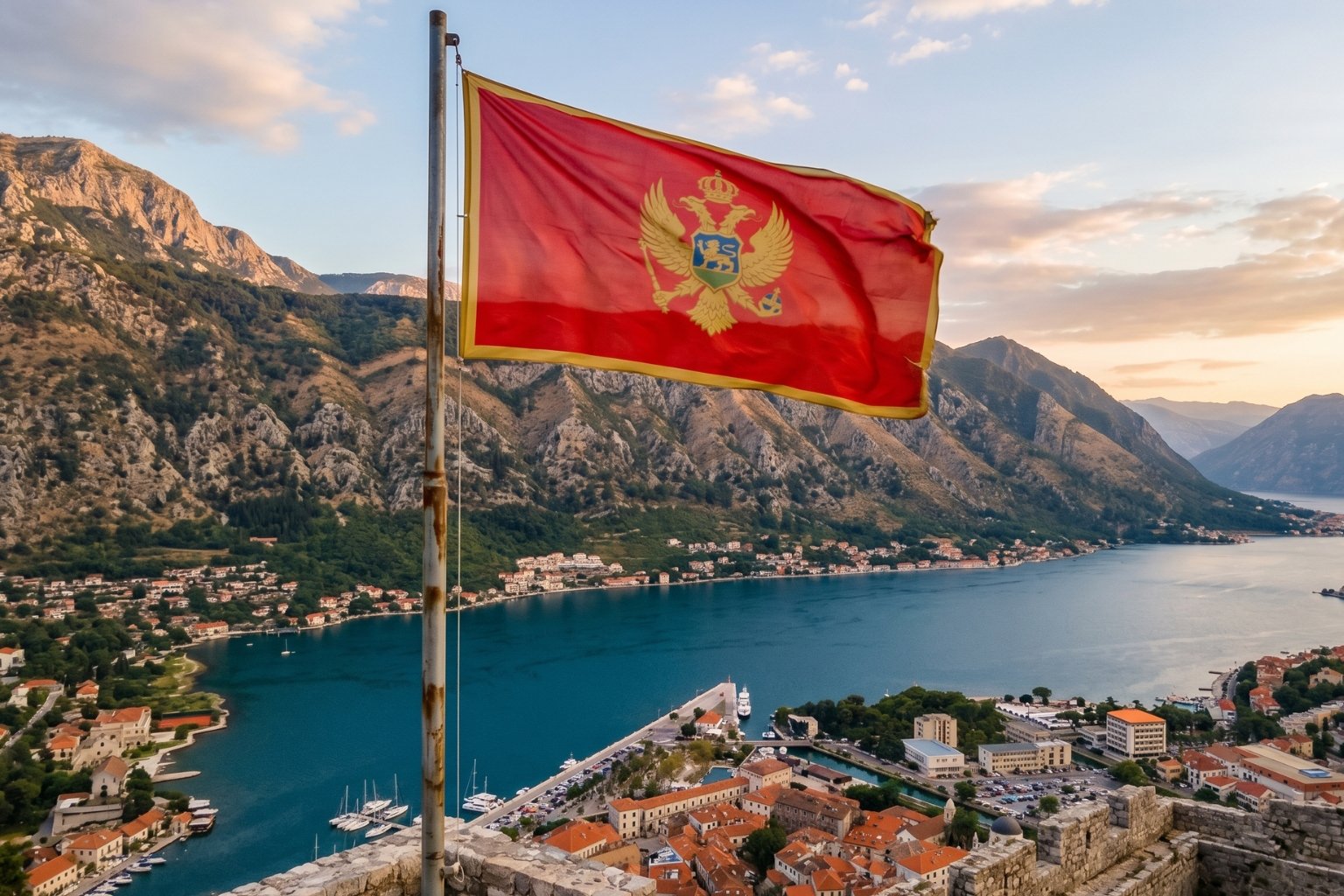

A red field trimmed in gold, crowned by a double-headed eagle. In a region of blue, white, and red tricolors stretching from Ljubljana to Belgrade, the flag of Montenegro reads almost like a provocation. It does not look like its neighbors. It was never meant to.
What the Montenegro Flag Looks Like
The flag is a crimson red rectangle bordered on all four sides by a narrow golden frame. At its center sits the national coat of arms: a gold double-headed eagle spreading its wings, wearing a crown, and holding a scepter topped with a cross in one talon and a blue globus cruciger in the other. On the eagle’s chest, a shield shows a golden lion striding across a blue and green field.
The flag’s proportions are standardized at a ratio of 1:2, and every detail of the coat of arms was formalized by parliamentary law in 2004 to ensure consistent reproduction across all official uses.
The Colors of the Montenegro Flag and What They Mean
Red
Red is not decorative here. It is a declaration. The deep crimson field references the sacrifices of Montenegrin fighters across centuries of resistance, from Ottoman incursions to the partisan uprisings of the Second World War. In heraldic tradition, red signals courage and valor. In Montenegro’s case, it also carries the weight of a small mountain nation that spent most of its modern history defending its borders against far larger powers.
Gold
Gold runs as a border and fills the eagle itself. It connects the flag directly to Byzantine heraldic tradition and to the royal legacy of the Petrović-Njegoš dynasty, the ruling house that shaped Montenegro’s identity for over two centuries. Gold here is not about wealth in the material sense. It speaks to continuity, legitimacy, and the long arc of statehood.
The Coat of Arms, Element by Element
The Double-Headed Eagle
The double-headed eagle is arguably the most loaded symbol on the flag. Its origins trace back to the Byzantine Empire, where it represented the union of spiritual and temporal power, one head facing the divine world, the other the earthly. Montenegro adopted this emblem through the Petrović-Njegoš dynasty, whose prince-bishops ruled the country as both religious and political leaders for generations.
The eagle is golden, crowned, and spread-winged, the posture of sovereignty rather than aggression.
The Lion on the Shield
On the eagle’s chest, the lion passant is a reference to episcopal authority and to the period when Montenegro was governed as a theocracy, ruled by prince-bishops rather than secular kings. The symbol is connected to the “Lion of Judah” in Christian tradition, a thread that runs through the country’s deep Orthodox identity.
That a republic chose to keep this theocratic emblem on its modern flag was not without controversy. The symbol remained because it was understood as historical rather than doctrinal, a marker of what Montenegro was, not necessarily what it professes to be today.
The Scepter and the Globus Cruciger
The scepter topped with a cross represents sovereign authority. The globus cruciger, the orb crossed with a Christian cross held in the opposite talon, is a traditional Christian imperial symbol meaning that the world is held under the dominion of faith. Together they express the dual claim of the Montenegrin state: independence from external powers and a rooted Orthodox identity.
The Crown
The crown above the eagle’s two heads ties the modern flag directly to the Kingdom of Montenegro, which existed from 1910 to 1918 under King Nicholas I. It is not simply decorative. It is a genealogical statement, a visible line between the contemporary republic and its monarchic past.
The History of the Montenegro Flag
The Theocratic Era
Before Montenegro was a modern state, it was governed by prince-bishops. During the reigns of Bishop Peter I and Bishop Peter II in the late 18th and early 19th centuries, the national flag was a white field bearing a red cross, a direct expression of the theocratic structure of the state. Religion and governance were not separated. The flag made that explicit.
1848 and the Pan-Slavic Turn
The revolutionary wave of 1848, which shook thrones across Europe, reached the Balkans through the lens of Pan-Slavic solidarity. Inspired by the congress in Prague, Montenegro adopted a tricolor of red, blue, and white, aligning visually with the broader Slavic national movement. The flag changed because the political imagination of the country changed. A theocratic symbol gave way to a civic one.
1878: International Recognition
Montenegro was recognized as a fully independent state at the Congress of Berlin in 1878. The tricolor was confirmed as the official national flag. The red, blue, and white combination served the country through its period of formal sovereignty, and then through its transformation into a kingdom in 1910.
The Yugoslav Decades
After the First World War, Montenegro was absorbed into the Kingdom of Serbs, Croats, and Slovenes, later renamed Yugoslavia. The flag became a tricolor again, now marked by a communist red star following the Second World War, when the country became part of Tito’s socialist federation as one of its six constituent republics.
The star came down in 1993, when Montenegro remained in a reduced federation with Serbia after the dissolution of Yugoslavia. The plain tricolor without the star served as the republican flag through the following decade.
2004: The Return of the Royal Banner
On July 12, 2004, the Parliament of Montenegro officially adopted the current flag. The design was not invented from scratch. It was recovered. The Heraldic Commission of the Montenegrin government drew directly from the royal standard of the Kingdom of Montenegro, the red and gold banner bearing the double-headed eagle that had flown during the reign of Nicholas I.
The first official raising of the modern flag took place on July 13, 2004, a date chosen to coincide with Statehood Day, which commemorates both the international recognition of independence in 1878 and the anti-Axis uprising of 1941.
No single designer is credited for the flag. It was a collective act of historical reclamation.
2006: A Flag at the United Nations
When Montenegro declared independence from the State Union of Serbia and Montenegro on June 3, 2006, and was admitted to the United Nations on June 28, 2006, the red and gold flag was raised at UN Headquarters in New York. A nation of fewer than 700,000 people, younger than many of the diplomats in the room, placed its royal eagle beside the banners of the world’s great powers.
Why the Montenegro Flag Stands Apart in the Balkans
Almost every former Yugoslav republic and most Balkan neighbors use some variation of the pan-Slavic tricolor, three horizontal stripes in combinations of blue, white, and red. Montenegro is the exception.
| Country | Flag Type |
|---|---|
| Serbia | Pan-Slavic tricolor with coat of arms |
| Croatia | Pan-Slavic tricolor with coat of arms |
| Slovenia | Pan-Slavic tricolor |
| Bosnia and Herzegovina | Non-tricolor, unique design |
| North Macedonia | Non-tricolor, unique design |
| Montenegro | Red field with gold border and coat of arms |
This distinctiveness is partly a reflection of Montenegro’s complex identity. Fewer than half of the country’s inhabitants identify as ethnically Montenegrin. Significant numbers identify as Serbian, Bosnian, Croatian, or Albanian. A pan-Slavic tricolor would have been a politically loaded choice in that context.
The red and gold banner sidesteps that tension by anchoring identity in dynastic and territorial history rather than ethnic solidarity. It says: we are Montenegrin because of where we come from and what we have built, not because of a color shared with our neighbors.
The Royal Standard It Was Born From
The flag in use today is formally known in Montenegrin as “Zastava Crne Gore”, simply the Flag of Montenegro, but it is also referred to colloquially as the “Kraljevska zastava”, the Royal Banner.
Its direct predecessor is the royal standard of the Kingdom of Montenegro flown between 1910 and 1918, which featured the same red field, the same golden eagle, and the same essential composition. The 2004 Heraldic Commission’s work was not creative in the conventional sense. It was restorative. Proportions were standardized, color codes were fixed for official reproduction, and the coat of arms was refined for constitutional adoption.
What returned to Montenegrin public life in 2004 was something that had been in storage for nearly nine decades, a symbol that predated communism, survived federation, and emerged on the other side still recognizable.
