


Few flags in the world were designed not by a nation but for one. The flag of Bosnia and Herzegovina is one of them. Adopted in 1998 under international pressure, it carries a deliberate neutrality that says as much about the country’s recent past as it does about its ambitions. Understanding it means understanding a land that has navigated centuries of empires, a brutal modern war, and the fragile work of rebuilding a shared identity.
What the Flag of Bosnia and Herzegovina Looks Like
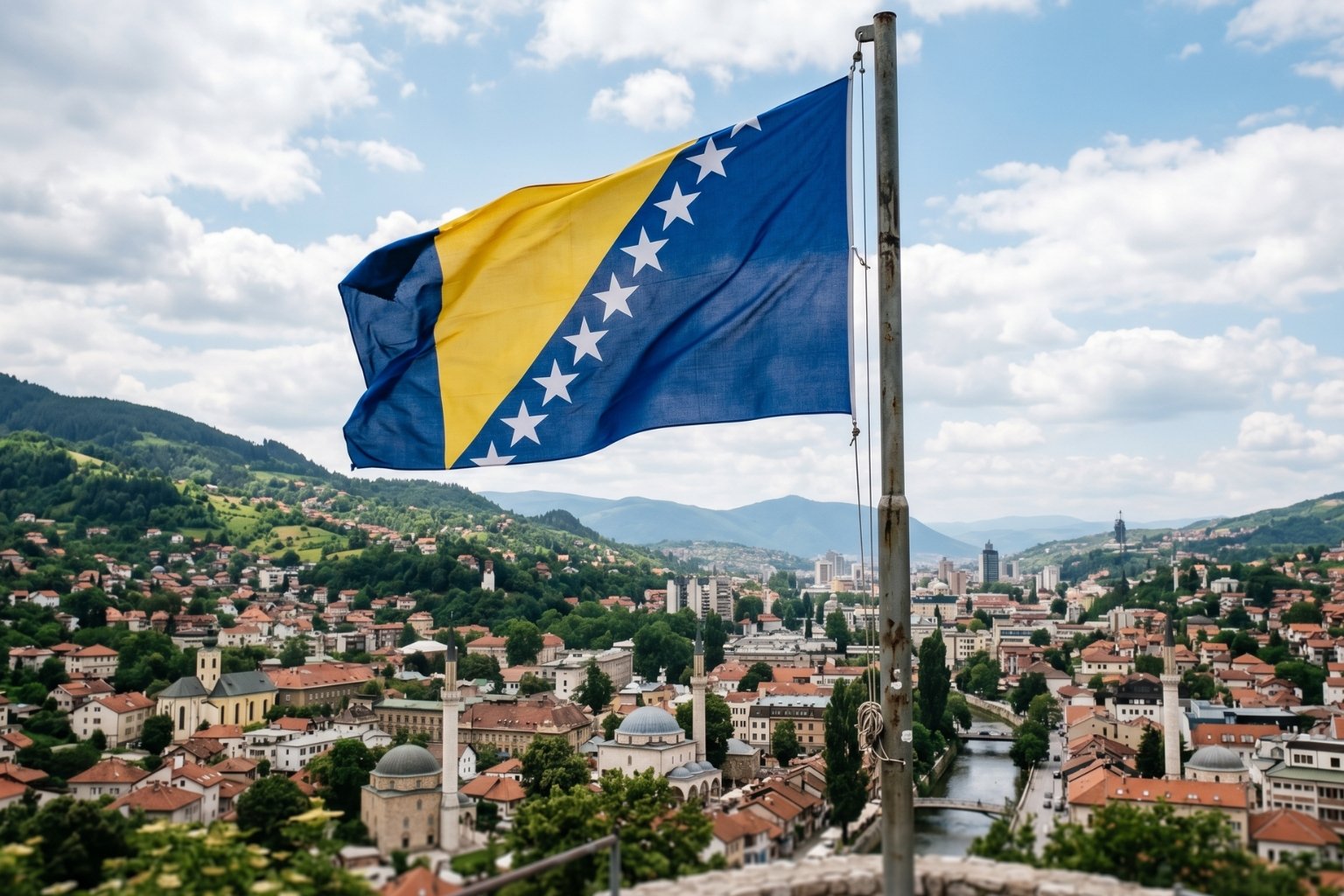
The current flag features a deep blue field crossed diagonally by a yellow isosceles triangle. Running along the hypotenuse of that triangle is a vertical line of nine five-pointed white stars. The two stars at the very top and bottom of the line are cut off by the edges of the flag, appearing as half stars.
The proportions are 1:2, making it a wide, horizontal banner. The triangle sits flush against the top edge and the hoist side, its third point reaching toward the center of the flag. The overall design is geometric, clean, and immediately identifiable among European national flags.
The Meaning of the Colors and Symbols
Blue: A Deliberate Nod to Europe
The dominant blue of the flag was not chosen at random. It directly echoes the blue of the European Union flag and the Council of Europe, signaling Bosnia and Herzegovina’s orientation toward European integration. This was a political statement embedded in the design from the start, a visual declaration of direction in a country emerging from a devastating conflict. The shade is closer to the EU blue than to any historical Bosnian color, which itself tells a story.
The Yellow Triangle: Three Peoples, One Territory
The yellow triangle carries a double meaning that rewards a second look. Its three corners represent the three constituent peoples of the country: Bosniaks, Croats, and Serbs. Each angle stands for one of these communities, meant to suggest equal weight and mutual belonging within a single frame.
At the same time, the triangular shape mirrors the actual geographic outline of Bosnia and Herzegovina on a map. The country’s territory forms a rough triangle, so the symbol works both as a political statement and as a geographic reference. Yellow was chosen for its associations with sunlight, optimism, and a new beginning after years of war.
The White Stars: Continuity Without End
The nine white stars running diagonally along the triangle’s longest side are directly inspired by the stars on the European flag. They are not meant to represent a fixed number of regions, ethnic groups, or historical moments. The two truncated stars at the edges are there deliberately. The design implies that the sequence continues beyond the fabric of the flag itself, a symbol of openness, forward motion, and an ongoing journey rather than a fixed destination.
A History Written in Flags
The Medieval Lily and the Kotromanić Dynasty
The oldest significant flag associated with Bosnia dates to the medieval kingdom. The coat of arms of the Kotromanić dynasty, the ruling family from the 14th to the 15th century, featured six gold fleurs-de-lis on a blue shield crossed by a white diagonal band. This emblem is most closely associated with King Tvrtko I, who ruled from 1377 to 1391 and brought the Bosnian kingdom to its greatest territorial extent. The gold lily, or ljiljan, became a lasting symbol of Bosnian identity and would resurface seven centuries later at a critical historical moment.
Five Centuries Under Ottoman Banners
When the Ottoman Empire conquered Bosnia in 1463, the medieval symbols fell out of official use. For nearly five hundred years, the territory was administered under Ottoman governance, and the flags that flew over it reflected that power: green banners with white or gold crescents and stars, used by local governors and landowners. Records from Mostar dating to 1760 describe Bosnian landlords using a green flag with a white crescent and star pointing to the left, distinct from the standard Ottoman flag in both size and orientation.
During the Bosnian revolt of 1830 to 1832, led by Husein Gradaščević in pursuit of autonomy from Istanbul, a green flag with a yellow crescent and five-pointed star was carried by the rebels. It was a symbol of Bosnian ambition within, and eventually against, the Ottoman framework.
Austro-Hungarian Administration and Yugoslav Identity
Bosnia and Herzegovina formally left Ottoman rule in 1908 when it was annexed by the Austro-Hungarian Empire. The empire used a bicolor banner of red and gold with a coat of arms at its center to represent the territory. When Austria-Hungary collapsed after the First World War and Bosnia became part of the Kingdom of Yugoslavia, its distinct symbols were folded into the larger Yugoslav identity.
Under communist Yugoslavia from 1946 onward, the Socialist Republic of Bosnia and Herzegovina flew a red banner with a small version of the Yugoslav national flag in the upper corner. The three-color Yugoslav tricolor with its red star was the flag of the federation, and Bosnia had no independent symbol of its own. Its particular history, culture, and ethnic complexity were subsumed beneath a shared socialist identity.
Independence and the Gold Lily Flag (1992 to 1998)
When Bosnia and Herzegovina declared independence on March 1, 1992, the new government faced an immediate problem: there was no flag that all communities could accept. The Bosniak-dominated government reached back into medieval history and adopted the Kotromanić coat of arms as its national symbol, white background with the gold lily shield that had represented the Bosnian kingdom six centuries earlier.
The choice was historically resonant but politically combustible. Bosnian Serbs and Croats rejected the symbol outright, seeing it as exclusively Bosniak rather than shared. As the country slid into civil war, the gold lily flag flew over a deeply fractured nation. It was recognized internationally but it never succeeded as a unifying emblem.
1998: A Flag Imposed from Outside
This is the detail most accounts leave out or gloss over. The current flag of Bosnia and Herzegovina was not designed by a Bosnian government committee, approved by a popular vote, or debated and agreed upon by the country’s parliament. It was imposed.
After the Dayton Peace Accords of 1995 brought the war to an end, the accords called for a new national flag that could represent all three constituent peoples without privileging any one group. The multiethnic parliament was tasked with agreeing on a design. It could not. Years of attempted negotiations produced no consensus.
In February 1998, Carlos Westendorp, the Spanish diplomat serving as the High Representative for Bosnia and Herzegovina, the international official appointed to oversee the implementation of the peace agreement, exercised his authority and unilaterally imposed the current design. The flag was officially adopted on February 4, 1998.
The designer was a staff member of the Office of the High Representative. The goal was a flag that contained no historical Bosnian, Serbian, or Croatian symbols, no references to any single community’s religious or cultural tradition, and no colors that could be claimed exclusively by any one group. The result was a flag that belonged to no one’s past and was meant to belong to everyone’s future.
A Symbol Between Aspiration and Distance
The flag achieves its neutrality but at a cost that remains visible today. A significant portion of the Bosnian Serb community does not identify with it and uses the flag of the Republika Srpska, the Serb-majority entity within the country, in preference. Many Bosniaks still feel a stronger attachment to the gold lily of 1992. The current flag is used officially and appears on public buildings, passports, and international stages, but the emotional connection that a national flag usually carries has been slow to develop.
This gap between official symbol and popular feeling is itself a reflection of where Bosnia and Herzegovina stands, a country whose institutions are further ahead of its communities than in most places, and where the shared future the flag points toward is still being built.
The National Coat of Arms
The coat of arms adopted on May 20, 1998, three months after the flag, follows the same design logic. It features the same blue field, the same yellow triangle, and a diagonal row of white stars, but with seven stars instead of nine. The visual language is consistent: Europe, the three peoples, and an openness to what comes next. The coat of arms appears on official documents, government seals, and diplomatic correspondence, reinforcing the same message in a different format.
What the Flag Actually Tells You About Bosnia
A flag is always a document. The flag of Bosnia and Herzegovina documents a country that had no agreed symbol of its own at the moment of independence, that fought a catastrophic war in part over competing identities, and that found its way to a national emblem not through consensus but through the intervention of an outside authority.
It also documents something else: a genuine aspiration toward Europe, toward peace, and toward a future in which three communities share a single frame. Whether the flag earns that aspiration over time is a question the country is still answering. For now, it flies, and the stars at its edges remain incomplete, pointing somewhere just beyond what can be seen.
