

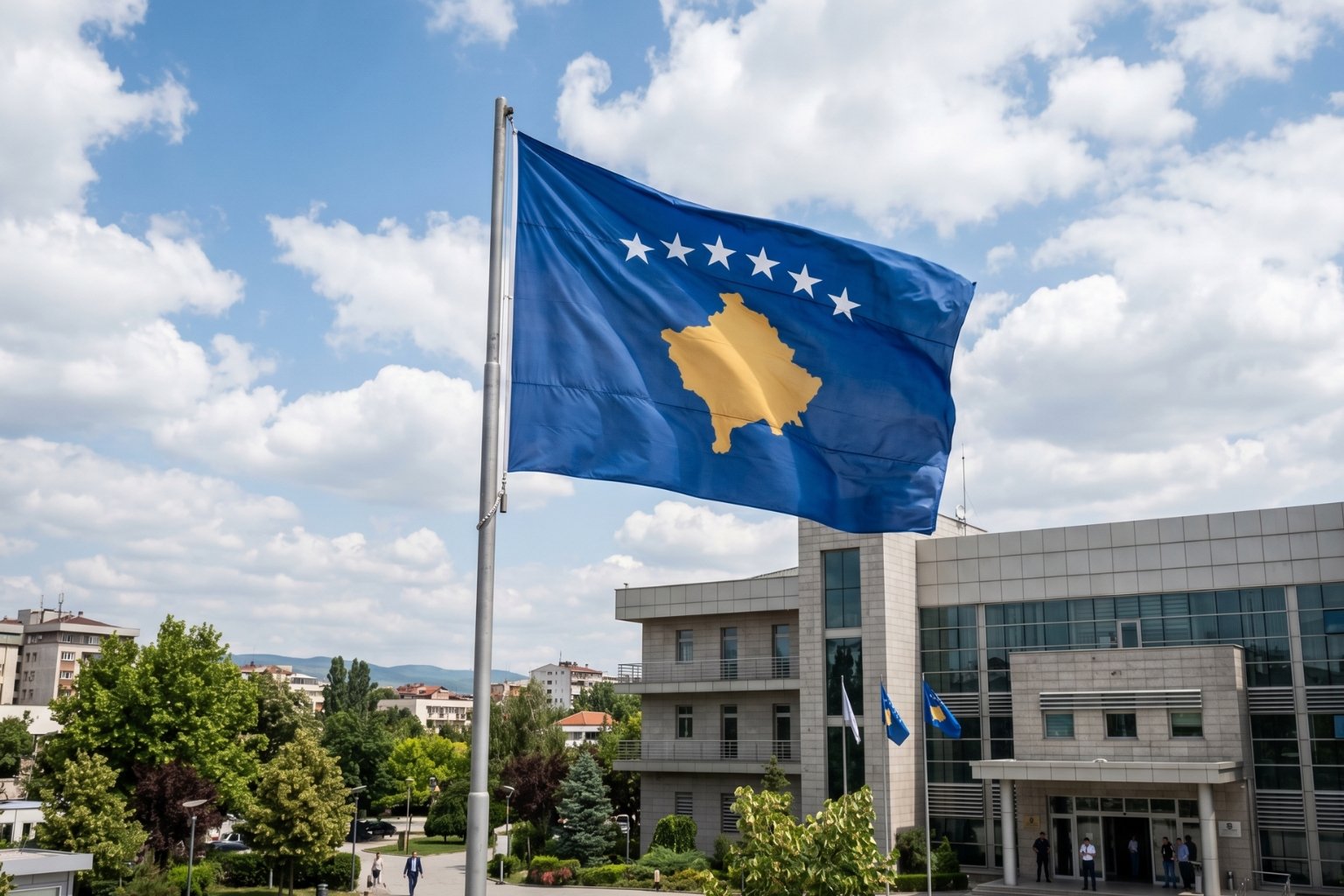

Most national flags are built from stripes, crescents, crosses, or eagles borrowed from centuries of heraldry. The Kosovo flag does something almost no other country dares: it places a map of itself at its own center. That choice is not decorative. It is a statement, made on a single extraordinary day in 2008, by a people who had spent decades without a flag to call their own.
A Flag Born on the Same Day as a Nation
On February 17, 2008, Kosovo declared independence from Serbia. Hours later, in the same parliamentary session, the Assembly of the Republic of Kosovo adopted its national flag. The two acts were inseparable by design.
This simultaneity matters. Kosovo had never held official flag status under Socialist Yugoslavia. The federal structure of Tito’s Yugoslavia granted flags only to its constituent republics, not to autonomous provinces. Kosovo, classified as an autonomous province of Serbia, had no banner of its own. Ethnic Albanians, who make up the vast majority of the population, flew the Albanian flag informally. After the 1998 to 1999 war and the subsequent NATO intervention, Kosovo passed under United Nations administration. From 1999 to 2008, the flag that flew over Kosovo’s institutions was the UN’s own light blue banner.
For nearly a decade, one of Europe’s most contested territories was represented by an international organization’s emblem. The moment a Kosovar flag rose on February 17, 2008, it carried the full weight of that absence.
The Design Competition That Shaped a Country’s Identity
Kosovo’s flag did not emerge from a government committee or a head of state’s preference. It came from an open international competition, organized by the Kosovo Unity Team, an informal body backed by the United Nations and the European Union, that received close to a thousand entries.
The brief was precise and demanding. Proposed designs had to meet strict criteria:
- No Albanian national symbols, including the double-headed eagle of the Albanian flag
- No Serbian symbols, including the red, blue, and white tricolor or the Serbian cross
- No combination of red and black, the colors of Albanian national identity
- The design had to be ethnically neutral, capable of representing all communities equally
This ruled out the most emotionally resonant options for Kosovo’s Albanian majority, who had long identified with Albanian symbols. The competition was, from the start, a political act dressed as a design exercise.
The winning entry came from Muhamer Ibrahimi, a Kosovar designer. His proposal, selected from among nearly a thousand submissions, beat out designs that had leaned more overtly toward one community or another. Ibrahimi later said the gold silhouette was chosen to represent Kosovo’s wealth, and that the blue was a deliberate nod to the Euro-Atlantic institutions Kosovo hoped to join.
There is a detail that has taken on near-legendary status in Pristina: Ibrahimi is said to have drawn inspiration from the Meridian Hotel, a building in the capital that was painted in blue and gold at the time. Whether true or apocryphal, it speaks to the deeply local roots of a symbol that was required to transcend locality.
The Colors of the Kosovo Flag and What They Mean
The Blue Field
The background of the Kosovo flag is a particular shade of blue that sits very close to UN blue and, not coincidentally, to the blue of the European Union flag. Ibrahimi confirmed this alignment was intentional. The color signals Kosovo’s aspirations toward Euro-Atlantic integration, toward the kind of institutional belonging that had been denied to it for so long.
Blue also carries the older, more universal symbolism of peace and open sky, a reading that makes particular sense for a country whose recent history included aerial bombardment and ethnic cleansing.
The Golden Map
Placing a country’s own geographic outline at the center of its flag is genuinely rare in world vexillology. Cyprus does it. Kosovo joined that small club, and the choice is worth sitting with.
The golden silhouette communicates sovereignty in the most literal terms possible: this land, this shape, this territory is ours. After decades of contested status, disputed borders, and international administration, the gesture carries real charge. Gold itself, in Ibrahimi’s own words, evokes the wealth of Kosovo, both its natural resources and its cultural depth.
The Six White Stars
Arranged in a gentle arc above the map, the six white five-pointed stars represent Kosovo’s six major ethnic communities: Albanians, Serbs, Bosniaks, Turks, Romani, and Gorani.
The arc is not incidental. Stars arranged in a line suggest ranking or sequence. An arc suggests togetherness and shared trajectory, a curved horizon rather than a hierarchy. The choice echoes, visually, the ring of stars on the EU flag, reinforcing the European aspiration embedded throughout the design.
White carries its own weight here: purity, peace, the desire for coexistence in a region where coexistence had recently collapsed into violence.
The Deliberate Erasure of Ethnic Symbols
The Kosovo flag’s neutrality is not passive. It is a considered, politically loaded decision.
Kosovo’s population is roughly 92% ethnic Albanian. The double-headed eagle on a red and black field, the symbol of Albania and of Albanian identity for centuries, would have been the instinctive choice for a large majority of Kosovars. It was precisely for that reason that the competition excluded it.
The rationale was practical: a flag that looked Albanian would make it harder to argue that Kosovo was a multiethnic state rather than a breakaway Albanian territory. It would inflame relations with the Serbian minority and complicate international recognition efforts. The flag needed to be something new, something that belonged to no prior identity.
The reaction among ethnic Albanians was divided. Some welcomed the clean break and the European symbolism. Others felt that their heritage had been erased from their own country’s most visible symbol. Ibrahimi himself acknowledged the criticism, noting that some responses were sharply negative. The flag, for all its careful neutrality, arrived into a landscape of raw emotion.
Kosovo’s Flag Before the Flag
Before 2008, Kosovo’s flag history is essentially a history of borrowed symbols.
Under Yugoslavia, ethnic Albanians in Kosovo increasingly used the Albanian national flag as a marker of identity, especially as tensions with the Serbian government grew through the 1980s and 1990s. Following the 1998 to 1999 conflict and the establishment of the UN Mission in Kosovo (UNMIK), the UN flag became the official emblem of Kosovo’s administration.
Flying another country’s flag, or an international body’s banner, is a particular kind of political condition. It signals that a territory’s identity remains unresolved, that sovereignty is provisional, that something is waiting to happen. For Kosovo, that waiting lasted nearly a decade.
The Albanian flag meanwhile never disappeared from the streets. It flew at protests, at football matches, at family celebrations. The unofficial always coexists with the official in places where the official is contested. Understanding this dual flag reality helps explain why the 2008 competition brief was so careful to exclude Albanian symbols: it was not trying to erase them, but to create a separate space alongside them.
How the Kosovo Flag Stands in the World Today
The Kosovo flag is one of the newest national flags on Earth, and it remains one of the most politically active.
Serbia does not recognize Kosovo’s independence and consequently refuses to acknowledge its flag at international gatherings and competitions. This tension surfaces regularly at sporting events, diplomatic summits, and United Nations proceedings, where Kosovo’s status as a partial member of international bodies creates procedural friction. Kosovo is recognized by over 100 countries, including the United States and most EU members, but not by Russia, China, or Serbia.
The flag’s shade of blue is sometimes referred to informally as Kosovo Blue, a term that has gained quiet traction in design and diplomatic circles. The specific CMYK values are defined in official state protocol documents, though the law governing flag usage was only formalized in 2009, a year after independence.
On February 17, Kosovo’s Independence Day, the flag fills the streets of Pristina in a way that leaves no room for ambiguity. Whatever the international disputes, whatever the ongoing negotiations with Belgrade, the flag is unambiguously present. It flies from the government buildings, from apartment windows, from cars inching through the capital. A map of a country, gold on blue, six stars in an arc.
It is a young flag. It has not yet had time to gather the patina of myth that older national symbols carry. But it was made with unusual deliberateness, by a designer working under strict constraints, for a people who had spent years without one. That deliberateness is visible in every element. Nothing on it is accidental.
