

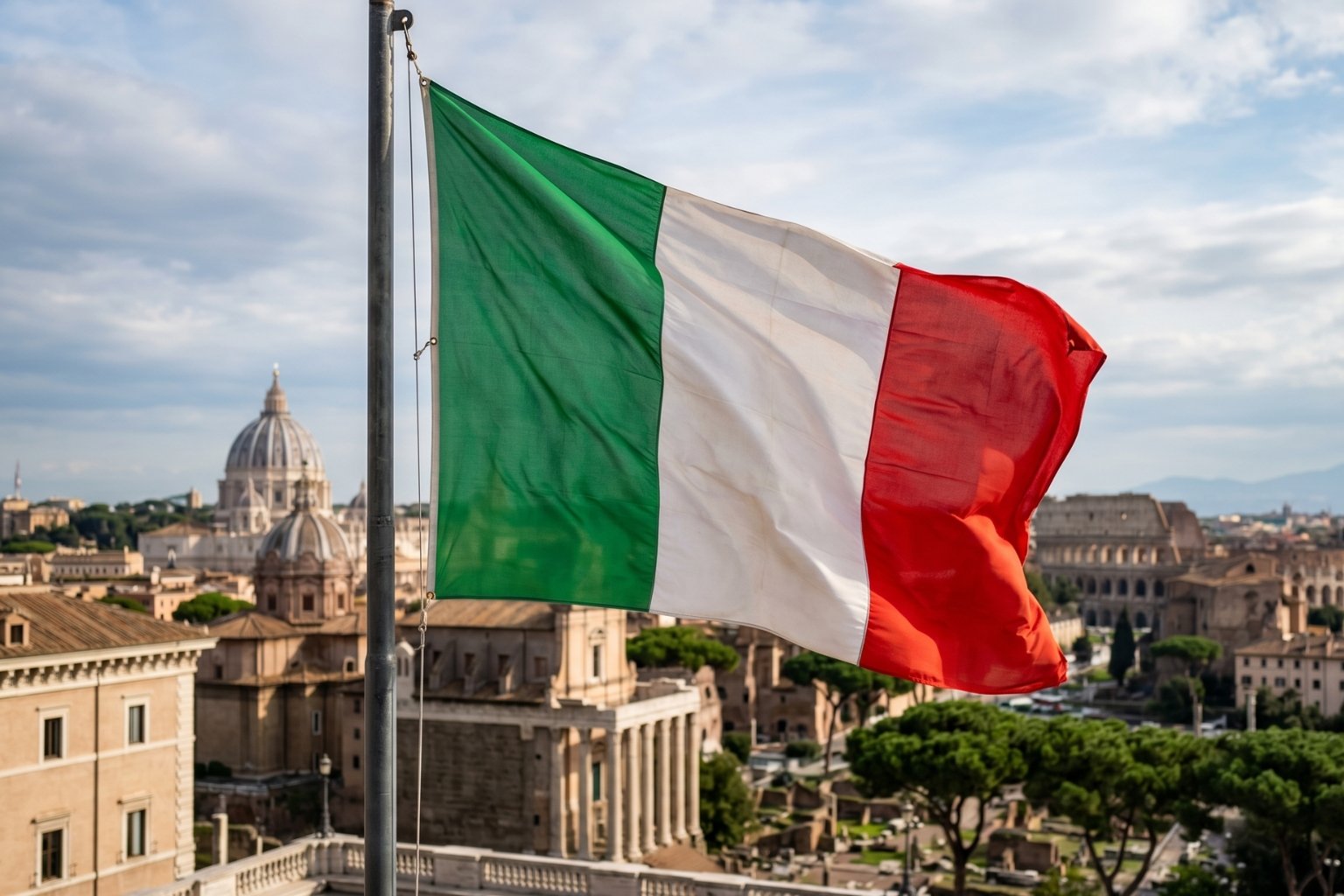

There is an irony at the heart of Italy’s national flag that no one likes to mention: one of the world’s great symbols of national identity was born under foreign occupation. The green, white, and red tricolor that Italians wave with pride at every World Cup, every parade, every moment of collective joy did not emerge from some ancient civic tradition. It was shaped, in large part, by Napoleon Bonaparte. And the meanings everyone quotes for its three colors? Those came later too, layered on like a coat of paint over a far more complicated wall.
What the Italian Flag Looks Like
The Italian flag, known in Italian as il Tricolore, consists of three equal vertical bands of color: green on the hoist side (the left, when displayed), white in the center, and red on the fly side (the right). The proportions are standardized at a ratio of 2:3, meaning for every two units of height, the flag extends three in length.
It is a vertical tricolor, which distinguishes it from the French flag (also green, white and red in spirit, but with blue instead of green, and arranged very differently in terms of national history). Its closest visual twin is the Mexican flag, a resemblance that trips up travelers and quiz contestants alike, and one worth explaining properly.
There is no coat of arms, no emblem, no inscription. Just three clean bands of color, and everything they carry.
What the Colors Actually Mean (And What They Don’t)
The interpretations everyone knows
Ask an Italian schoolchild what the colors of the flag mean, and you will likely hear one of two versions.
The poetic-religious reading: green for hope, white for faith, red for charity. A tidy echo of the three theological virtues, popular with those who like their national symbols to feel eternal and ordained.
The landscape reading: green for the rolling hills and plains of the peninsula, white for the snow-capped Alps, red for the blood shed in the wars of unification. More visceral, more modern, and arguably more Italian in temperament.
Both versions circulate freely. Both appear in school textbooks, tourist brochures, and official-sounding websites. Neither is historically accurate as an origin story.
What the colors actually came from
The honest answer is simpler and more interesting than any of the poetic versions.
The red and white came from the flag of Milan, the city whose civic colors had represented the region for centuries. The green came from the color of the uniforms worn by the Milanese civic militia, the urban guards who kept order in the city in the late 18th century. When revolutionary republican governments began forming in northern Italy under French influence in 1796, they needed symbols. They reached for what was already there.
The symbolism was applied afterward, by generations of Italians who needed their flag to mean something beyond the accidents of military history. That is not dishonesty. That is how flags work. But knowing the real origin makes the Tricolore feel more human, more contingent, and ultimately more remarkable for having lasted.
The Origins of the Italian Flag
1796: The militia of Milan and the first green, white, and red
The earliest documented use of green, white, and red together as a national symbol dates to October 9, 1796, when the colors appeared on the cockade (the small circular badge worn on hats) of the Transpadane Republic, a short-lived French client state in Lombardy. The colors were drawn directly from the uniforms of Milan’s urban militia. This was not yet a flag, but it was the first time these three colors formally represented a political entity on Italian soil.
January 7, 1797: The day that made it official
The decisive moment came a few months later, in the small Emilian city of Reggio Emilia. On January 7, 1797, during a congress of the newly formed Cispadane Republic (another French-sponsored state, this one covering parts of modern Emilia-Romagna), a deputy named Giuseppe Compagnoni stood up and proposed that the republic adopt an official flag of three colors: green, white, and red.
The proposal passed unanimously. The Cispadane Republic became the first sovereign Italian state to formally adopt the tricolor. The original design used horizontal stripes, with the republic’s coat of arms at the center.
January 7th is now celebrated in Italy as Festa del Tricolore, a national day honoring the flag.
From horizontal to vertical
When the Cispadane Republic merged with neighboring territories to form the larger Cisalpine Republic later that same year, the flag was redesigned. The stripes were rotated from horizontal to vertical, creating the layout that has defined the Tricolore ever since. The reason was partly practical, partly aesthetic, and partly an echo of the French model, whose vertical tricolor had already become a visual template for revolutionary governments across Europe.
The Flag Through Two Centuries of Italian History
The Napoleonic era and its mutations
Between 1797 and 1814, the Tricolore went through a series of transformations that reflect the instability of the period. The Italian Republic (1802 to 1805) used the same three colors but arranged them in a striking geometric pattern: a red field, a white lozenge, a green square at the center. When Napoleon crowned himself Emperor and the Italian Republic became the Kingdom of Italy, the design changed again, this time gaining a Napoleonic eagle at its center.
These variants were short-lived. When Napoleon fell in 1814, most of them fell with him. But the core color combination survived, embedded in the memory of a generation that had lived through revolution.
The Risorgimento: the flag becomes a cause
From 1814 to 1861, the Tricolore led a double life. Officially, it belonged to no state. In practice, it had become the emblem of Italian nationalism, the visual rallying point of the Risorgimento, the long, painful movement to unify the fragmented Italian peninsula into a single sovereign nation.
Revolutionaries carried it. Poets wrote about it. Governments banned it in territories under Austrian or papal control, which only made it more powerful.
When Italy was finally unified in 1861 under King Vittorio Emanuele II and the House of Savoy, the tricolor became the official flag of the new kingdom. One element was added: the Savoy coat of arms, a white cross on a red shield, placed at the center. The flag would carry that emblem for the next 85 years.
Fascism and the Second World War
The Savoy tricolor remained Italy’s flag through the fascist period under Benito Mussolini, from 1922 to 1943. The regime did not change the flag’s basic design, though it surrounded the national symbol with its own imagery and iconography at every opportunity. The Tricolore itself survived, but the context in which it flew was transformed beyond recognition.
1946: The flag is made clean again
In June 1946, Italians voted in a referendum to abolish the monarchy and establish a Republic. The House of Savoy was expelled. With it went the coat of arms that had sat at the center of the flag for nearly a century.
The decision to return to a plain tricolor was deliberate and significant. The young Republic wanted a flag with no dynastic associations, no emblem tied to a regime or a royal house. Three colors. Nothing more.
The modern Italian flag was formally adopted on January 1, 1948, when the republican constitution came into force. It has not changed since.
Italy vs Mexico: Why the Two Flags Look So Similar
The Italian and Mexican flags are frequently confused, and understandably so. Both are vertical tricolors of green, white, and red, in exactly that order. Side by side without context, they are nearly identical at a distance.
The explanation lies in timing, not coordination. Both flags drew inspiration from the same source: the French Revolutionary tricolor, which swept across the Western world in the late 18th and early 19th centuries as the visual shorthand for liberty and republican government. Mexico’s independence movement (1810 to 1821) and Italy’s early republican experiments (1796 to 1802) both reached for the French template and happened to land on overlapping color combinations.
The clearest way to tell them apart: the Mexican flag bears a coat of arms at its center, a complex emblem depicting an eagle on a cactus devouring a serpent, rooted in Aztec mythology. The Italian flag has nothing at its center. Just white. That absence is, in its own way, a statement.
The Tricolore Today
The Italian flag is one of those rare national symbols that genuinely generates emotion, not just recognition. It appears on government buildings, at Serie A matches and Azzurri rugby games, draped from apartment windows during moments of national joy or grief, worn by athletes at the Olympics, and carried in the luggage of millions of Italians living abroad who want to keep something of home within reach.
On June 2nd, the Festa della Repubblica, towns and cities across Italy fill with flags. The date marks the 1946 referendum. It is not just a celebration of the flag but of the political choice the flag now represents: the decision to become a republic, to strip away the crown, and to start again with three plain colors and a constitution.
For a country with as layered and contested a history as Italy, a flag that carries that much meaning in that much simplicity is something close to a small miracle.
