

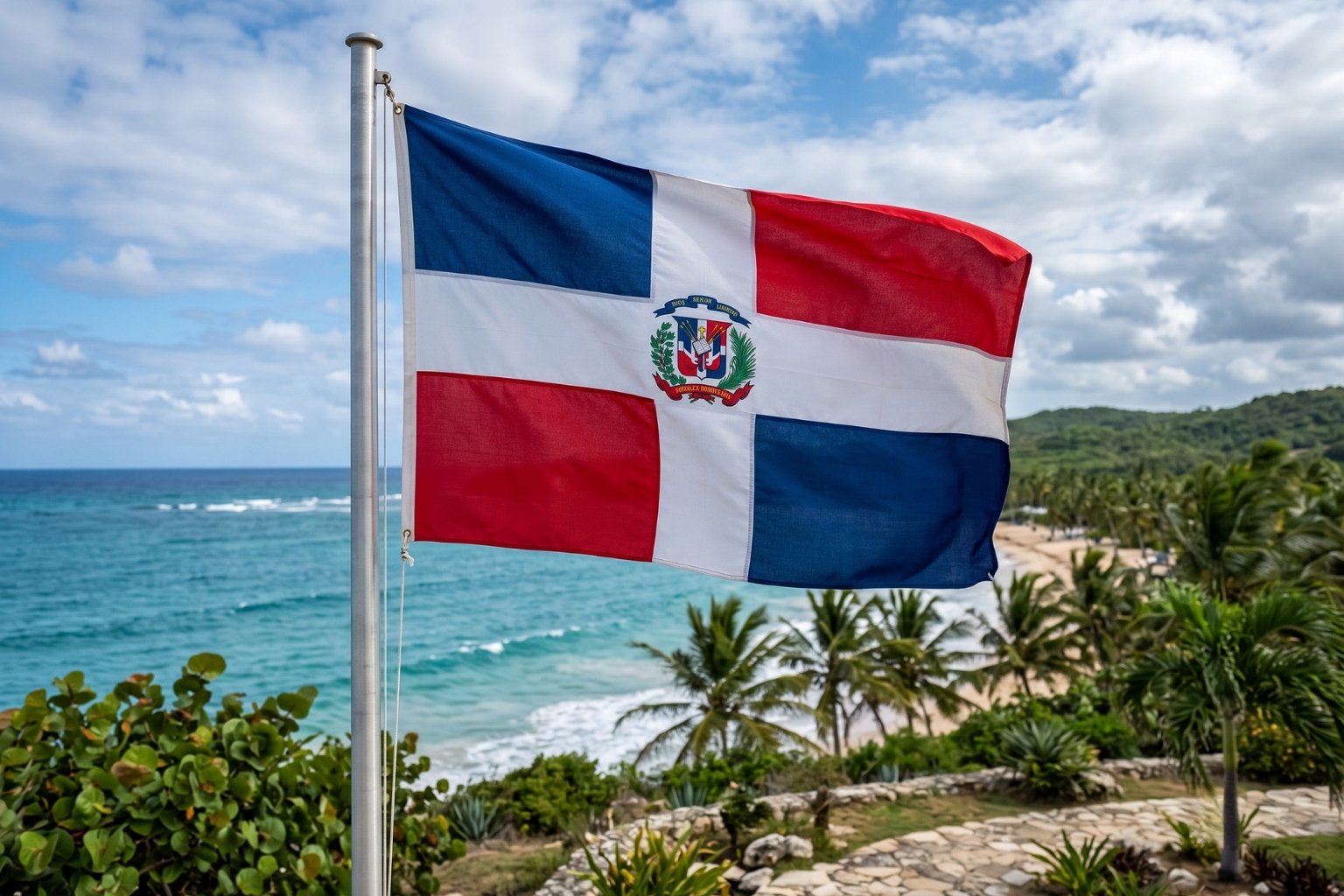

It is the only national flag in the world with a Bible printed on it, open to a verse about truth. Fly over Santo Domingo’s Malecón or watch a baseball game in Washington Heights and you will see it everywhere, red, white and blue quarters split by a bold cross. Behind that design sits one of the Caribbean’s most layered independence stories, born from occupation, faith and a small group of revolutionaries who met in secret.
What the Dominican Republic Flag Looks Like
The flag is built around a large white cross that stretches to all four edges, dividing the field into four equal rectangles. The upper left and lower right rectangles are ultramarine blue, while the upper right and lower left are vermilion red, creating an alternating pattern rather than two solid halves.
At the very center of the cross sits the national coat of arms, small but dense with symbolism. The official proportions set the flag’s width at two thirds of its length, and the blue rectangle always sits closest to the hoist, the side attached to the pole.
What Each Color Means
Every color on the flag carries a specific meaning tied to the country’s fight for independence, and Dominicans learn this reading from childhood.
- Blue represents liberty and, in the traditional interpretation, God’s protection over the nation
- Red stands for the blood shed by the heroes and martyrs of the independence struggle
- White symbolizes peace, unity and salvation, echoed in the cross that carries it across the whole flag
Historical sources describe two slightly different readings of blue and red, both still taught today.
| Color | Common interpretation | Alternative interpretation |
|---|---|---|
| Blue | Liberty and divine protection | The liberators’ fight toward a free future |
| Red | Blood of the fallen heroes | Blood of fighters during the war of independence |
| White | Peace, salvation, unity | Care and protection of the nation by God |
The Coat of Arms, Explained Piece by Piece
The coat of arms is where the flag stops being decorative and starts telling a full story. Every element was written into the Dominican constitution with a precise meaning.
- Open Bible, turned to John 8:32, the source of truth the nation is built on
- Gold cross, placed above the Bible, marking Christian faith and sacrifice
- Six spears, three on each side, standing for the defense of the nation
- Laurel branch on the left, symbol of victory and glory
- Palm branch on the right, symbol of peace and freedom
- Blue ribbon at the top, carrying the national motto Dios, Patria, Libertad, God, Fatherland, Liberty
- Red ribbon at the bottom, bearing the words República Dominicana
Where the Flag Comes From
The Haitian Flag as a Starting Point
Christopher Columbus reached Hispaniola in 1492 and claimed it for Spain. French colonists later built a separate colony in the western part of the island, which became Haiti, while the eastern, Spanish speaking side kept its own identity for centuries.
In 1822, the newly independent Republic of Haiti took control of the eastern territory. Haiti’s national flag at the time used horizontal blue and red stripes, and that design became the raw material for what Dominicans would later transform into their own emblem.
La Trinitaria and the White Cross
A small underground movement called La Trinitaria, founded in 1838 by Juan Pablo Duarte, wanted full independence rather than another form of occupation. To mark the new nation’s Christian identity, the group placed a white cross over the existing blue and red field, splitting it into four separate rectangles instead of stripes.
February 27, 1844
The revolution broke out on February 27, 1844, and the flag designed within La Trinitaria was raised the very next day at the Puerta del Conde in Santo Domingo. That date is still celebrated as Independence Day, the moment the Dominican Republic separated from Haitian rule.
The 1849 Redesign
The first version of the flag lacked a coat of arms and arranged its blue and red rectangles differently. In 1849, the design was reworked into the alternating pattern used today, and the national coat of arms was added at the center, giving the flag the layered look it has kept ever since.
Independence Day and Restoration Day: Why the Flag Flies Twice a Year
Most visitors assume the flag only marks one historical moment, but Dominicans actually celebrate two separate national days tied to it. February 27 honors independence from Haiti in 1844. August 16 honors the War of Restoration, when Dominicans ended a brief return to Spanish rule and reclaimed full sovereignty in 1865.
Understanding both dates changes how you read the flag once you are actually there. What looks like a single patriotic symbol is really a record of two separate fights for the same freedom, decades apart.
The Flag Beyond the History Books
Walk through Santo Domingo and the flag is not tucked away in museums, it is part of daily life. It hangs over government buildings, snaps above baseball stadiums during a Sunday game, and lines the Malecón during national holidays.
The same pride travels well beyond the island. In New York’s Washington Heights, home to one of the largest Dominican communities outside the country, the flag appears on stoops, storefronts and car windows year round, not only on Independence Day. For a traveler, noticing where and how often the flag shows up is often a faster way into Dominican identity than any museum plaque.
Quick Facts
| Detail | Information |
|---|---|
| Adopted | November 6, 1844, current design since 1849 |
| Designer | Juan Pablo Duarte, coat of arms by Casimiro Nemesio de Moya |
| Proportions | 2:3 |
| National motto | Dios, Patria, Libertad |
| Independence Day | February 27 |
| Restoration Day | August 16 |
