

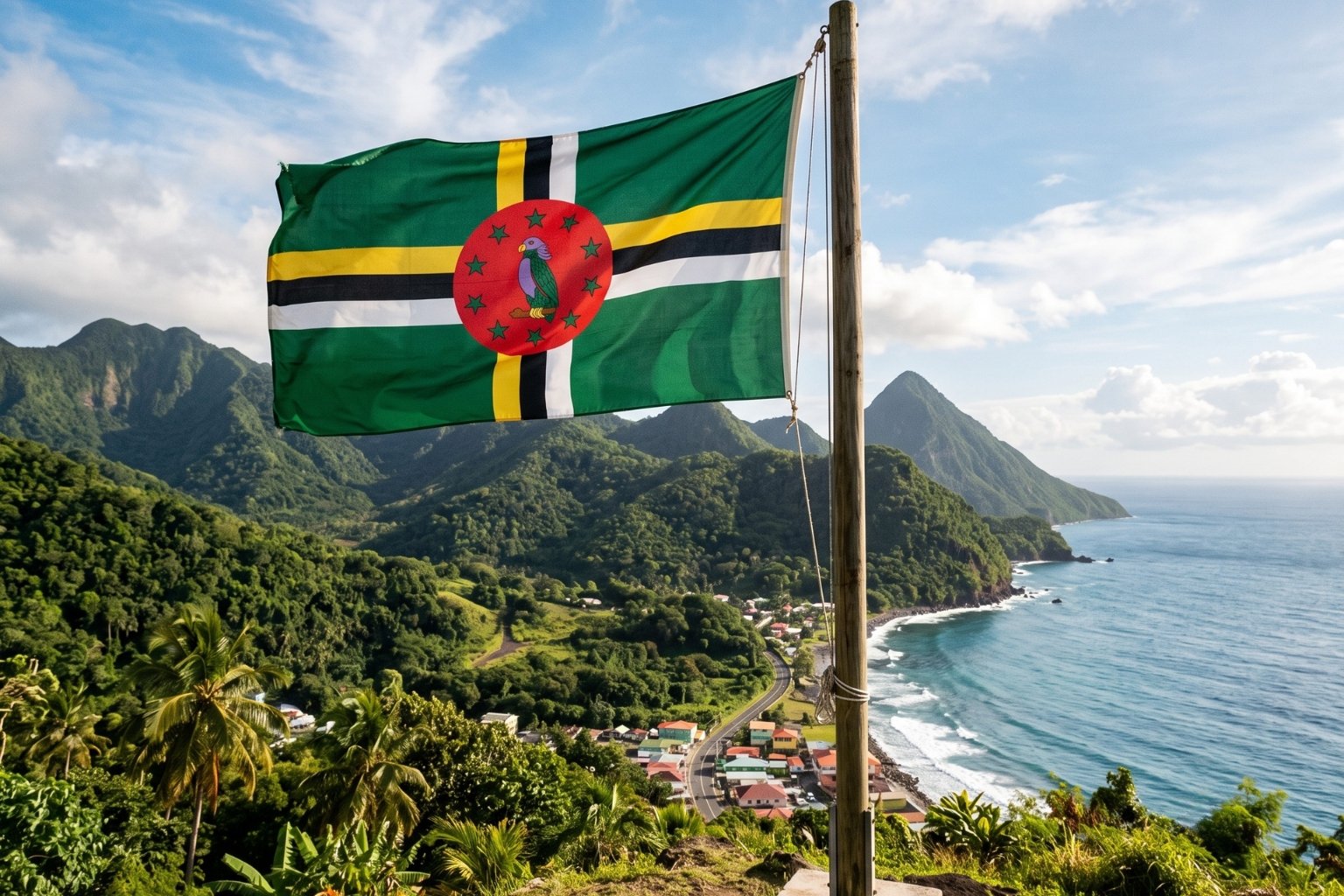

Somewhere between the airport and the first bend into the rainforest, most visitors catch their first glimpse of it: a deep green field with a cross of yellow, black and white, and a parrot inside a small red circle at its center. The Dominica flag’s colors, meaning, history and origin all trace back to this small, mountainous island in the Eastern Caribbean, and none of it is decorative. Every color and symbol was chosen to say something about the land, the people and a parrot found nowhere else on Earth.
What Does the Dominica Flag Look Like
The flag is a rectangle twice as wide as it is tall. Its background is a deep forest green, crossed from edge to edge by three narrow bands of yellow, black and white arranged like a plus sign. At the very center sits a red disc holding an image of a parrot in profile, surrounded by ten small stars, each with five points, colored green and outlined in yellow.
The Meaning Behind Every Color and Symbol
Nothing on this flag is filler. Each element was chosen during Dominica’s preparation for independence, and each one still means exactly what it meant in 1978.
The Green Background
Dominica calls itself the Nature Island of the Caribbean, and the flag’s green background is the reason why. It represents the island’s rainforest cover, among the densest and best preserved in the entire Caribbean, and the general lushness that greets every visitor who leaves the coast for higher ground. Hike into Morne Trois Pitons National Park, a UNESCO World Heritage site, and the color stops feeling symbolic and starts feeling literal.
The Cross of Yellow, Black and White
The cross running through the green field represents Christianity and the Holy Trinity, a nod to the deep religious tradition on the island. Each of its three bands also carries its own separate meaning. Yellow stands for sunshine and for the citrus and banana crops that shaped Dominica’s agricultural economy, and it also honors the Kalinago and Arawak peoples, the island’s first inhabitants. Black represents the fertile volcanic soil that makes that agriculture possible, and it also acknowledges the African ancestry of the majority of Dominicans today. White stands for the clarity of the island’s rivers, of which there are said to be 365, one for every day of the year, and for the purity of the nation’s aspirations.
The Red Disc
At the center of the cross sits a red disc, and its color speaks to social justice and equality, values written into Dominica’s national identity from the very start.
The Sisserou Parrot
Inside that red disc is the island’s most famous resident: the Sisserou parrot, or Amazona imperialis, found in the wild only in Dominica and nowhere else on the planet. It is critically endangered, with an estimated population of around 50 mature birds in recent counts, which makes its place on the national flag feel closer to a promise than a portrait. Its chest is colored purple, a detail that puts Dominica among a very short list of countries whose flag uses that color at all, alongside Nicaragua.
The Ten Stars
Ten small stars circle the parrot, and each one stands for one of Dominica’s ten parishes, from Saint George in the south, home to the capital Roseau, to Saint Andrew in the northeast. It is a detail most flag guides skip entirely, but it is the clearest sign that this design was built around the island’s own geography rather than a generic template.
A Brief History of the Flag
For most of its colonial history, Dominica did not have a flag of its own. Like other British Windward Islands, it flew a blue ensign with the Union Jack in the corner and a colonial badge on the fly, a design shared with several neighboring territories rather than a symbol unique to Dominica.
The origin of the flag, and the history behind it, only really begins as independence approached. A national competition was held to design a flag that could represent the island on its own terms, and the winning entry came from Alwin Bully, a Dominican playwright and artist. His concept introduced the elements that still define the flag today: the green field, the tricolor cross, the red disc and the parrot. It was officially raised for the first time on November 3, 1978, the day Dominica became independent.
How the Flag Has Changed Since 1978
The core design has stayed remarkably stable since independence, but two rounds of small adjustments have taken place over the years.
| Year | Change |
|---|---|
| 1978 | Original flag adopted at independence, designed by Alwin Bully |
| 1981 | Order of the black and white bands in the cross rearranged, and a yellow outline added around the stars |
| 1988 | Direction the parrot faces was reversed |
Fun Facts Worth Knowing
- Dominica is one of only two countries whose national flag includes the color purple, the other being Nicaragua.
- The flag’s proportion is twice as wide as it is tall.
- Dominica is often confused with the Dominican Republic, but the two flags share nothing in common. The Dominican Republic’s flag is blue and red split by a white cross, with no green, no parrot and no purple anywhere on it.
- The Sisserou parrot on the flag also appears on Dominica’s coat of arms and holds the title of national bird.
Where You’ll See the Flag in Dominica
The flag is most visible each year on November 3, Independence Day, when Roseau fills with parades, music and the flag’s five colors worn as proudly as any national dress. Creole Day, celebrated on the last Friday of October as part of the World Creole Music Festival season, often puts the flag alongside madras patterns and Creole flags in a display of the island’s layered identity.
Away from official events, the flag tends to show up quietly: painted on a fishing boat in Portsmouth, hung outside a guesthouse in the hills above Roseau, or worn as a pin during Mas Domnik, the local Carnival and one of the last genuinely homegrown carnivals left in the Caribbean. Travelers who notice it there are, without realizing it, reading the same colors, cross and parrot explained here, carried by a very small flag with a very specific story.
