

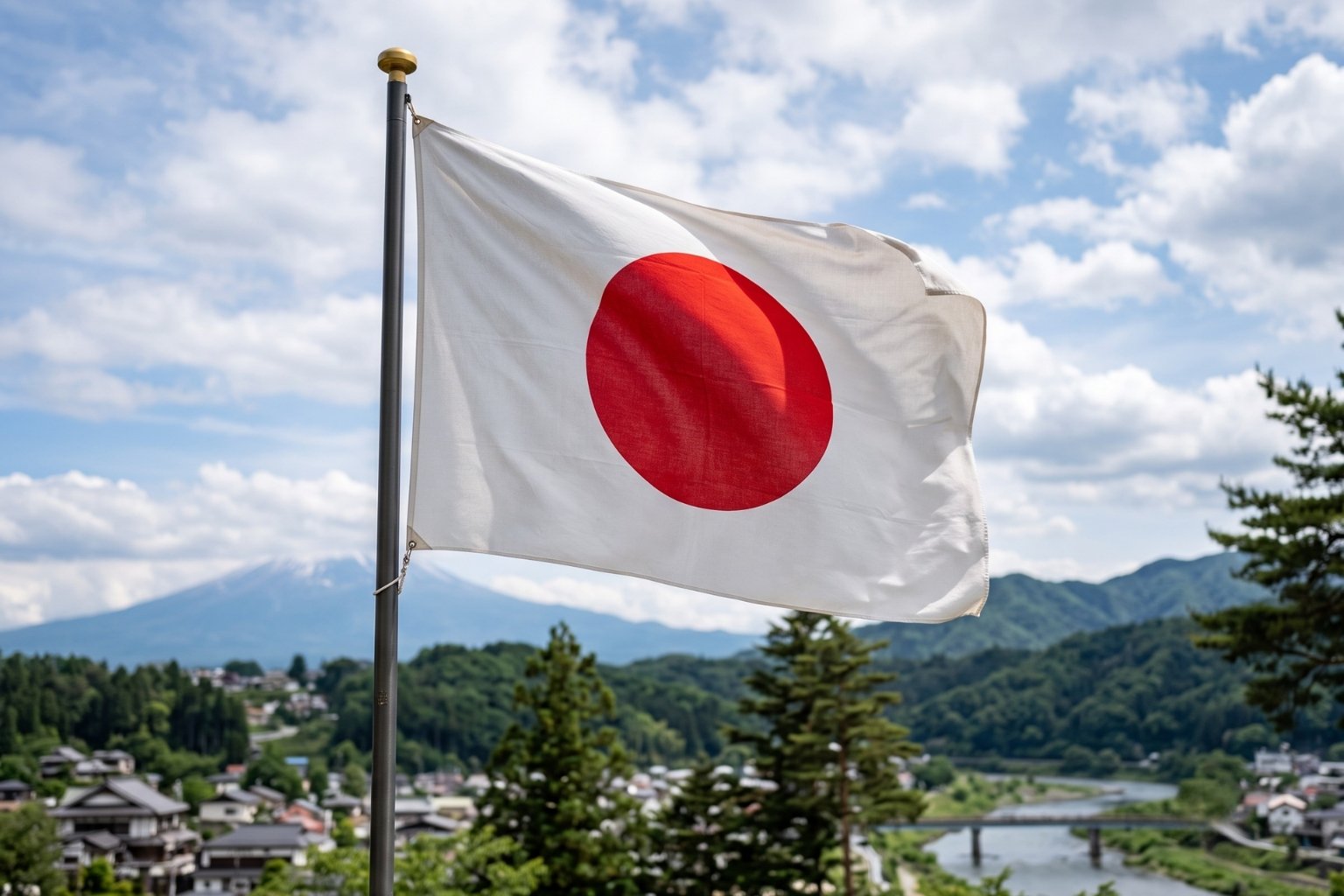

A red circle floating in a field of white. That is the entire visual vocabulary of the Japan flag, and somehow it says everything: the sun, a goddess, and a country that has called itself the Land of the Rising Sun for well over a thousand years. Behind that quiet design sits a story running from Shinto legend through samurai war banners to twentieth century politics. Here is where it actually comes from, what its colors mean, and where you will still see it flying if you know where to look.
Japan’s Flag at a Glance
| Official name | Nisshoki (flag of the sun) |
| Common name | Hinomaru (circle of the sun) |
| Design | Red disc centered on a white field |
| Ratio | 2 to 3 |
| Officially adopted | August 13, 1999, under the Act on National Flag and National Anthem |
| Represents | The sun, tied to the myth of the sun goddess Amaterasu and Japan’s imperial line |
What the Colors and Design Actually Mean
The Red Disc and the Sun
The red circle at the center is the sun, plain and direct. In Shinto belief, the sun is a living presence, and the imperial family is said to descend from Amaterasu, the sun goddess herself. Red on this flag is often read as vitality, warmth, and life force rather than aggression.
The White Field
White surrounds the disc and gives it room to breathe. It is generally understood in Japan as purity, honesty, and a kind of clean intention, values that show up constantly in Japanese art, architecture, and daily etiquette. The contrast between the two colors is the whole point.
Why the Design Stays This Simple
Nothing is added, nothing decorated. That restraint is not an accident. Japanese visual culture has long valued the idea that a single strong element, placed with care in open space, communicates more than a crowded composition ever could. The flag of Japan is a national scale example of a principle you will also notice in a tea bowl, a garden, or a piece of calligraphy.
A small curiosity worth knowing: Japan is not alone in using a plain circle on a field. Bangladesh and Palau both fly flags built the same way, though their colors carry entirely different meanings. It is a reminder that simple shapes travel across cultures even when their stories do not.
Hinomaru or Nisshoki: Understanding the Names
Nisshoki is the formal, legal name of the flag. In practice almost nobody in Japan uses it. People say Hinomaru, which translates roughly to circle of the sun, and that is the name you will hear in conversation, in schools, and in the news.
Where the Symbol Comes From
Amaterasu and the Sun Goddess Myth
Japanese mythology places Amaterasu at the origin of the imperial line, with Emperor Jimmu counted among her descendants. That single thread connects the sun to the throne, and the throne to the country itself. Even today the emperor has been referred to as the Son of the Sun, and the nickname Land of the Rising Sun grows directly out of this myth.
Emperor Monmu’s Banner in the Year 701
The earliest documented use of a sun motif flag in Japan goes back to Emperor Monmu, who is recorded as having displayed a sun banner at his court in 701. Oral tradition pushes the symbolism back even further, but this is the first solid written trace historians point to.
The Genpei War and the Origins of the Modern Design
The design closer to today’s flag has a more dramatic backstory. During the Genpei War of the late twelfth century, the ruling Taira clan fought the Minamoto clan for control of Japan. The Taira flew a red banner marked with gold and silver moons. The Minamoto answered with a plain white flag. When the Minamoto eventually triumphed and founded the Kamakura Shogunate, later generations of their line used a red circle on white as a unifying symbol, a direct ancestor of the Hinomaru we recognize now.
From Edo Merchant Ships to a National Flag
The Edo Period and Commodore Perry’s Arrival
During the Edo period, the ruling Tokugawa shogunate had merchant ships fly a red sun design to identify themselves at sea. That practical need became more urgent after 1853, when Commodore Matthew Perry’s arrival forced Japan open to foreign trade and diplomacy. Ships needed a clear national marker, and the sun flag was the natural choice.
1870 and the First Official Adoption
The Meiji government formally adopted the Hinomaru as the flag for merchant vessels in 1870, and the design’s proportions and placement were later standardized under the Meiji era’s push to modernize Japan on every front, from its military to its national symbols.
The Rising Sun War Flag Is a Different Flag
Alongside the Hinomaru, a second design emerged: the Kyokujitsu-ki, or Rising Sun flag, with red rays extending outward from the disc. Adopted by the Imperial Japanese Army in 1870 and later the Navy, it became the military’s own emblem, distinct from the civilian national flag even though both share the same sun at their core.
The Twentieth Century: War and a Long Pause
The Hinomaru served as Japan’s flag through the Second World War and the years of Allied occupation that followed. During that occupation, flying it required special permission from Allied authorities, though the restrictions eased gradually. By the early 1950s, the flag had returned to schools, homes, and public buildings across the country.
1999: How Hinomaru Became Legally Official
Despite centuries of use, Japan had no formal law naming its national flag until surprisingly late. The Act on National Flag and National Anthem passed the Diet on August 13, 1999, finally giving the Hinomaru legal status alongside the anthem Kimigayo. The law followed years of quiet dispute in Japanese schools over whether the flag should be raised and saluted, a debate tied to the flag’s association with Japan’s militarist past. That tension has never fully disappeared, and it remains a sensitive topic in some classrooms today.
Hinomaru vs the Rising Sun Flag: Why the Confusion Persists
People frequently mix up the two designs, and it matters. The Hinomaru is the civilian national flag, plain and uncontroversial in most contexts. The Kyokujitsu-ki, with its sunburst rays, carries the weight of Japan’s imperial military history and remains genuinely painful in South Korea and China, where it recalls occupation and wartime aggression. A modified version with fewer rays is still used today by Japan’s Self Defense Force, which keeps the debate alive in the region.
Where You Will Actually See the Flag in Japan
Look for the Hinomaru at government buildings year round, and at national holidays across the country. It appears at sumo tournaments, raised before the day’s bouts begin, and at international sporting events wherever Japan competes. Some schools still hold morning flag ceremonies, though the practice is not universal and remains a point of quiet disagreement among educators. If you travel through a fishing port, you may spot a related sun banner flown to mark a good catch, a custom with its own separate folk tradition.
Flag Etiquette for Visitors
Treat a physical flag the way you would treat any national symbol you respect. Avoid letting it touch the ground, fold it neatly if you handle one, and display it right side up with the disc centered rather than off to one edge. Buying a small souvenir Hinomaru is entirely normal and welcomed. Exercise more care with old signed flags sold as antiques, since some were personal wartime keepsakes carrying messages for soldiers, and they deserve to be treated as historical artifacts rather than casual decor.
Frequently Asked Questions
Why is there a sun on Japan’s flag? Because Japanese mythology traces the imperial family back to Amaterasu, the sun goddess, and Japan has long called itself the Land of the Rising Sun.
Is the Japanese flag only red and white? Yes. The national flag uses exactly two colors, a red disc on a white field, with no other elements.
What is the difference between Hinomaru and the Rising Sun flag? Hinomaru is the plain civilian national flag. The Rising Sun flag adds red rays around the disc and has military origins that remain controversial in parts of Asia.
When did Japan officially adopt its flag? The Hinomaru had been used informally for over a century before it was made legally official on August 13, 1999, under the Act on National Flag and National Anthem.
