

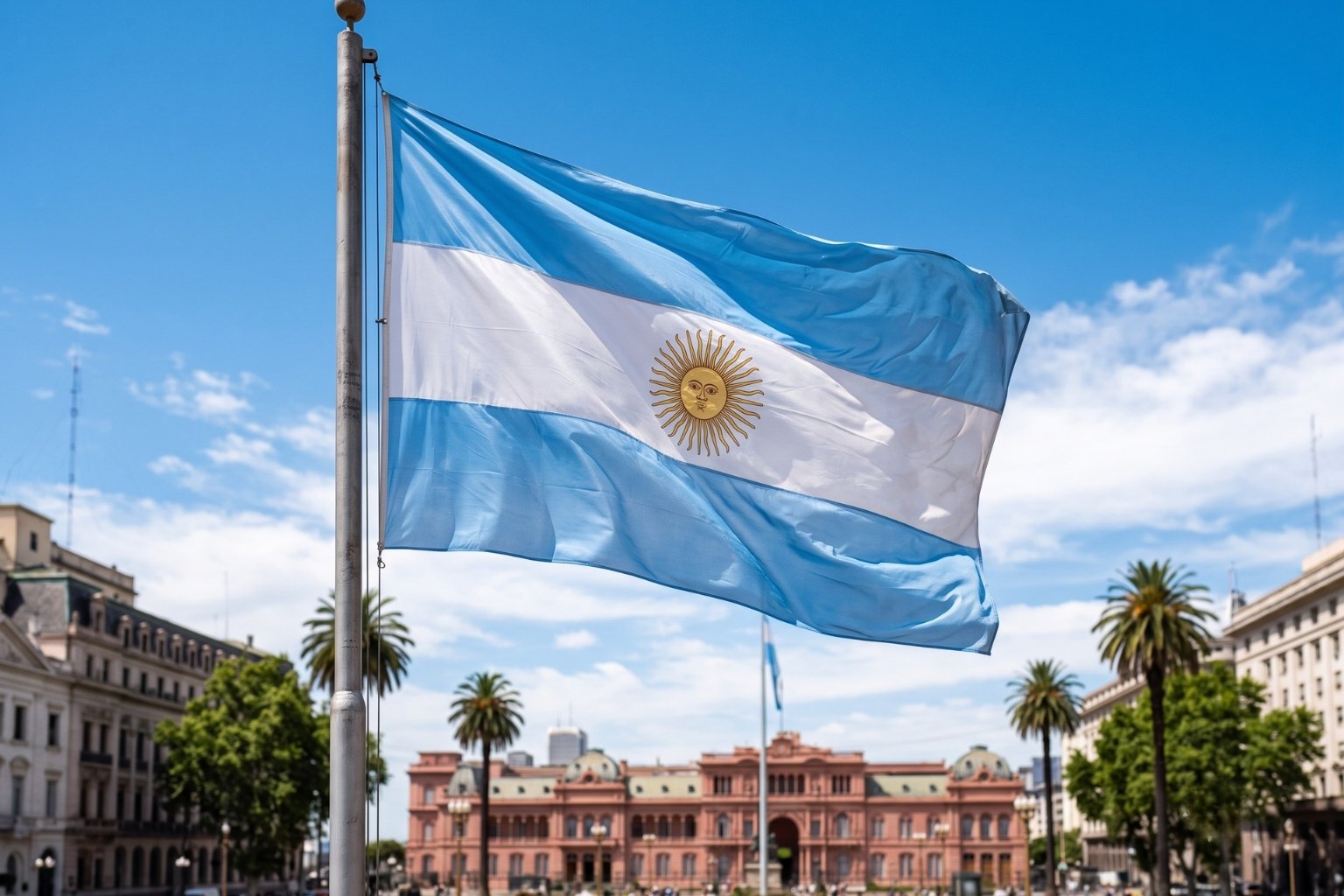

Fly into Buenos Aires and one of the first things you notice, before the steak, before the tango, before anyone mentions Messi, is a pale blue and white banner rippling over Plaza de Mayo. The colors, symbolism, and history behind the Argentina flag turn out to be more contested, and more human, than most visitors ever learn. Once you know the story, you start seeing it everywhere, on school uniforms, in football chants, on the side of a bus in Rosario.
What Does the Argentina Flag Look Like
The flag is made of three equal horizontal bands. The top and bottom bands are celeste, a soft sky blue, and the middle band is white. At the center sits the Sun of May, a golden disc with a human face, radiating 32 alternating straight and wavy rays.
There are actually two legitimate versions in circulation. The plain triband without the sun is called the civil flag, while the version with the sun is the official ceremonial flag, used by the government, the military, and on national holidays.
The Colors of the Argentina Flag and What They Mean
No official document from 1812 explains exactly why Manuel Belgrano chose celeste and white. What exists instead is a set of competing readings, each with its own defenders among Argentine historians.
Sky, Clouds and the Río de la Plata
The most popular explanation ties the colors to nature itself. Blue stands for the open Argentine sky, and white for the clouds, or in some versions the snow capping the Andes. This reading grew out of the light blue and white cockade worn by patriots during the May Revolution of 1810, two years before the flag existed.
The Disputed Theory: The House of Bourbon
A rival theory points somewhere less poetic. Some historians argue Belgrano borrowed the colors from the ribbon of the Order of Charles III, tied to the Spanish royal House of Bourbon, which also used blue and white. It is an uncomfortable idea for a flag born out of independence from Spain, which is likely why it never became the popular story.
Why Historians Still Do Not Fully Agree
The debate resurfaced repeatedly through the 19th century. Domingo Sarmiento rejected earlier confederate flag versions outright during his 1873 speech at the unveiling of the Belgrano Monument, while Bartolomé Mitre and other historians clashed over the exact original shade decades later. Nobody has ever settled it definitively, and that uncertainty is part of the flag’s charm rather than a flaw in the record.
| Theory | Blue is said to represent | White is said to represent |
|---|---|---|
| Sky and clouds | The open Argentine sky | Clouds, or Andean snow |
| House of Bourbon | Loyalty to the Spanish royal house | A shared royal color |
| Río de la Plata | The river’s waters | Silver, echoing the country’s name |
The Sun of May, Argentina’s Most Distinctive Symbol
The Sun of May was not part of the original 1812 flag. It was added six years later, on January 25, 1818, based on the engraving found on Argentina’s first minted coin.
The design shows a golden face surrounded by 32 rays, 16 straight and 16 wavy, bordered in brown. One theory, championed by historian Diego Abad de Santillán, connects it to Inti, the Inca sun god. The more commonly told story links it to May 25, 1810, when the sun is said to have broken through the clouds over Buenos Aires just as the first mass demonstrations for independence took place.
The History of the Argentina Flag
1810: The Cockade Before the Flag
Before there was a flag, there was a ribbon. Patriots in Buenos Aires began wearing light blue and white cockades during the uprisings of 1810, and the combination was formally decreed the national cockade on February 18, 1812.
February 1812: Belgrano Raises the First Flag in Rosario
Nine days after the cockade decree, General Manuel Belgrano raised the celeste and white triband for the first time, on February 27, 1812, on the banks of the Paraná River in what is now Rosario. The revolutionary government at the time still nominally claimed loyalty to the Spanish crown, so the First Triumvirate refused to formally approve the flag, even as patriot forces kept using it in battle.
1816: Independence and the Congress of Tucumán
Argentina declared independence from Spain on July 9, 1816. It was the Congress of Tucumán that finally designated Belgrano’s blue and white banner as the official national flag, ending years of informal, battlefield only use.
1818: The Sun Is Added
On January 25, 1818, Juan Martín de Pueyrredón formally established the flag bearing the Sun of May, completing the design still recognized today.
The Flags of Macha
Some of the oldest surviving Belgrano battle flags were hidden inside a chapel near the town of Macha when he judged his forces likely to be captured. They stayed hidden for more than seventy years before being rediscovered, and they remain among the most treasured artifacts tied to the flag’s early history.
2010: The Modern Redesign
The flag’s appearance was refined once more in the modern era. On November 23, 2010, a slightly darker shade of blue and a redesigned sun emblem came into official use, the version still seen today.
One Country, Two Flags: The Civil Flag and the Ceremonial Flag
For most of the 20th century, only government institutions and the armed forces were legally permitted to fly the version of the flag bearing the Sun of May. Ordinary citizens were restricted to the plain civil flag without the emblem.
That changed in 1985, when a new law granted every Argentine citizen the right to fly the full ceremonial flag with the sun. Both versions remain valid national symbols today, though the sun bearing design is the one used for official state purposes.
Where to See the Argentina Flag’s History in Person
The National Flag Memorial in Rosario
Built on the exact spot where Belgrano first raised the flag, the Monumento Nacional a la Bandera in Rosario is a sweeping riverside complex with an eternal flame and a crypt honoring Belgrano himself. For anyone road tripping between Buenos Aires and the north of the country, it is a natural stop and a far more moving experience than reading the history in a book.
Flag Day, June 20
Flag Day, or Día de la Bandera, falls on June 20 each year, the anniversary of Belgrano’s death. Schools across Argentina hold ceremonies where students formally pledge allegiance to the flag for the first time, and the celebrations in Rosario around the monument are especially worth planning a trip around if your dates line up.
The Argentina Flag’s Influence on Other Flags
Argentina’s blue, white, and sun combination did not stay within its own borders. Uruguay’s flag carries the closest resemblance, with its own Sun of May placed in a white canton, a direct legacy of the shared struggle within the former Viceroyalty of the Río de la Plata. Several Central American nations, including El Salvador, Guatemala, Honduras, Costa Rica, and Nicaragua, are also often cited as having drawn on Argentina’s early independence era flag design in shaping their own.
Quick Facts About the Argentina Flag
- Designer: General Manuel Belgrano
- First raised: February 27, 1812, in Rosario
- Declared national flag: July 9, 1816, by the Congress of Tucumán
- Sun of May added: January 25, 1818
- Sun rays: 32 total, 16 straight and 16 wavy
- Colors: Officially defined celeste (sky blue) and white, using the CIE 1976 standard
- Last redesign: November 23, 2010
- Flag Day: June 20, marking the anniversary of Belgrano’s death
