

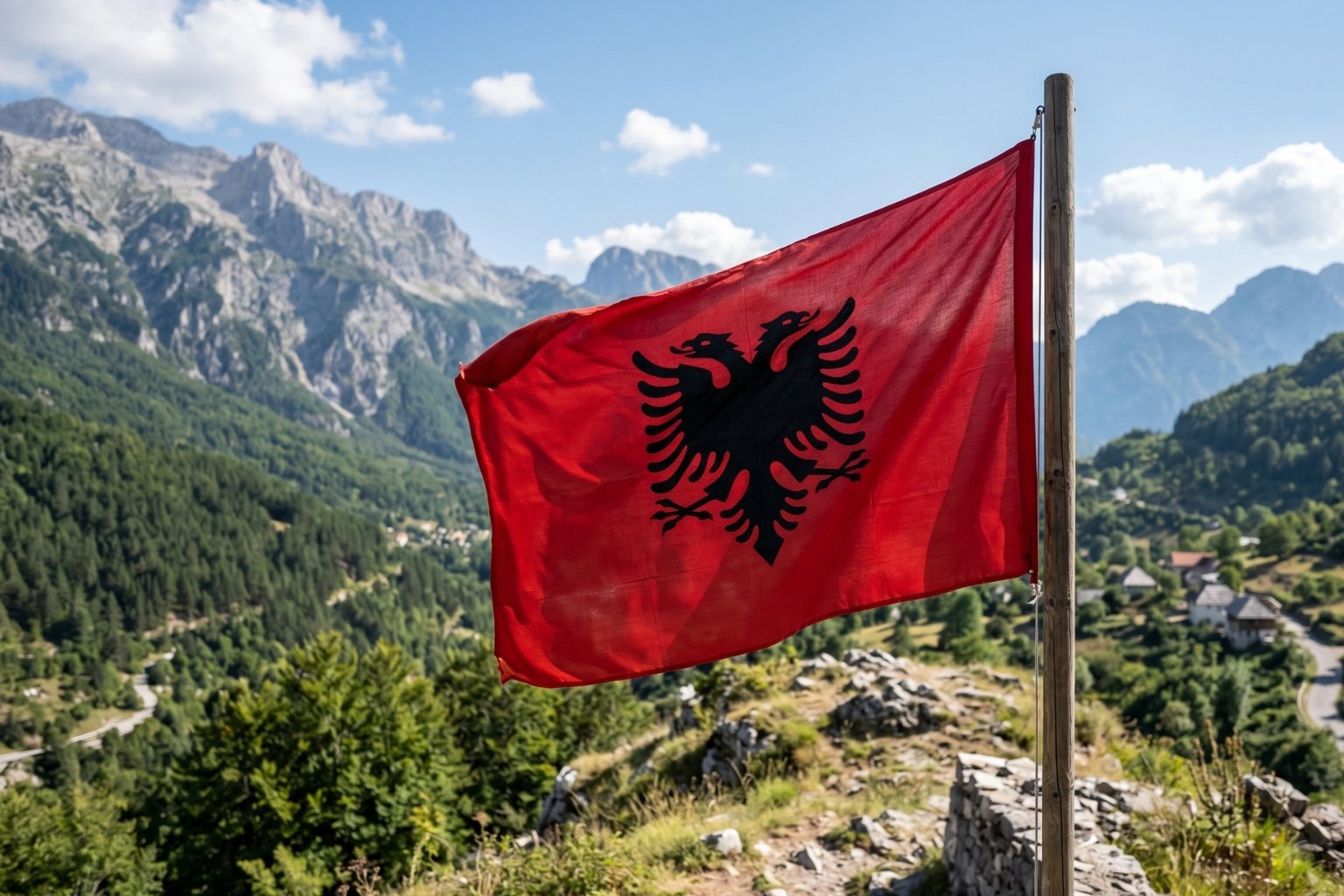

At first glance, the Albania flag is almost brutal in its simplicity. A solid crimson field. A black eagle at the center, its two heads facing opposite directions. No border, no motto, no ornament of any kind. And yet this flag is one of the most historically layered national symbols in Europe, carrying the weight of a resistance leader who died in 1468, five centuries of occupation, a communist regime that tried to stamp its own mark on it, and a post-Soviet identity crisis that ultimately resolved in the same image it started with.
What the Albania Flag Looks Like
The flag is a red field with a black double-headed eagle centered on it. Its official proportions are 5 to 7 (width to length). The eagle’s wings are spread wide, its two heads face left and right, and its talons point downward. There is nothing else. No stripes, no stars, no shield. That studied emptiness is part of its power.
The official red is close to what printers call a vivid crimson, a strong, saturated color that reads from a distance with real authority. The eagle is rendered in deep matte black, creating a contrast that is almost heraldic in its sharpness.
What the Colors Mean
Red: a war banner before it was a national flag
The red field is not a modern invention chosen for visual effect. It predates the Albanian state by centuries. When Gjergj Kastrioti Skanderbeg rallied Albanian nobles against the Ottoman Empire in the 1440s, his banner was already crimson. The color carried an immediate, visceral meaning on a medieval battlefield: blood, sacrifice, and an absolute refusal to yield.
Over time, it absorbed additional layers of meaning: bravery, the warmth of national pride, the sacrifices of generations who kept the memory of Albanian sovereignty alive even when the flag itself could not be flown openly. Red is one of the most common colors in national flags worldwide. On the Albanian flag, it earns its place through history, not convention.
Black: the color of the eagle
The black of the eagle is not mourning, and it is not defiance in the theatrical sense. In the heraldic tradition from which the Albanian symbol descends, black signifies constancy, wisdom, and vigilance. The eagle is black because it is meant to be seen, to be unmistakable, and to communicate something serious about the nature of the state it represents.
The Double-Headed Eagle: “Shqiponja”
The Albanian word for eagle is shqiponjë, and it sits at the etymological root of the country’s own name for itself. Albanians call their country Shqipëria, which translates roughly as “Land of the Eagles.” This is not a poetic nickname applied after the fact. It is a foundational self-description, a people who identified themselves through a bird long before their flag was codified.
The eagle is not on the flag because it is powerful. The eagle is the flag because it is Albania.
Origins older than Byzantium
The standard account places the double-headed eagle’s entry into Albanian identity via the Byzantine Empire, where the symbol served as a mark of imperial authority, a creature watching both East and West simultaneously. That is accurate as far as it goes. But there is compelling archaeological evidence of eagle symbolism in the Illyrian cultures that preceded the Byzantine presence in the Balkans by over a thousand years.
Stone carvings, artifacts from the royal tombs at Selça e Poshtme near Lake Ohrid, and decorative items found across the region suggest the eagle was embedded in the visual culture of these lands well before Rome or Byzantium consolidated their authority here. What Byzantium contributed was the specific double-headed form and the heraldic grammar that gave it political weight. Albanian nobles in the medieval period absorbed this tradition and made it their own. By the time Skanderbeg raised his banner, the two-headed eagle was not a borrowed symbol. It had become Albanian.
What the two heads mean
In heraldic tradition, the two heads of the eagle facing in opposite directions carry a cluster of meanings: dual sovereignty, the capacity to rule and watch over two realms at once; vigilance, the sense that nothing approaches unseen; and a kind of geopolitical self-awareness specific to a small nation located at a crossroads, surrounded by larger ambitions.
Albania sits at the meeting point of the Orthodox East and the Catholic West, of the Adriatic coast and the Balkan interior. The eagle’s two gazes, outward in both directions, are a remarkably precise description of the country’s strategic reality across every century of its existence.
Skanderbeg and the Birth of the Flag
Gjergj Kastrioti, known to history as Skanderbeg, was born around 1405 into a noble Albanian family and sent as a hostage to the Ottoman court, where he was raised as a Muslim and trained as a military commander. In 1443, he defected, converted back to Christianity, and returned to take the fortress of Krujë from Ottoman control. On November 28, 1443, he raised a red flag bearing a black double-headed eagle from its walls. That date is now Albania’s independence day.
What followed was one of the more astonishing military feats of the 15th century. Skanderbeg united Albanian nobles under the League of Lezhë in 1444 and held off Ottoman forces for 25 years, winning battle after battle against an empire that had swept through the Balkans almost without resistance. The eagle became the rallying symbol of that resistance, displayed across a dozen Albanian clans whose other loyalties and disputes ran deep.
Skanderbeg died in 1468. Within ten years, Albania had fallen to the Ottomans. But the flag did not disappear. It went underground, carried in collective memory, in folklore, in the oral traditions of a people who had lost their sovereignty but not their sense of who they were.
Five Centuries of Change, One Symbol That Survived
| Period | Regime | Change to the flag |
|---|---|---|
| 1443 to 1468 | League of Lezhë (Skanderbeg) | Original red field with black double-headed eagle |
| 15th to 19th century | Ottoman occupation | Flag banned publicly; eagle preserved in craft, folklore, and resistance |
| 1878 | National revival / League of Prizren | Eagle revived as central motif of the Albanian nationalist movement |
| November 28, 1912 | Independence (Ismail Qemali) | Original flag raised by hand in Vlorë, stitched by Marigo Posio |
| 1928 to 1939 | Kingdom of Albania (King Zog) | Royal crown added above the eagle |
| 1939 to 1943 | Italian fascist occupation | Crown replaced by the fasces |
| 1944 to 1991 | Communist People’s Republic (Hoxha) | Gold five-pointed star added above the eagle’s two heads |
| April 7, 1992 | Post-communist republic | Star removed; flag restored to its original, clean form |
The pattern that emerges from this timeline is striking. Every regime that controlled Albania felt compelled to add something to the flag: a crown, a bundle of fasces, a communist star. And every time power changed hands, those additions were stripped away. The eagle on red proved more durable than any of the ideologies that tried to claim it.
The diaspora’s role in keeping the flag alive
During the long Ottoman period and the 19th-century nationalist revival, it was often Albanians living abroad who kept the symbol in circulation. Faik Konitsa in Brussels and Querim Panarity in Boston were among those who popularized Skanderbeg’s image and revived his flag as a rallying point for Albanians at home and in exile. The flag was, in part, preserved by people who could not fly it over their own rooftops.
The hand-stitched flag of 1912
When Ismail Qemali declared Albanian independence in Vlorë on November 28, 1912, the flag raised that day was sewn by hand by Marigo Posio, a local woman who stitched the eagle onto the red cloth herself. The choice of date was deliberate: the anniversary of the day Skanderbeg had raised the same symbol over Krujë, exactly 469 years earlier. Independence was announced as a homecoming.
The Albania Flag Today
For Albanians living in Tirana, in Pristina, in Milan, in New York, or in the communities scattered across Greece and Germany, the flag carries a weight that is hard to overstate. It is not primarily a political symbol. It is an identity marker, the one constant that survived Ottoman conquest, European great-power politics, fascist occupation, and forty-five years of one of the most isolated communist regimes in the world.
The relationship between the Albanian flag and Kosovo adds another layer of complexity. Albanians in Kosovo flew the Albanian national flag informally for decades before Kosovo declared independence in 2008. Today Kosovo has its own flag, deliberately designed to avoid ethnic symbols in favor of a more civic image. But in many homes and at many gatherings, the red flag with the black eagle still appears alongside it, a reminder that national identity and state borders do not always align neatly.
Travel to Krujë today, the fortress city north of Tirana where Skanderbeg raised his flag in 1443, and you will find the eagle everywhere: on carved wooden doors, on the silver jewelry of the old bazaar, on the walls of the Skanderbeg Museum built into the fortress itself. The flag flying above those walls is not a decorative gesture. It is a direct line to the moment the whole story began, six centuries ago, on exactly the same hillside.
That is what the Albania flag ultimately represents. Not a design. Not a color scheme. Not a heraldic convention. A refusal to be erased.
