


In a rented room in New York, a woman named Emilia Teurbe Tolón sewed a flag for a country that did not exist yet as an independent nation. Three blue stripes, two white stripes, a red triangle, one white star. That handmade banner sailed into a failed invasion the following year and would not officially fly over Cuban soil for another five decades. The colors and the history behind it are more layered, and more human, than the version everyone repeats online.
What Cuba’s Flag Looks Like
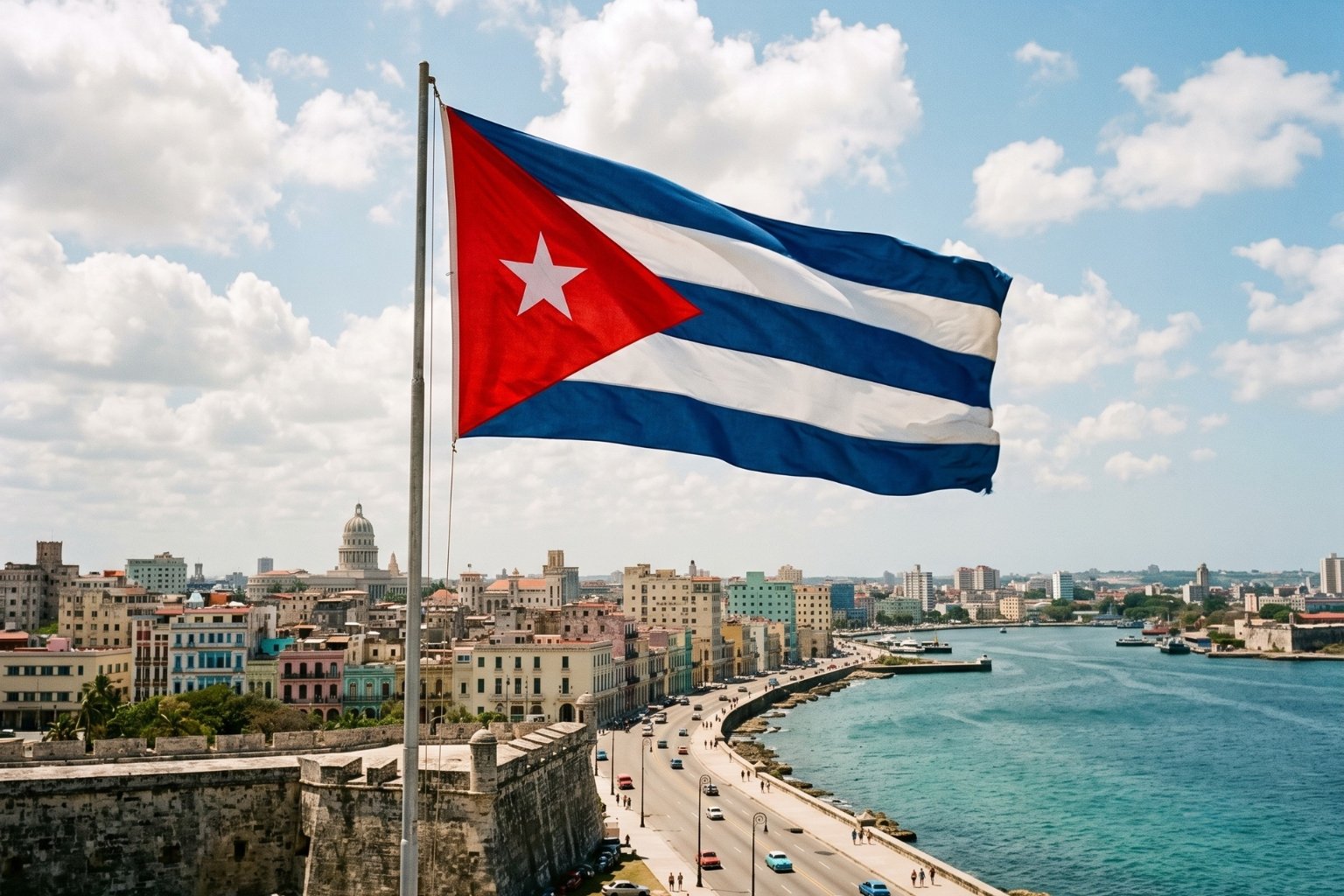
Cuba’s flag is built on five horizontal stripes of equal width, alternating blue and white, starting and ending in blue. Along the hoist side, a red equilateral triangle cuts into the stripes, and at its center sits a five pointed white star. The proportion is one to two, meaning the flag is exactly twice as long as it is tall.
Cubans often call it La Estrella Solitaria, the Lone Star, a nickname born decades before the flag was ever officially adopted.
What Each Color and Symbol on the Cuban Flag Means
Ask five sources what the Cuban flag means and you will often get five slightly different answers. That is not sloppiness. Two symbolic traditions have coexisted since the flag’s earliest days, one rooted in Masonic ideas of equality, the other in the memory of blood spilled for independence. Cuban institutions today tend to blend both.
The Three Blue Stripes
The blue stripes refer to the three old departments into which Spanish colonial authorities divided the island: Oriental, Central and Occidental. The exact shade has shifted over the decades, from a lighter blue favored by the original 19th century designers to the deeper indigo blue used on official flags today.
The Two White Stripes
The white stripes are traditionally read as the purity of the independence cause. Some sources give them a gentler reading as peace, though purity remains the interpretation most Cuban institutions use.
The Red Triangle
The red triangle carries two competing meanings that both trace back to the same 19th century context. In the Masonic reading, common among the exiled revolutionaries who designed the flag, the triangle stands for liberty, equality and fraternity. In the reading that gained ground later, the same red stands for the blood shed by Cuban patriots during the wars of independence.
The Lone White Star
The white star at the center of the triangle represents independence and, by extension, the unity of the Cuban people around that goal. It is this star that gave the flag its lasting nickname decades before Cuba became a republic.
| Element | Common reading | Alternate reading |
|---|---|---|
| Three blue stripes | The three old colonial departments of Cuba | Regional unity across the island |
| Two white stripes | Purity of the independence cause | Peace |
| Red triangle | Masonic liberty, equality and fraternity | Blood shed for independence |
| White star | Independence | Unity of the Cuban people |
Who Designed the Cuban Flag, and Why
The flag was conceived in 1849, not in Cuba but in New York, among Cuban exiles plotting against Spanish rule. Narciso López, a Venezuelan born general who had fought in the Spanish army before turning against colonial rule, asked his friend Miguel Teurbe Tolón, a Cuban poet living in exile, to design a flag for the movement.
Teurbe Tolón sketched the design. His cousin and wife, Emilia Teurbe Tolón, sewed the first physical flag out of satin. López carried it into Cuba in 1850, landing at Cárdenas, and again in a second failed attempt at Playitas in 1851. Both invasions ended in defeat, but the flag survived them.
From an Exile’s Banner to a National Flag: A Timeline
1849. Designed in New York by Miguel Teurbe Tolón at the request of Narciso López, and sewn by Emilia Teurbe Tolón.
May 19, 1850. Raised on Cuban soil for the first time in Cárdenas, during López’s failed invasion. The town is still nicknamed Ciudad Bandera, Flag City, for that reason.
April 11, 1869. Adopted as the official flag of the Republic of Cuba in Arms by the Constituent Assembly at Guáimaro, chosen over a rival banner associated with independence leader Carlos Manuel de Céspedes.
1899 to 1902. After Spain lost the island in the Spanish American War, the flag of the United States flew over Cuba during the military occupation.
May 20, 1902. Officially raised at El Morro Castle in Havana by General Máximo Gómez, marking the founding of the Republic of Cuba.
April 21, 1906. Exact proportions and colors fixed by presidential decree under Tomás Estrada Palma, Cuba’s first president.
1940. Written into Cuba’s constitution, Article 5, as the republic’s sole recognized national flag, a status it kept unchanged even after 1959.
The Cuban Flag’s Quiet Influence Beyond Cuba
Few visitors realize the Cuban flag has a close relative flying over Puerto Rico. Both designs came out of the same exile community in New York during the fight against Spanish rule, and Puerto Rico’s flag simply swaps the position of red and blue. The resemblance is not a coincidence but a deliberate echo of shared history between two independence movements.
Cuban historians also point to a broader legacy: the flag’s clean geometry, a triangle and a lone star, was echoed by a number of countries in Africa and Asia that designed their own flags during their 20th century independence movements. It is a small detail, but it turns a piece of cloth into part of a much longer global story.
How Cubans Honor the Flag Today
Cuba has no single official Flag Day. Instead, the flag’s memory is spread across several dates that Cubans mark informally each year, May 19 for its first raising in Cárdenas, April 11 for its adoption at Guáimaro, and May 20 for its raising over El Morro in 1902.
Travelers who spend time in Havana will see the flag flown over the Castillo de los Tres Reyes del Morro, across Plaza de la Revolución, and along the Malecón, where it appears in murals and street art as often as on official buildings. In Cárdenas, its birthplace, the flag features in local pride the way a hometown team might elsewhere. Among the Cuban diaspora, from Miami to Madrid, it remains one of the most visible symbols of identity, often flown alongside the flag of the country that took people in.
Frequently Asked Questions About the Cuban Flag
What do the colors of the Cuban flag mean? Blue represents the island’s three old colonial departments, white represents the purity of the independence cause, and red represents either Masonic equality and fraternity or the blood of Cuban patriots, depending on which tradition is being followed.
Why does the Cuban flag look like the Puerto Rican flag? Both flags came out of the same New York exile community fighting Spanish colonial rule in the 19th century. Puerto Rico’s flag uses the same design with the red and blue positions swapped.
When was Cuba’s flag officially adopted? It was designed in 1849, first raised on Cuban soil in 1850, adopted by the independence movement in 1869, and officially became the national flag on May 20, 1902.
Has the Cuban flag ever changed? The core design has not changed since 1902. Its exact proportions and colors were formally fixed by decree in 1906 and have stayed the same, including through the political changes after 1959.
