

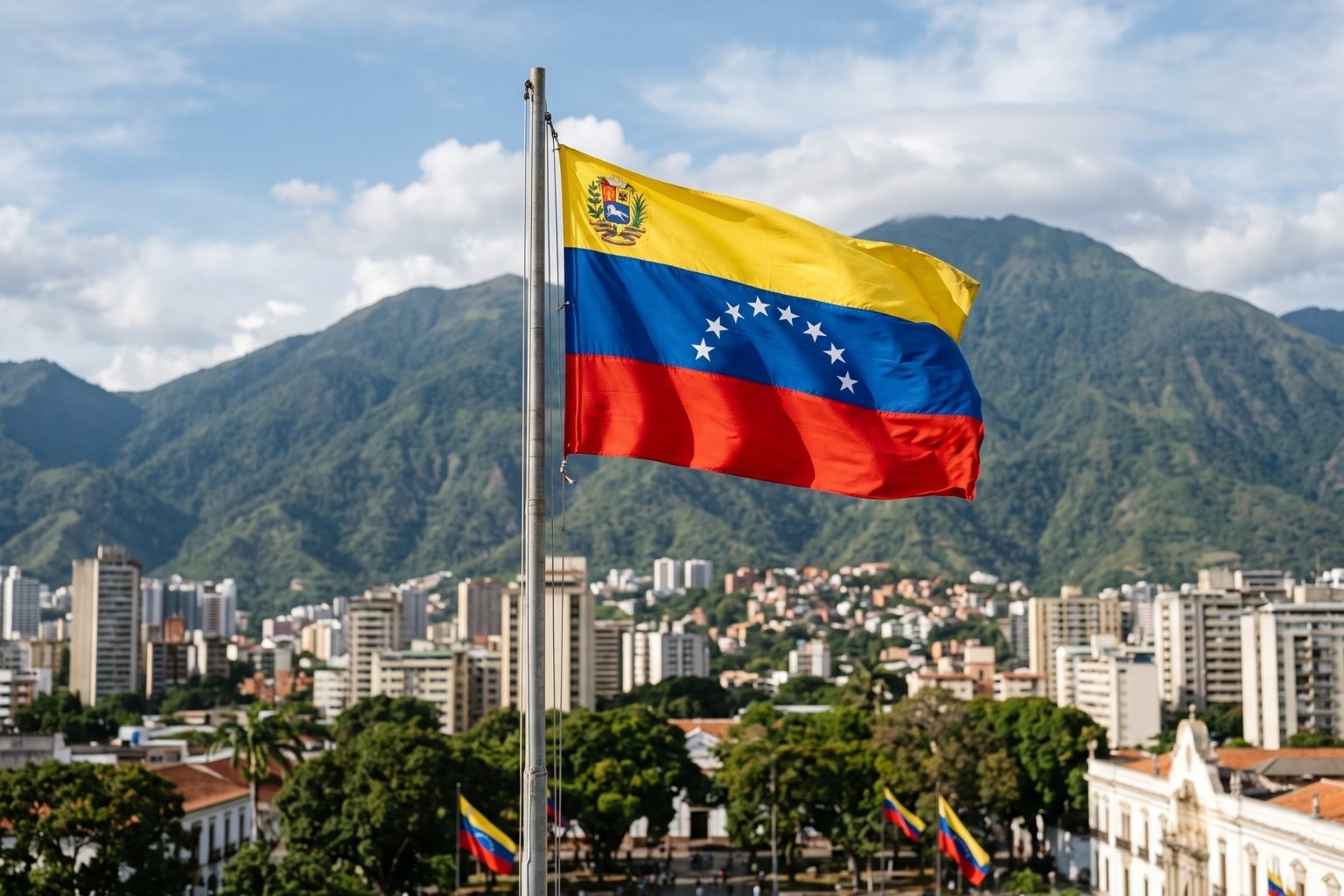

Three horizontal bands, eight white stars curved like a rising arc, and two centuries of politics packed into a 2:3 rectangle. The Venezuela flag looks simple from a distance, but almost every detail on it was debated, redesigned, or fought over, some of it as recently as 2006. Yellow, blue, and red seem to say wealth, sea, and blood at first glance, and that reading isn’t wrong. It’s just the surface of a much richer story.
What the Venezuela Flag Looks Like
The flag is built from three equal horizontal stripes: yellow on top, blue in the middle, red at the bottom. An arc of eight white five pointed stars sits centered on the blue band, curving slightly upward like a smile.
There are actually two official versions in use.
- Civil flag: the plain tricolor with the eight stars, flown by ordinary citizens and businesses.
- State flag: the same tricolor with the national coat of arms added in the upper left corner of the yellow band, reserved for government buildings, military use, and official ceremonies.
If you see the coat of arms on a Venezuelan flag, you’re looking at an institution, not a private home.
What Each Color and Symbol Means
Yellow, the wealth of the land
Yellow represents Venezuela’s natural riches, its soil, its agriculture, and by extension its sovereignty. Some interpretations also tie it to the sun as a source of light and vitality.
Blue, the sea and the courage to cross it
Blue stands for the Caribbean Sea that separates Venezuela from Spain, the colonial power it broke away from. It also carries a second meaning closer to home: the courage and perseverance of the Venezuelan people during the independence struggle.
Red, the blood of independence
Red marks the bloodshed of the wars fought to break from Spanish rule between 1811 and the early 1820s. It’s the most literal of the three colors, and the one every source agrees on without variation.
The eight stars and the provinces behind them
The stars aren’t decoration. Each one stands for a province that joined the fight against Spain, with the eighth added later to honor a promise that took nearly two hundred years to keep.
| Star | Province | Added |
|---|---|---|
| 1 to 7 | Barcelona, Barinas, Caracas, Cumaná, Margarita, Mérida, Trujillo | 1811 to 1817 |
| 8 | Guayana | 2006, fulfilling Simón Bolívar’s 1817 decree |
The color theory story behind the design
Francisco de Miranda, the man credited with the flag’s original tricolor, left two different explanations for his choice of yellow, blue, and red. In a personal letter, he claimed he was inspired by a conversation with Johann Wolfgang von Goethe, who shared his theory that yellow is the warmest and noblest color, closest to light itself, while blue recedes into shadow and red brings the two into balance. His own journal tells a different story: that the idea came from watching a military unit in Hamburg. Both versions survive in the historical record, and nobody has fully settled which one is true.
The Origin of the Flag: Francisco de Miranda’s Design
Miranda first raised his yellow, blue, and red banner on March 12, 1806, in Jacmel, Haiti, while preparing his expedition to liberate Venezuela from Spanish rule. He flew it again on Venezuelan soil on August 3, 1806, at La Vela de Coro. That second date matters more than it sounds: it’s the reason Venezuela now celebrates Flag Day on August 3 rather than March 12, a change made in 2006.
Miranda’s tricolor didn’t stay confined to Venezuela. The same yellow, blue, and red base later became the foundation for the flags of Colombia and Ecuador, both born out of the shared independence movement that once united the region as Gran Colombia.
How the Flag Evolved, Republic by Republic
The tricolor itself has barely changed since 1811. What kept shifting was everything around it: the number of stars, their arrangement, and whether the coat of arms appeared at all.
| Year | What changed |
|---|---|
| 1811 | Congress formally adopts Miranda’s yellow, blue, red tricolor |
| 1817 | Bolívar decrees an eighth star for Guayana from Angostura, though it isn’t implemented yet |
| 1830 | Venezuela separates from Gran Colombia, keeps the tricolor with a new coat of arms |
| 1864 | Law fixes the basic design that still underlies today’s flag |
| 1954 | The coat of arms is formally added to government versions of the flag |
| 2006 | The eighth star becomes permanent, coat of arms redesigned |
Through all of this, the stars did the heavy lifting of representing political change, while the colors stayed untouched. That consistency is part of why the flag still feels recognizably the same one Miranda raised in 1806, even after two centuries of amendments.
The 2006 Redesign, and Why It’s Still Debated
In 2006, under President Hugo Chávez, the National Assembly approved the most visible change to the flag in over a century. The eighth star for Guayana, promised by Bolívar in 1817, was finally made official. The coat of arms was also redesigned: the white horse now gallops to the left with its head facing forward, correcting what heraldic tradition considers the honorable direction, and a bow and arrow was added to represent Venezuela’s indigenous peoples alongside a machete symbolizing labor.
The change wasn’t purely aesthetic. Opposition groups in Venezuela have continued to fly the earlier seven star flag as a form of political protest against the government, turning a design detail into a visible marker of political identity. It’s a reminder that flags rarely stay neutral objects once they become tied to a specific administration.
Venezuela’s Flag Compared to Colombia and Ecuador
Because all three flags trace back to Miranda’s original design, they’re constantly mixed up, especially by travelers moving between the three countries.
| Country | Band proportions | Stars | Coat of arms |
|---|---|---|---|
| Venezuela | Three equal bands | Arc of 8 white stars on the blue band | Optional, upper left, state use only |
| Colombia | Yellow takes half the flag, blue and red share the rest | None | Only on the presidential flag |
| Ecuador | Yellow takes half the flag, blue and red share the rest | None | Always centered on the flag |
The fastest way to tell them apart: check whether the yellow band is the same width as the others (Venezuela) or twice as wide (Colombia and Ecuador), then check for stars, which only Venezuela has.
Flag Day and the Flag in Everyday Venezuelan Life
Venezuela celebrates Flag Day on August 3, marking the anniversary of Miranda’s 1806 landing at La Vela de Coro rather than his earlier raising of the flag in Haiti. Before 2006, the date fell on March 12 instead.
Travelers will see the flag everywhere during national holidays, at government buildings year round, and at international sporting events, where it’s usually the plain civil version without the coat of arms. Among the Venezuelan diaspora, the flag has taken on an extra layer of meaning as a symbol of identity and, for some, of political dissent tied to which version they choose to fly.
