

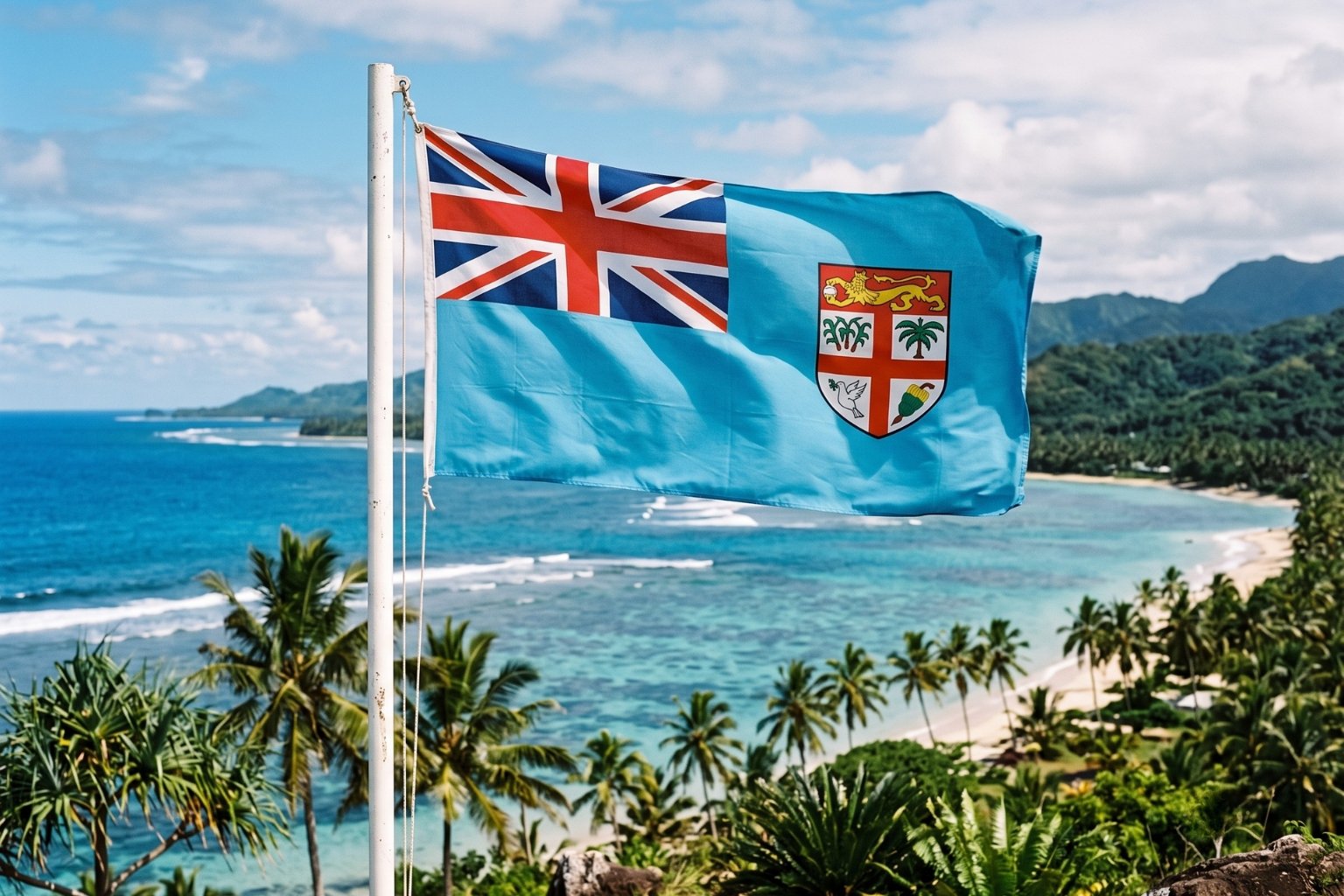

Fly into Nadi and one of the first things you notice, right after the heat, is a pale blue rectangle snapping above the terminal. The Fiji flag looks almost gentle compared to its Pacific neighbors, yet it carries a British royal crest, a chief’s personal emblem and a crop the islands barely grow. It also came within one government announcement of disappearing altogether in 2016. That mix of quiet color and loud history is what makes this flag worth understanding properly, not just glancing at.
What the Fiji Flag Looks Like Today
The flag follows a 1 to 2 ratio, meaning it is twice as long as it is tall, a proportion shared with the United Kingdom’s own ensigns. A light blue field covers the whole surface. The Union Jack sits in the upper hoist corner, and the shield from Fiji’s coat of arms is placed on the fly side, the half farthest from the pole.
| Element | Position | What it carries |
|---|---|---|
| Light blue field | Full background | The Pacific Ocean |
| Union Jack | Upper hoist corner | Ties to the United Kingdom |
| Coat of arms shield | Fly side | Lion, crops, dove, cross of Saint George |
The Colors of the Fiji Flag and What They Mean
Light Blue, the Ocean That Shapes Everything
The dominant light blue is not decorative. It stands for the Pacific Ocean surrounding the archipelago, the same water that shapes Fiji’s climate, its fishing economy and the rhythm of village life on its outer islands.
The Union Jack, Kept on Purpose
The dark blue, red and white of the Union Jack in the canton mark Fiji’s decades as a British colony, from 1874 to independence in 1970. Fiji is one of only a handful of independent nations, alongside Australia, New Zealand, Tuvalu and the Cook Islands, that chose to keep this British emblem after cutting political ties with London.
Red and White Inside the Shield
Within the coat of arms itself, a red cross of Saint George on a white background divides the shield into four sections. It is a direct English heraldic borrowing, added when Fiji’s coat of arms was formally granted in 1908, decades before independence.
Inside the Coat of Arms, Symbol by Symbol
The Lion and Its Curious Cocoa Pod
At the top of the shield sits a golden lion holding a cocoa pod between its paws. It looks specific until you realize Fiji has never had a real cocoa industry. The detail was borrowed wholesale from British heraldic tradition when the arms were designed in 1908 and simply never updated, a small colonial fingerprint that most visitors walk past without noticing.
Sugarcane, Coconut Palm and Bananas
The other three sections of the cross show a stalk of sugarcane, a coconut palm and a bunch of bananas, the three crops that defined Fiji’s economy under British rule and still matter to it today. Sugarcane in particular brought thousands of indentured laborers from India in the nineteenth century, a migration that permanently reshaped Fijian society and still shows in the country’s population today.
The Dove of Peace and a Chief’s Personal Flag
In the lower left section, a white dove holding an olive branch has a more local origin than the rest of the shield. It comes from the personal standard of Ratu Seru Epenisa Cakobau, the powerful nineteenth century chief who once ruled much of Fiji before ceding the islands to Britain in 1874. Of everything on the flag, this is the one symbol that is genuinely Fijian rather than imported.
From a Missionary Banner to a National Flag
Before Britain, a Flag With a Dove
Fiji’s very first flag predates British rule. In the early 1870s, the independent kingdom used a white and blue striped flag with a red shield bearing a white dove, a design borrowed from the banners carried by Christian missionaries who had arrived a few decades earlier. That dove is the ancestor of the one still on the flag today.
From 1874 to 1970, the Colonial Years
Fiji became a British colony in 1874 through the Deed of Cession signed by local chiefs, Cakobau among them. For decades afterward, government buildings flew the plain Union Jack while ships flew the Red or Blue Ensign. In 1908, Fiji received its own coat of arms, added as a badge to the colony’s Blue Ensign so it could be told apart from other British territories.
Independence in 1970, What Changed and What Did Not
When Fiji became independent on 10 October 1970, the new national flag kept almost the entire colonial design. The main change was cosmetic but deliberate: the dark navy field of the colonial ensign became the lighter, brighter blue still used today, and the shield was simplified, with its crest, motto and supporting figures removed so the coat of arms itself could stand out more clearly.
The Flag That Almost Disappeared
This is the part most flag guides skip entirely. In his 2013 New Year address, Prime Minister Frank Bainimarama announced that Fiji would design a new flag, one without the Union Jack, arguing that the symbol represented Britain rather than Fiji. A national competition launched in 2015 drew more than 2000 submissions, later narrowed to 23 finalists for public review.
The process stalled repeatedly through 2015 and early 2016, with deadlines pushed back again and again amid public pushback and petitions asking for a referendum instead. Then, in August 2016, everything changed direction. Fiji’s rugby sevens team had just won Olympic gold in Rio, and the country rallied behind its existing flag with a passion the government had not anticipated. Combined with the cost of recovering from Cyclone Winston earlier that year, Bainimarama announced the redesign was off, saying Fijians should keep flying the flag they already knew. It has remained unchanged ever since.
Where You Will Actually See the Fiji Flag
If you are traveling through Fiji rather than reading about it from a distance, the flag shows up in specific, memorable moments. It flies everywhere on 10 October, Fiji’s Independence Day, with parades and church services across Suva and the outer islands. It appears painted on faces and waved by the thousands whenever the national rugby sevens team plays, a sport Fiji treats close to religion. You will also see it, smaller and quieter, at village kava ceremonies and outside government buildings across the country, a reminder that this particular mix of British blue and Fijian symbolism is still something people choose to fly, not just something they inherited.
Quick Answers
Why does Fiji still have the Union Jack on its flag? Because a 2016 government decision to remove it, after years of design competitions, was reversed following strong public attachment to the existing flag.
What does the light blue on the Fiji flag represent? The Pacific Ocean surrounding the islands and the central role it plays in daily life and the economy.
When was the current Fiji flag adopted? On 10 October 1970, the day Fiji gained independence from Britain, using a lightened version of its colonial era Blue Ensign.
Is the dove on the Fiji flag a general peace symbol? Not originally. It traces back to the personal standard of Ratu Seru Cakobau, the Fijian chief who ceded the islands to Britain in 1874.
