

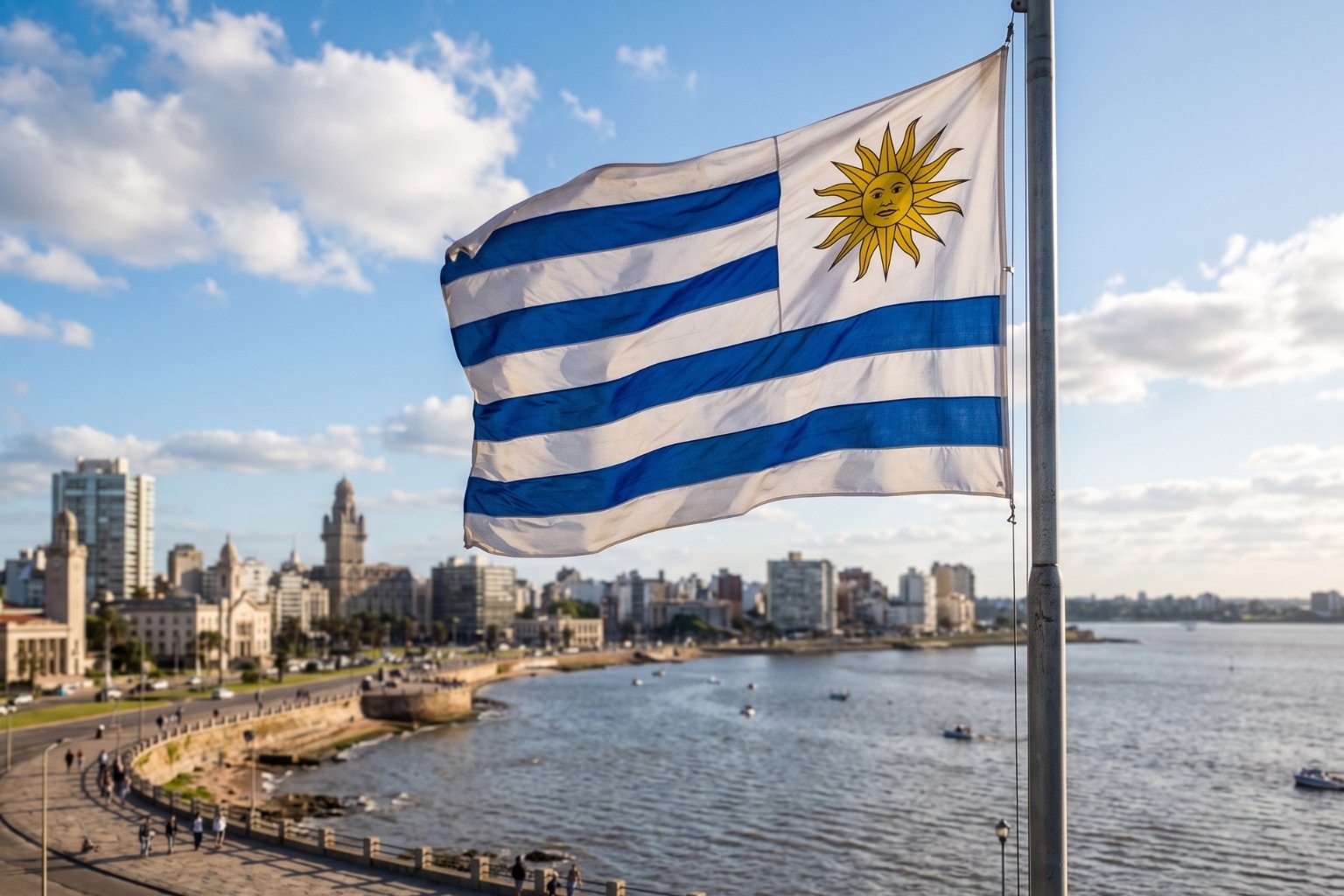

Nine stripes of white and blue, a golden sun tucked in the corner. The Uruguay flag looks simple at first glance, but every line of it was negotiated, redesigned, and fought for. Behind those stripes sits a story of revolution, borrowed symbols, and a young country working out what it wanted to become. Here is what the flag actually shows, what it means, and how it got there.
What the Uruguay Flag Looks Like
The flag is built from nine horizontal stripes, five white and four blue, running the full width of the fabric. In the upper hoist corner sits a white square, the canton, holding a golden sun known as the Sun of May. The sun has a human face and 16 rays that alternate between straight and wavy. The whole flag follows a 2 to 3 ratio, meaning it is one and a half times as wide as it is tall.
| Element | Description | Position |
|---|---|---|
| Stripes | 5 white, 4 blue | Full flag, horizontal |
| Sun of May | Golden sun, 16 alternating rays | Canton, upper left |
| Canton | White square | Upper hoist corner |
| Proportion | 2 to 3 | Overall flag |
The Meaning Behind Every Element
The Nine Stripes and Uruguay’s Original Departments
Each stripe stands for one of the nine departments that made up Uruguay when the flag reached its current form in 1830. It was a way of putting distinct regions on equal footing, all folded into a single piece of cloth. Uruguay has since grown to 19 departments, but the flag was never updated to match. The number nine stayed fixed, a small reminder of where the country started rather than where it ended up.
The Sun of May and Its Deeper Roots
The Sun of May is not unique to Uruguay. Argentina carries the same emblem, and the connection is intentional. Both symbols trace back to the May 1810 revolution in Buenos Aires, when the sun was said to break through the clouds as independence from Spain was first declared in the region. The face on the sun has also been linked to Inti, the sun god of Inca tradition, giving the emblem a layer that reaches beyond the colonial period into older South American belief systems.
What Blue, White and Gold Represent
The blue stripes are usually tied to the sky and to loyalty. The white stripes stand for peace. The gold of the sun points to prosperity and to the sun itself as a source of life. None of this is spelled out in a founding legal text with the precision of a color chart, but the associations have held for nearly two centuries and are the ones taught in Uruguayan schools today.
Where the Uruguay Flag Comes From
Under Belgrano’s Flag (1812 to 1815)
Before Uruguay had its own flag, the territory then known as the Banda Oriental flew the blue, white, blue banner raised by General Manuel Belgrano in 1812, as part of the wider Río de la Plata provinces. The region was still finding its political footing, caught between loyalty to Buenos Aires and a growing sense of separate identity.
The First Independent Designs (1815)
On January 13, 1815, a distinct Uruguayan flag appeared for the first time, adding a red stripe to the center of each blue band from the earlier design. That version did not last long. By August 25 of the same year, it had already been replaced by equal horizontal stripes of blue, white, and red.
The Nineteen Stripe Flag of Independence (1828)
Once Uruguay secured recognition as an independent republic from both Argentina and Brazil, the new government adopted a flag on December 16, 1828, with 19 stripes, nine light blue and ten white, plus the Sun of May in the corner. It was the direct ancestor of the flag flown today, but far busier and harder to reproduce cleanly at a distance.
The Final Version (July 11, 1830)
The design was simplified on July 11, 1830, shortly after the swearing of the constitution. The stripe count dropped from 19 to nine, the blue shade was adjusted, and the sun was redrawn. That July day, with the new flag raised over Government House in Montevideo, marks the version Uruguayans still salute.
The Three Official Flags of Uruguay
The National Flag
The nine striped flag with the Sun of May is the one people mean when they simply say the Uruguay flag. It is the version flown at borders, on government buildings, and at international events.
The Flag of the Treinta y Tres
This flag carries blue, white, and red horizontal stripes, with the national motto Libertad o Muerte, Freedom or Death, written across the center band. It honors the Treinta y Tres Orientales, the group of exiles who returned to launch the campaign for independence. By law, it must be flown alongside the national flag on official buildings during national holidays.
The Artigas Flag
Named for José Gervasio Artigas, the figure regarded as Uruguay’s founding hero, this flag uses a diagonal striped pattern distinct from the other two. It is raised on ceremonial occasions tied to Artigas and to the broader story of Uruguayan independence.
Uruguay’s Flag Next to Argentina’s
The resemblance between the Uruguayan and Argentine flags is not a coincidence. Both trace back to the same colonial roots and to Belgrano’s original blue and white design, adopted by Uruguay out of respect for that shared history during the fight against Spanish rule.
| Uruguay | Argentina | |
|---|---|---|
| Stripes | 9, white and blue | 3, light blue and white |
| Canton or center | Sun of May, upper corner | Sun of May, center |
| Adopted (current form) | 1830 | 1818 |
Greece’s flag also uses blue and white stripes with a similar rhythm, which surprises some travelers, but there is no historical link between the two. It is a visual echo, nothing more.
How Uruguayans Live With Their Flag Today
Flag Day, June 19
Uruguay’s flag ceremony, the Jura de la Bandera, falls on June 19, chosen because it is also the birthday of José Gervasio Artigas, born in 1764. Since a 1940 law, first year primary students promise loyalty to the flag and first year secondary students formally swear it, in public ceremonies held in schools across the country. It is a civic date rather than a day off in the tourist sense, but it says a lot about how seriously the flag is treated in daily life.
Where Travelers Actually See It
Plaza Independencia in Montevideo is the most obvious place to picture the flag in context, close to where it was first raised in 1830. Beyond that, it shows up on government buildings, in classrooms, and famously above football stadiums on match days, when it becomes less a national symbol and more a shared, noisy identity.
Uruguay Flag Quick Facts
| Detail | Information |
|---|---|
| Adopted | July 11, 1830 |
| Proportion | 2 to 3 |
| Stripes | 9 (5 white, 4 blue) |
| Canton symbol | Sun of May, 16 rays |
| Commonly credited designer | Joaquín Suárez |
| Number of official flags | 3 (National, Treinta y Tres, Artigas) |
| Flag Day | June 19 |
Common Questions About the Uruguay Flag
Why does the flag have nine stripes and not more? Because Uruguay had nine departments when the current design was adopted in 1830. The flag was never revised as the country expanded.
Is the sun on Uruguay’s flag the same as Argentina’s? Yes, both use the Sun of May, tied to the same 1810 revolution and to a shared colonial history between the two nations.
What do the colors mean exactly? Blue for the sky and loyalty, white for peace, gold for prosperity. These meanings are cultural and educational rather than fixed in a single founding legal document, but they are consistent and widely taught.
