

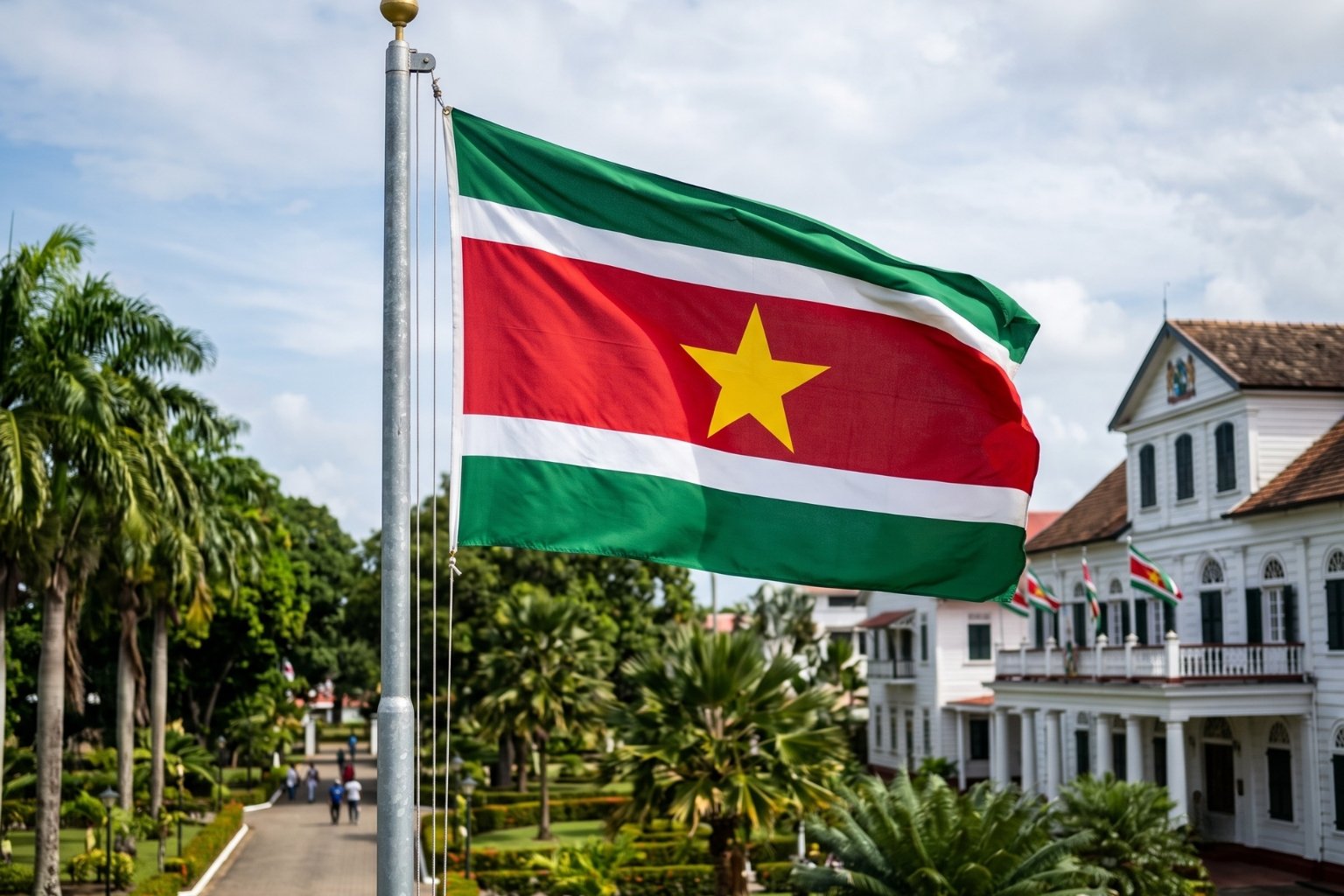

Suriname’s flag looks almost off balance at first glance, a wide red band pinched between four thin stripes and a single yellow star sitting at its center. That imbalance is intentional. Every stripe, every color, and that lone star were chosen to answer one question: how do you design a flag for a country built from five completely different peoples who never asked to share a border.
What the Suriname Flag Looks Like
The flag of Suriname is made of five horizontal bands: green on top, a thin white line, a wide red band in the middle, another thin white line, and green again on the bottom. A large five pointed yellow star sits centered on the red band. The overall proportions are 2:3, meaning the flag is one and a half times as long as it is tall.
The bands are not equal in size. The two green stripes are double width, the white stripes are the thinnest, and the red band in the middle is quadruple width, roughly four times as wide as either green stripe. That weighting is deliberate. Red dominates the flag visually, and that was very much the point in 1975.
| Band | Color | Width | Position |
|---|---|---|---|
| 1 | Green | Double | Top |
| 2 | White | Single | Upper |
| 3 | Red | Quadruple | Center |
| 4 | White | Single | Lower |
| 5 | Green | Double | Bottom |
The yellow star sits centered on the red band, five points, no border.
What Each Color and the Star Actually Mean
Green, the Land Itself
Green is not a stand in for generic nature. Suriname is one of the most forested countries on Earth, with more than 90 percent of its territory covered in tropical rainforest. The green stripes represent that land directly, its agriculture, its fertility, and the hope that comes from a country rich in resources it hasn’t finished developing.
White, Peace and Justice
The two white stripes stand for peace, justice, and freedom. In a country built from waves of colonization, indentured labor, and slavery, that meaning carries more weight than it might elsewhere. White is also read as a call for fairness among Suriname’s many communities, a thread that runs through the entire flag.
Red, Progress and Its Price
Red is the widest band for a reason. It represents progress and the country’s love for itself, but older readings also tie it to the cost of getting there, the sacrifice behind independence. Placing the boldest color at the center of the flag was a statement about where the nation’s priorities were meant to sit.
The Yellow Star, One People, Five Origins
The star’s five points are commonly read as the five continents behind Suriname’s population: Indigenous Americans, Africans, Europeans, and the Indian and Chinese communities brought over as indentured laborers, alongside later Javanese arrivals. Its yellow color points toward a shared, golden future rather than any single group’s history. That is the star’s real job, standing for unity in a country where unity was never guaranteed.
Before Independence, Suriname Under Dutch Rule
Suriname spent more than three centuries as a Dutch colony, known for most of that time as Dutch Guiana, after Britain ceded the territory to the Netherlands in 1667. For much of that period the colony simply flew the Dutch flag, with no symbol of its own.
That changed in 1959, when Suriname, then an autonomous territory within the Kingdom of the Netherlands, adopted its first flag. It looked nothing like today’s version: a plain white field carrying a black ellipse, with five colored stars, white, black, brown, yellow, and red, arranged around it. Each star stood for one of the territory’s ethnic groups, Europeans, Africans, Indians, Chinese, and Amerindians.
The design sounds inclusive on paper, but in practice it opened a real fight. Which star sat at the top of the ellipse became a genuine point of contention, since the hoisting mechanics meant one color effectively led the others upward, and some Surinamese read that as a hierarchy in disguise. As independence approached in the early 1970s, the criticism only grew louder. A flag built from five separate ethnic symbols was starting to look like the opposite of a national one.
1975, Designing a Flag for a New Country
When independence from the Netherlands was set for November 25, 1975, the government opened a national competition to design a flag from scratch. Accounts of the process vary, but the more detailed ones describe around 270 submissions reviewed by a judging committee ahead of independence day.
The winning design came from Jacques Herman Pinas, an art teacher and graphic designer. One detail rarely mentioned elsewhere is that his original submission featured a black star, not yellow, and the color was changed during the selection process, reportedly over his own objections. It’s a small but telling footnote. Even the country’s founding symbol went through the kind of committee compromise that shapes most things built by consensus.
Who Actually Designed the Suriname Flag
Jacques Herman Pinas is the name most consistently credited across reference sources, tied to a documented national design competition held ahead of independence. That said, attribution online is not fully settled. A few sources describe the flag as the work of an unnamed government committee, and at least one names a different designer entirely with details that don’t match the flag’s actual layout. Where accounts disagree, the competition story tied to Pinas is the version with the clearest documentation, so it’s the one worth trusting.
Why the Design Changed So Completely
The distance between the 1959 flag and the 1975 flag is not just visual, it’s philosophical. The old flag catalogued Suriname’s differences, five stars, five colors, five separate identities held together by a black ring. The new flag did the opposite, one shared palette, one star, no group singled out or ranked above another.
That shift was a direct response to the resentment the 1959 design had built up. A newly independent country needed a symbol that people from every background could stand under without wondering whose color came first. A single yellow star sitting at the center of a red band, equidistant from every edge, was the clearest way to say that.
The Suriname Flag Today
The flag is raised nationwide every November 25 for Independence Day, still the country’s most significant public holiday. It also flies over Paramaribo’s historic inner city, a UNESCO World Heritage site where Dutch colonial architecture sits alongside Caribbean influence, wooden facades built by the same mix of communities the star is meant to represent.
Suriname’s population today genuinely includes Creole, Hindustani, Javanese, Chinese, Indigenous, and European communities, not just as a line in a museum placard. Walk through Paramaribo on a Sunday and you can pass a mosque, a synagogue, and a Hindu temple within a few blocks of each other, which is about as close as a flag’s symbolism ever gets to matching the street it flies over.
Suriname Flag FAQ
When was the Suriname flag adopted? November 25, 1975, the same day Suriname became independent from the Netherlands.
What do the colors mean? Green stands for fertility and hope, white for peace and justice, and red for progress and the effort behind it.
What does the star represent? Unity among Suriname’s communities, with its five points often linked to the continents its population descends from.
What are the flag’s proportions? 2:3, meaning the flag’s length is one and a half times its height.
Was there a flag before this one? Yes. From 1959 to 1975, Suriname flew a white flag with five colored ethnic stars inside a black ellipse, replaced at independence by the current design.
