

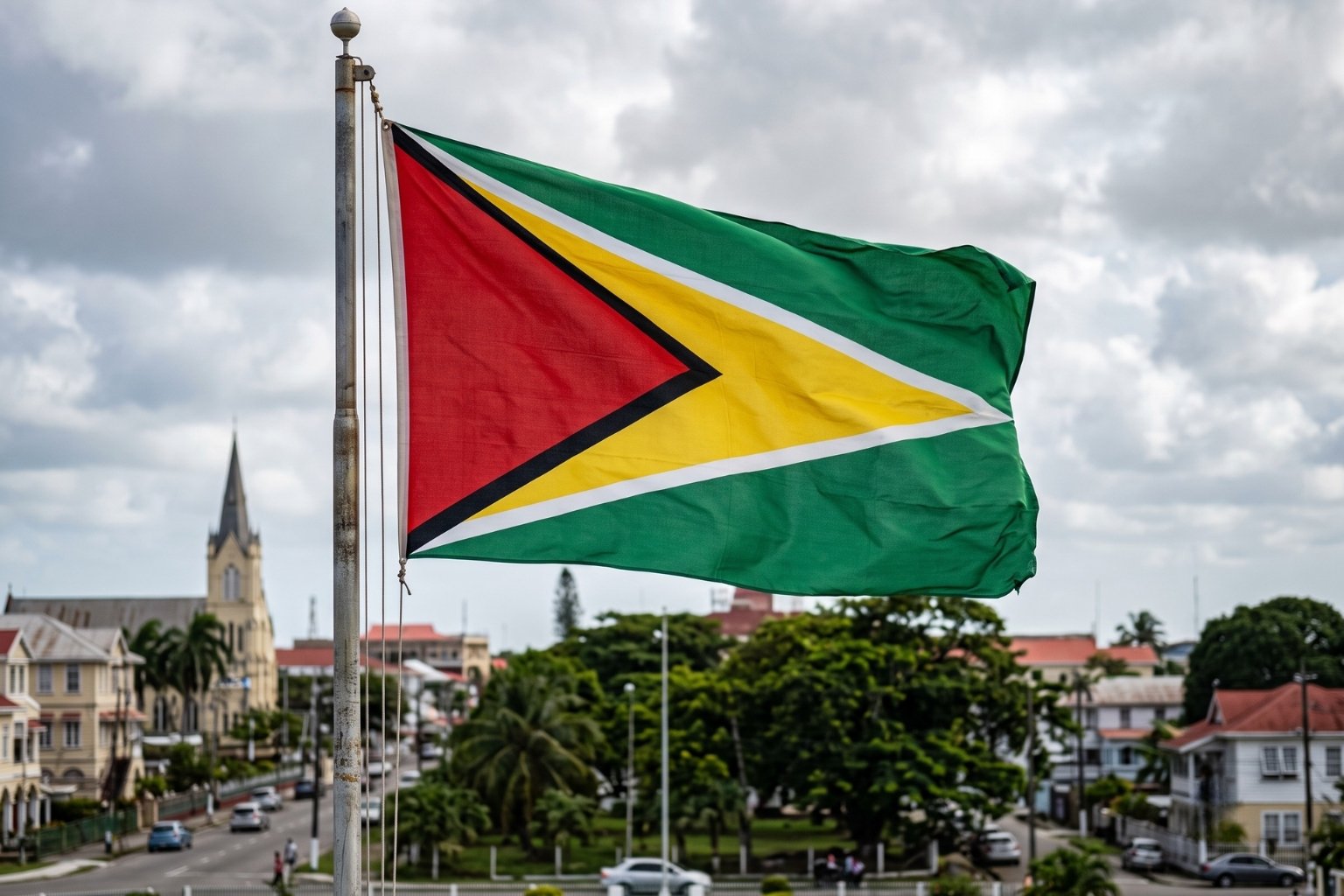

A green field crossed by a golden arrowhead trimmed in white, itself topped by a red triangle edged in black. The Guyana flag looks unlike any other flag in South America, and its shape is no graphic accident. Adopted in 1966 when the country gained independence, it tells the story of a former colony turned nation, rich in forests, rivers and minerals.
What the Guyana flag looks like
The background is solid green. A large golden arrowhead, bordered in white, starts at the hoist and stretches almost to the opposite edge. A smaller red triangle, edged in black, sits on top of that golden shape, closer to the pole.
This layered, arrow like design gives the flag its local nickname, the Golden Arrowhead. No other national flag repeats quite this same stack of nested triangles.
The meaning behind each color
Each color carries a specific meaning, tied directly to the land and history of the country.
| Color | Meaning |
|---|---|
| Green | The forests and farmland that cover roughly 90 percent of the country |
| Gold | The nation’s mineral wealth and the idea of a prosperous future |
| White | The countless rivers, the source of the country’s own name, which means “land of waters” in an indigenous language |
| Red | The zeal and sacrifice needed to build the nation |
| Black | The endurance and perseverance of the Guyanese people |
Why it’s called the Golden Arrowhead
The name comes straight from the flag’s shape. Seen from a distance, the golden point stretching toward the fly reads like an arrow ready to fly off toward the horizon. That visual detail, more than the colors themselves, is what gave the flag its popular identity.
The history behind the flag
From Dutch colonies to the British crown
Long before it became Guyana, the territory was home to the Arawak and Carib peoples. Starting in 1616, the Dutch founded the colony of Essequibo, followed by Berbice in 1627 and Demerara in 1773. These territories fell under British control in 1781.
British Guiana then flew a Blue Ensign, a dark blue flag marked with a colonial badge showing a sailing ship. That badge was revised several times, in 1875, 1906, 1919, and again in 1955, without ever breaking from the standard colonial template.
The 1962 international competition
As independence approached, an international competition was launched to design a new national flag. The winning entry came from Whitney Smith, an American vexillologist who later became one of the world’s leading authorities on flags.
His original concept envisioned a red field with a green triangle. Guyanese authorities reversed the colors, producing the green field and golden point known today. The College of Arms in London then added the thin black and white borders separating the triangles, a final touch that gave the flag its current clarity.
Independence and official adoption
The flag became official on May 26, 1966, the day Guyana gained independence from the United Kingdom. This new emblem permanently replaced the colonial Blue Ensign.
Guyana’s national pledge, recited at official ceremonies, opens with a promise to the flag itself, to honor it at all times. Few countries write their flag so directly into a civic text.
Proportions and technical specifications
The flag follows a 3 to 5 ratio for standard land use. An elongated version, at a 1 to 2 ratio, serves as the national ensign at sea.
In construction, the red triangle spans the full height of the flag at the hoist, while the golden point, wider at its base, overlays it and extends further toward the fly. A civil air ensign also exists, combining the Guyanese flag with the design of the British Civil Air Ensign, used at airports and on aircraft registered in the country.
Where to see the flag today
For travelers, the best time to spot the Golden Arrowhead is during Mashramani, the lively public celebration held every February 23 to mark the country’s move to republic status. Georgetown’s streets fill with green, gold and red.
The flag also flies year round on government buildings, along the Seawall that lines the capital, and during independence celebrations on May 26. A related banner, the Presidential Standard, has existed since 1970 and marks the residence or movements of the head of state, a detail that often catches the sharpest eyed visitors off guard.
