

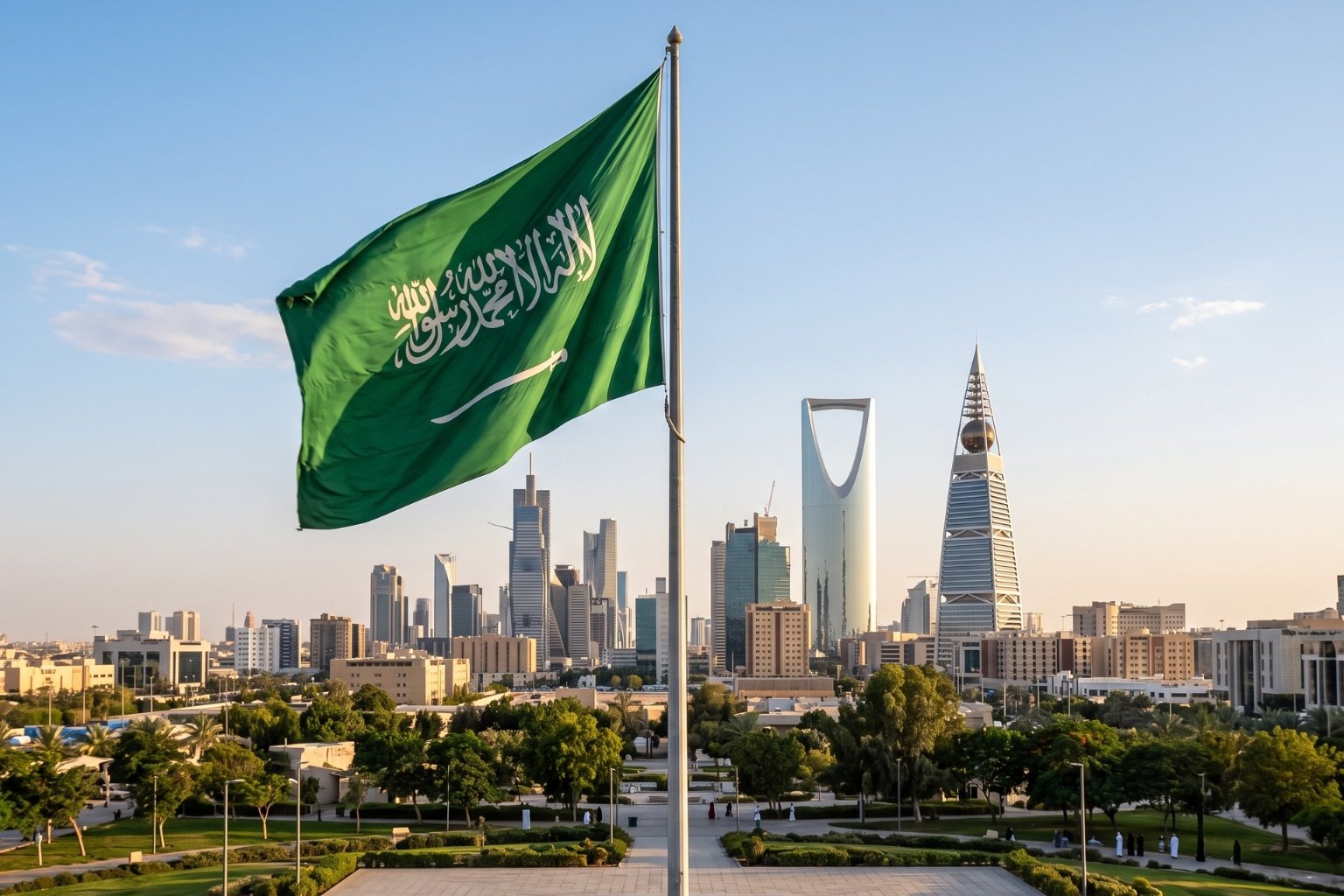

No national flag carries quite the same weight as this one. The Saudi Arabia flag is built around a full sentence of scripture rather than stripes or stars, and that single choice tells you almost everything about the Kingdom’s identity. Behind the deep green field and the white sword lies three centuries of conquest, faith and family history.
What the Saudi Arabian flag looks like today
The flag is a solid green field carrying two elements in white: the Shahada, the Islamic declaration of faith, written in flowing Thuluth calligraphy, and a straight bladed sword positioned beneath it, tip pointing toward the hoist. Nothing else appears on the field. No stars, no stripes, no emblem competing for attention.
The design looks almost identical from both sides, which is rarer than it sounds. Most flags are printed on a single layer of fabric, so the reverse shows a mirrored image. The Saudi flag is sewn from two pieces of cloth joined together so the script reads correctly, right to left, no matter which side faces you.
| Feature | Detail |
|---|---|
| Adopted | March 15, 1973 (current design) |
| Field color | Green |
| Inscription | The Shahada, in white Thuluth script |
| Symbol | A white sword, straight bladed |
| Ratio | 2:3 (width to length) |
| Countries sharing the Shahada on a flag | Only Afghanistan |
What the colors and symbols actually mean
Why the flag is green
Green did not become the Kingdom’s color by accident of taste. It traces back to the Wahhabi movement, an eighteenth century religious reform current that became the driving ideological force behind the rise of the Al Saud family. Green already carried meaning in Islamic tradition well before that, linked to Fatimah, the Prophet’s daughter, and long associated with paradise, growth and renewal in Islamic art and architecture, from mosque domes to the covers of the Quran.
The Shahada, the heart of the design
The white script across the field is the Shahada, the Islamic declaration of faith: “There is no god but God, Muhammad is the Messenger of God.” Its presence is what makes this flag unlike almost any other on the planet. Only one other national flag in the world, that of Afghanistan, also carries the Shahada, which makes Saudi Arabia’s version one of just two examples of this kind of symbolism at a national level.
Because the phrase is considered sacred, the flag’s treatment is stricter than that of most countries, a point worth keeping in mind if you plan to visit or bring back a souvenir.
The sword and King Abdulaziz
Beneath the script sits a single sword, added to the flag’s early ancestor around 1902 by Abdulaziz Al Saud, the leader who would go on to found the modern Kingdom. The sword stands for justice and for the military campaigns that unified the Arabian Peninsula’s separate regions into one state. Its shape has changed over time: early twentieth century versions showed a curved sabre, and the straight blade seen today only became standard with the 1973 redesign.
The history behind the flag, from Diriyah to 1973
The first Saudi state and its early banners
The story starts long before the Kingdom itself existed. In 1744, Muhammad ibn Saud and the religious reformer Muhammad ibn Abd al Wahhab founded the Emirate of Diriyah, often called the First Saudi State, and flew a green banner marked with a white crescent. That early emirate fell in 1818, but the symbolism it introduced never really disappeared.
Rival flags of Nejd and Hejaz
Through the nineteenth and early twentieth centuries, the region that is now Saudi Arabia was split among competing powers, each with its own banner. Nejd, in the center of the peninsula, kept close to the green and white tradition. Hejaz, home to Mecca and Medina, flew a very different flag during the Arab Revolt of 1916, a horizontal tricolor of black, white and green with a red triangle at the hoist, echoing the Pan Arab colors still visible in several Middle Eastern flags today.
Unification and the 1932 flag
Abdulaziz spent three decades folding these separate territories into one, starting with the capture of Riyadh in 1902 and continuing through the conquest of Hejaz in the mid 1920s. When the Kingdom of Saudi Arabia was proclaimed in 1932, the flag was formalized for the first time as a national symbol: a green field, the Shahada filling most of the space, and a curved sword below.
The 1973 standardization
The version flown today only became official on March 15, 1973, by royal decree. The script was reduced in size, the proportions were fixed, and the sword’s blade was straightened. Since then, the design has not changed, and it remains one of the most stable flag identities in the world.
Flag etiquette: what travelers should know
A few rules make the Saudi flag genuinely unusual, and they matter if you are visiting or writing about the country.
- It is never lowered to half mast, not even during periods of national mourning, since lowering a flag carrying the Shahada is considered disrespectful to the sacred text itself.
- It is rarely printed on clothing, cushions or disposable items, again because of the religious inscription. Do not expect flag themed souvenirs the way you might in other countries.
- Its double sided construction means the script always reads correctly, so a printing error that mirrors the text is considered a serious mistake, not a stylistic quirk.
These are not bureaucratic footnotes. They reflect how central the Shahada is to how Saudis see their own national identity.
Where you will actually see the flag
Two dates bring the flag out in force across the Kingdom. Founding Day, celebrated on February 22, marks the establishment of the First Saudi State in 1727 and has only been an official holiday since 2022. National Day, on September 23, celebrates the 1932 unification and is the louder, more visible of the two, with green lighting up buildings from Riyadh to Jeddah and the flag appearing on cars, balconies and public squares.
The flag also connects to Al Ardah, the traditional sword dance performed at celebrations across the country, a living link between the blade on the flag and a cultural practice still very much alive today. And its two core elements, the Shahada and crossed swords, reappear in the national coat of arms, alongside a palm tree representing vitality and prosperity.
How it compares to other flags in the region
Green is common across Islamic flags, from Pakistan to Mauritania, but for different reasons in each case, usually tied to a crescent or star rather than script. What sets Saudi Arabia apart is the use of an actual sentence of scripture as the flag’s central and only symbolic device. As noted above, Afghanistan is the sole other country to do the same, which places the Saudi flag in a category of exactly two among the roughly two hundred national flags flown today.
Frequently asked questions
Why doesn’t the Saudi flag fly at half mast?
Because it carries the Shahada, lowering the flag is viewed as disrespectful to the sacred text it displays, regardless of the occasion.
What does the sword on the Saudi flag mean?
It represents justice and the military unification carried out by King Abdulaziz Al Saud in founding the modern Kingdom.
Can you buy or wear a Saudi flag?
Flag branded merchandise is uncommon and, in some forms, restricted, since the inscription is considered sacred and its casual use is discouraged.
What do the colors of the Saudi flag mean in short?
Green reflects Islam and the Wahhabi movement’s role in the country’s founding, while white carries the Shahada and the sword, symbols of faith, justice and unity.
