

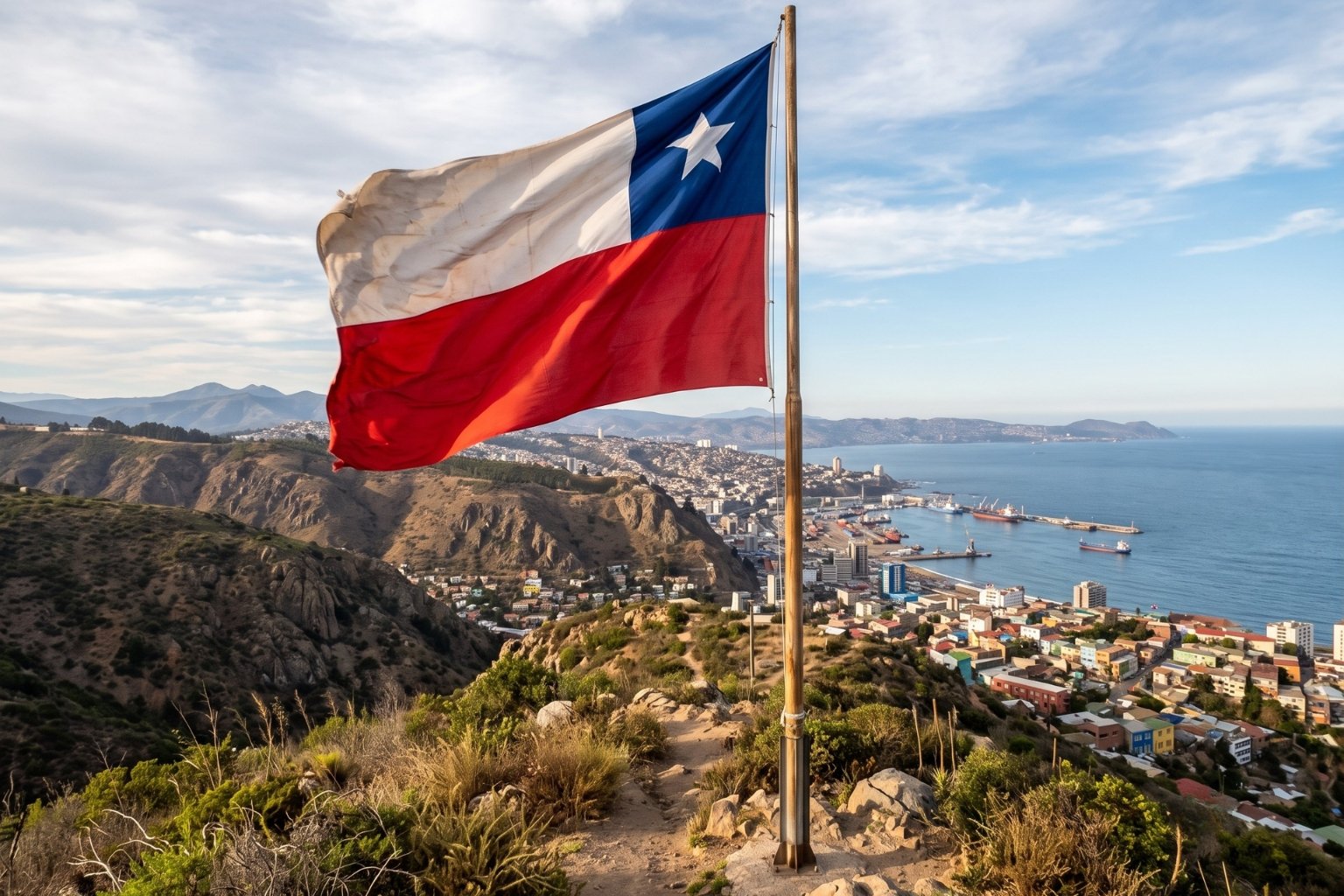

Picture a fonda in full swing during Fiestas Patrias, empanadas on the grill, cueca dancers spinning, and above it all, snapping in the wind, the white, red and blue of the Chile flag. This banner is not a static museum piece. It is stitched into balconies, painted on fishing boats and worn on jackets every September, and its story is older and stranger than most people realize.
What the Chilean Flag Looks Like
The flag is built from two horizontal bands of equal height, white on top and red below. In the upper hoist corner sits a blue square, exactly as tall as the white band, holding a single white star with five points. Chileans often call it La Estrella Solitaria, the Lone Star, and the name fits, since that one star carries most of the flag’s mystery.
The Colors of the Chilean Flag and What They Mean
Each color points to something physical that shapes daily life in Chile, not an abstract ideal invented after the fact.
| Color | Meaning |
|---|---|
| Blue | The sky and the Pacific Ocean |
| White | The snow covered peaks of the Andes |
| Red | The blood spilled during the fight for independence |
Anyone who has driven the Panamericana knows why blue and white made the cut. The Andes are visible from nearly everywhere in central Chile, and the Pacific defines the entire western edge of the country. These are not poetic choices, they are geography made into fabric.
The Meaning of the Star
The star is where historians start disagreeing, and honestly, that disagreement is part of what makes it interesting. One reading says it represents a guide toward progress and honor. Another ties it to Chile’s identity as a unitary state, a single star for a single, centrally governed nation, unlike federal countries whose flags carry a star for each state or province. A third and more contested theory connects the star to the Mapuche and to Venus, a celestial reference with roots going back long before the republic existed. No single explanation has won out, and most serious sources treat the star as layered rather than settled.
Where the Chilean Flag Came From
The Lone Star did not appear fully formed. It is the last in a short line of flags tied to Chile’s break from Spain.
Before Independence, the Patria Vieja Flag
The first version, raised in 1812, used blue, white and yellow stripes. It lasted only until 1814, when Spanish forces retook control and the flag disappeared along with the short lived independence movement that carried it.
The Flag of Transition
When patriot forces regrouped under José de San Martín, a new banner appeared, three equal stripes of red, white and blue. It served as a bridge design, used while the country prepared for the flag that would actually stick.
The 1817 Flag and Its Designers
On October 18, 1817, the current design became official. Credit for pushing the project through usually goes to José Ignacio Zenteno, Bernardo O’Higgins’s Minister of War, though who actually drew the flag is still debated between the Spanish born soldier Antonio Arcos and Gregorio de Andía y Varela. One detail almost no one mentions outside vexillology circles, the original proportions were built on the golden ratio, giving the placement of the star a level of mathematical intention that most flags never bother with.
The Mapuche Connection
This is the thread that turns a history lesson into something closer to a mystery. In the 16th century epic poem La Araucana, the soldier poet Alonso de Ercilla describes Mapuche war bands carrying blue, white and red banners during the Arauco War, centuries before Chile existed as a nation. Whether the republic’s flag deliberately drew from that imagery or simply landed on similar colors by coincidence is still an open question. Either way, it means the flag’s palette may reach back further than the independence movement that made it official.
How the Flag Is Regulated Today
Chile takes its flag seriously enough to write laws around it. Households and businesses are required to display it on specific national holidays, and mistreating it in public is treated as a real offense rather than a minor faux pas. If you are traveling through Chile in early September and notice flags appearing on nearly every window, this is why.
National Flag Day and Fiestas Patrias
Every July 9, members of Chile’s armed forces gather to formally pledge allegiance to the flag, marking the sacrifice of 77 soldiers at the Battle of La Concepción in 1882. The far more visible moment for travelers comes in September, during Fiestas Patrias. For nearly two weeks, flags cover entire neighborhoods, fondas fill public parks, and the Lone Star becomes less a national symbol and more a shared, lived experience.
The Chilean Flag and Its Lookalikes
If the flag looks familiar, there is a reason. Its resemblance to the flag of Texas is close enough that visitors regularly mistake one for the other, though the similarity appears to be coincidence rather than influence, since star and stripe combinations show up independently in flags from Cuba to Liberia.
Next time that flag catches the wind over a market stall in Valparaíso or a fishing pier in the south, it will carry a little more weight, the Andes, the Pacific, a contested star, and a history that starts well before the republic that finally claimed it.
