

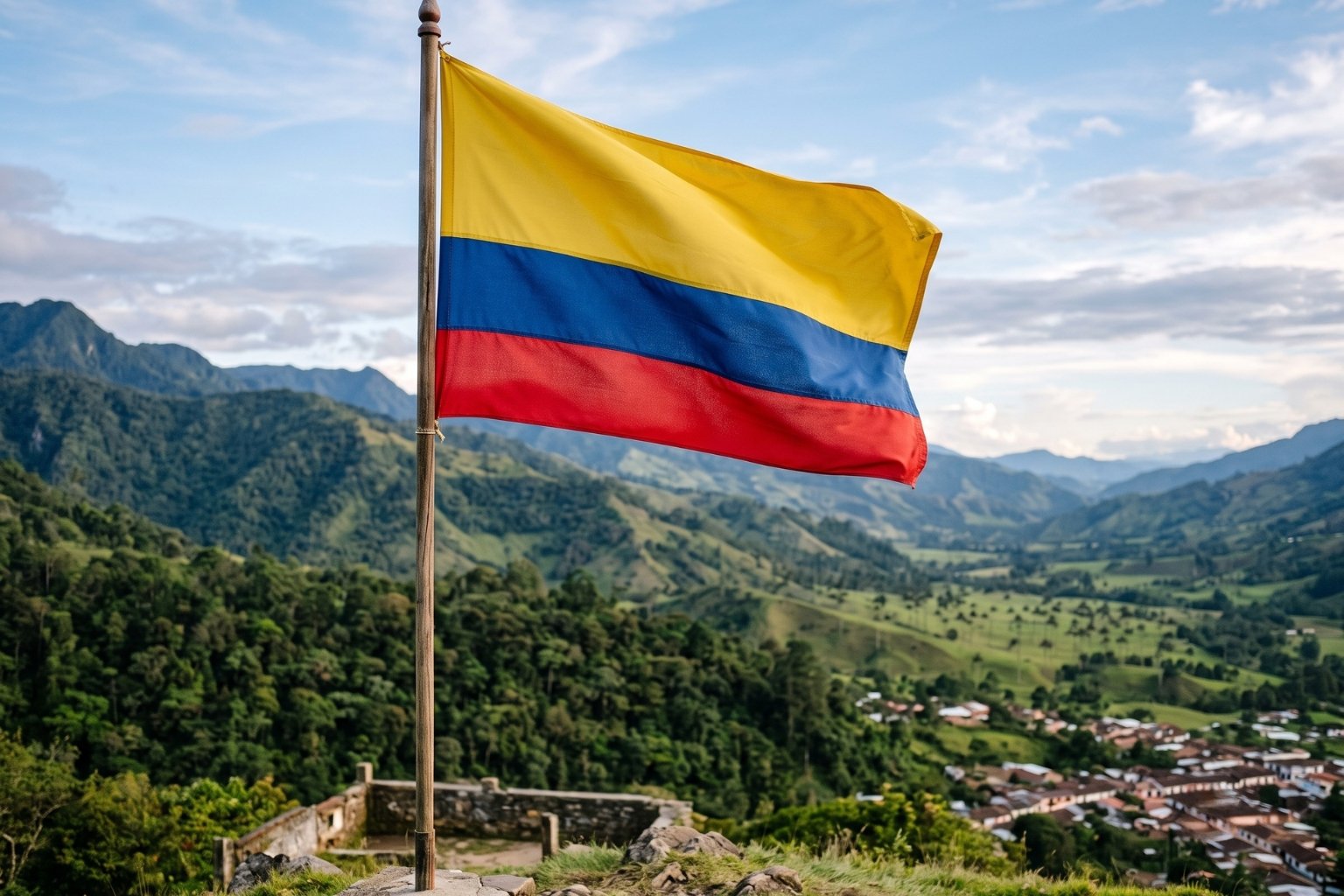

Three bands of yellow, blue and red stretched across a pole tell you more about Colombia than most guidebooks manage in a full chapter. The Colombia flag carries gold rushes, two oceans and a war of independence in a single glance. Here is what each color actually means, where the design came from, and why you will keep spotting it long after you land in Bogotá.
What the Colors of the Colombia Flag Represent
The tricolor is not decorative. Each band was chosen to stand for something specific about the land and the people who fought for it.
Yellow, the widest band
Yellow takes up exactly half the flag, twice the width of the other two stripes combined. It represents the country’s mineral wealth, particularly gold, along with sovereignty, harmony, justice and the sun as a source of light and life.
Blue, the two oceans and the sky
Blue stands for water in every form that matters to Colombia. It evokes the Pacific and the Caribbean, the two oceans that border the country, along with its rivers and open sky.
Red, the price of independence
Red honors the blood spilled during the fight for independence from Spain. It is read today as a symbol of valor, sacrifice and the determination that carried the movement through.
| Stripe | Share of flag | Core meaning |
|---|---|---|
| Yellow | 50 percent | Gold, sovereignty, sun, justice |
| Blue | 25 percent | Oceans, rivers, sky |
| Red | 25 percent | Blood shed for independence, valor |
No Colombian law fixes the exact shade of each color. The tones most commonly used, including in the official flag manual for the 2012 Olympics, follow recommendations from the International Federation of Vexillological Associations rather than a binding national statute.
Where the Colors Actually Came From
Ask five historians why Miranda picked yellow, blue and red, and you will get four different answers. That disagreement is part of the story, and worth knowing before you repeat any single version as settled fact.
Francisco de Miranda and the first flag raised in Haiti
The tricolor traces back to Francisco de Miranda, a Venezuelan revolutionary who requested materials for ten flags in red, yellow and blue as part of a plan he submitted to the British cabinet in 1801. The design was not actually flown until March 12, 1806, in Jacmel, Haiti, during his expedition toward Venezuela. In 1811 the colors were formally presented to the Venezuelan Congress and adopted for the First Republic of Venezuela, the political ancestor of the flag Colombia still flies.
Four theories, one flag
- The Spanish flag theory. Some historians argue Miranda borrowed red and yellow from the Spanish naval ensign, then added blue to represent the ocean separating the new republics from Spain.
- The Columbus coat of arms theory. A related reading ties the palette to the coat of arms granted to Christopher Columbus by the Spanish crown, which also combined red, yellow and blue.
- The Goethe conversation. In a letter Miranda wrote to Count Vorontsov, he described a late night conversation with Johann Wolfgang von Goethe in Weimar in 1785 about how the human eye processes primary colors, an account many historians treat as more legend than documented origin.
- The modern popular reading. The interpretation most Colombians grow up with skips the historical debate entirely and lands on the version taught in schools today, yellow for the land’s riches, blue for its oceans, red for its people’s sacrifice.
From Gran Colombia to Today, How the Flag Changed Shape
The tricolor you see today is not the one Bolívar fought under. The design shifted more than once as the country’s borders and government changed.
| Year | Event | Design |
|---|---|---|
| 1810 | Uprisings begin against Spanish rule | Each rebel region flies its own separate banner |
| 1819 | Battle of Boyacá secures independence | Gran Colombia adopts the horizontal yellow, blue, red tricolor |
| 1834 | New Granada period | Stripes turn vertical, a white star with eight points added at center |
| 1861 | Gran Colombia has long since dissolved | Government reverts to horizontal yellow, blue, red, the version still in use |
Local uprisings against Spanish rule started on July 20, 1810, in Bogotá and spread quickly to Cartagena, the Cauca valley and Antioquia, each region proclaiming independence under its own flag. Simón Bolívar’s victory at the Battle of Boyacá on August 7, 1819, ended that fragmentation and gave the new republic its first shared tricolor. When Gran Colombia broke apart, New Granada briefly switched to vertical stripes with a white star before the government settled permanently on the horizontal design on November 26, 1861, later reinforced by decrees in 1924 and 1934.
Colombia, Ecuador, Venezuela, Same Colors Different Flags
If the flag looked familiar the moment you saw it, that is because Colombia shares its color story with two neighbors that were once part of the same republic.
| Country | Stripe proportions | Central emblem | Notes |
|---|---|---|---|
| Colombia | Yellow 2, blue 1, red 1 | None on the standard flag | Emblem free civil flag, coat of arms only on official state versions |
| Ecuador | Yellow 2, blue 1, red 1 | Coat of arms at center | The closest match to Colombia’s proportions |
| Venezuela | Yellow 1, blue 1, red 1 | Stars, coat of arms depending on version | Equal stripes make it the most conventional tricolor of the three |
All three flags descend from the banner Miranda designed for Gran Colombia, the short lived republic that once united what are now Colombia, Venezuela and Ecuador. Ecuador stays closest to Colombia in structure, while Venezuela’s evenly sized bands set it apart at a glance.
The Flag in Colombian Life Today
Knowing the history is one thing. Seeing where it still plays out is what turns a fact into something worth noticing on the ground.
Independence Day and Flag Day
Colombia marks its break from Spanish rule every July 20, and returns to the flag again on August 7, the anniversary of the Battle of Boyacá, which doubles as national Flag Day. Schools across the country hold ceremonies that morning, raising the tricolor and walking students through what each color stands for.
Where travelers can see the story up close
The Puente de Boyacá, a bridge and monument near Tunja in the Boyacá department, marks the exact site of the battle that secured independence, and draws visitors well beyond the anniversary date. Bogotá’s Plaza de Bolívar flies the flag at full scale in front of the Capitolio, and Cartagena’s colonial balconies fill with smaller versions during national celebrations, giving the same colors a very different backdrop.
Everyday presence
Outside of official holidays, the tricolor shows up on the national football jersey during World Cup years, on coffee packaging aimed at both local and export markets, and tied to motorbikes and taxi mirrors whenever there is something worth celebrating.
Quick Facts
| Detail | Value |
|---|---|
| Current design adopted | November 26, 1861 |
| Width to length ratio | 2 to 3 |
| Stripe proportions, top to bottom | Yellow 2, blue 1, red 1 |
| Independence Day | July 20 |
| Battle of Boyacá and Flag Day | August 7 |
Frequently Asked Questions
Does Colombia have a law fixing the exact flag colors? No. There is no national law setting precise shades, only recommended colors approved by the International Federation of Vexillological Associations, the same ones used in official manuals like the one prepared for the 2012 Olympics.
What is the difference between the civil flag and the state flag? The everyday civil flag is a plain tricolor with no emblem. Official versions used by the government and armed forces add the national coat of arms at the center for formal purposes.
Why is the yellow stripe twice as wide as the others? The proportion dates back to the 1861 arrangement and has stuck ever since, visually reinforcing yellow’s symbolic weight as the color of the country’s wealth and abundance.
Is Colombia’s flag the same as Ecuador’s? Nearly. Both use the same 2 to 1 to 1 stripe proportions inherited from Gran Colombia. The main difference is that Ecuador’s official state flag adds a coat of arms at the center, while Colombia’s standard flag stays emblem free.
