

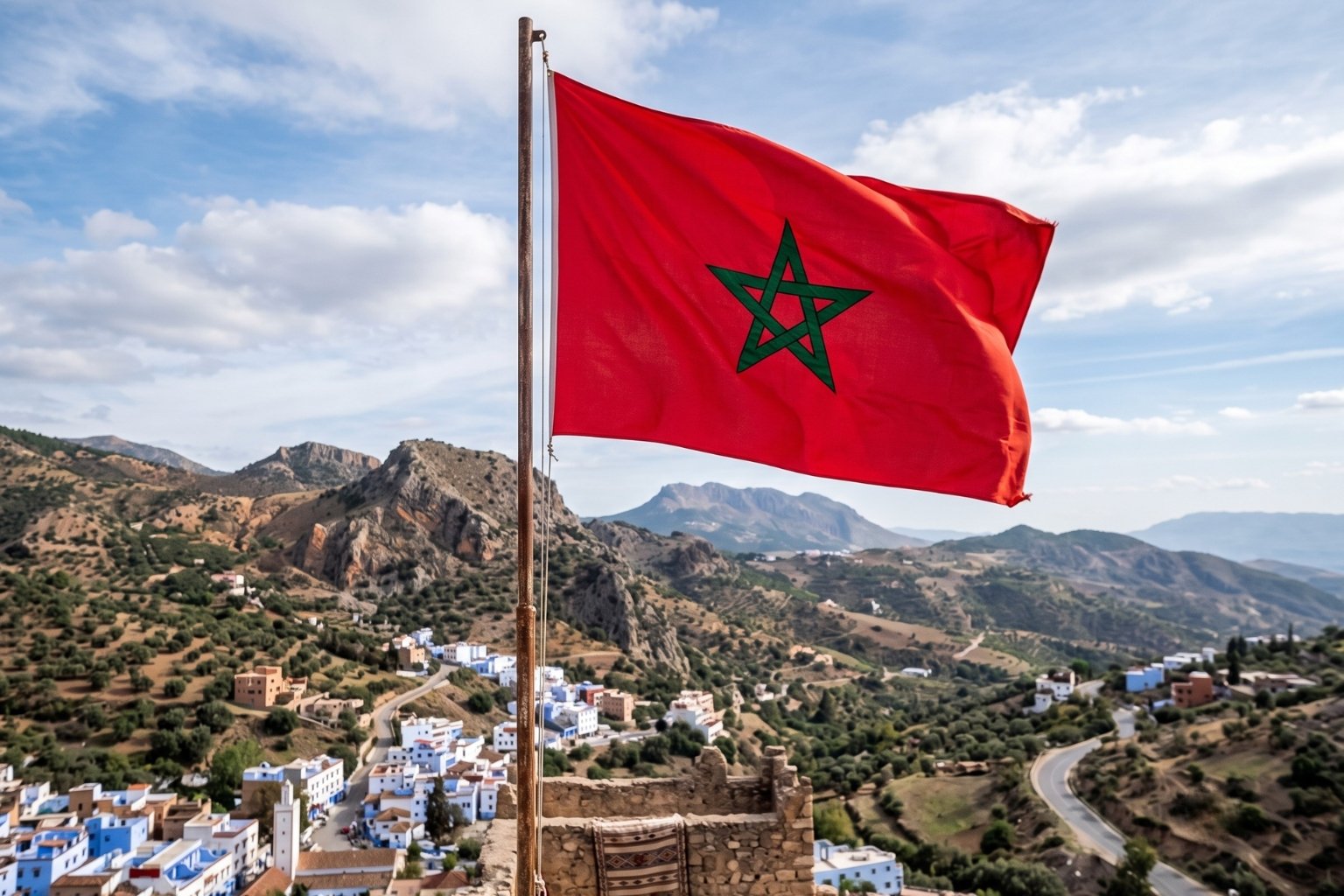

A single red field, one green star at its center. That is all the Morocco flag needs to carry seven centuries of dynasties, a fight for independence, and a faith that still shapes daily life from Tangier to the Sahara. Once you know how to read it, you start noticing it everywhere: over the Hassan Tower in Rabat, on a taxi dashboard in Fez, snapping above a stadium in Casablanca on match day.
What the Moroccan Flag Looks Like Today
The design is deceptively simple. A vivid red rectangle fills the entire field, and at its exact center sits a green five pointed star, open in shape, with one point always facing upward.
Moroccan law is precise about the proportions, down to the fraction of the flag’s length. Here is the flag at a glance.
| Element | Detail |
|---|---|
| Field color | Bright red |
| Star color | Palm green |
| Star shape | Open pentagram, five points, one facing up |
| Ratio (height to length) | 2 to 3 |
| Adopted | 17 November 1915 |
| Also used at sea since | 1956, after independence |
No other information is legally specified about the exact shade of red or green, which is why you will sometimes see slightly different tones on flags made in different countries.
The Meaning Behind the Colors and the Star
Red, a Color Older Than the Flag Itself
Red did not arrive with this flag. It arrived centuries earlier, tied to the Alaouite dynasty, which has ruled Morocco since the seventeenth century and traces its lineage to the Prophet Muhammad through his daughter Fatima and her husband Ali.
The same red was historically used by the sharifs of Mecca and the imams of Yemen, a detail that ties Morocco’s flag to a much wider network of dynasties claiming descent from the Prophet. In Morocco specifically, the color has come to represent strength, hardiness, and the sacrifice of those who defended the kingdom.
The Green Star, the Seal of Solomon
The star is not a generic decoration. It is the Seal of Solomon, a pentagram with roots stretching across Amazigh, Jewish, and Islamic traditions long before it appeared on any flag. In Moroccan popular belief, it is often read as a nod to the five pillars of Islam, though this interpretation came after the fact rather than being written into the 1915 decree itself.
Green itself carries its own layered symbolism in Moroccan culture: nature, hope, wisdom, and above all Islam, the color long associated with paradise in the Quran. Together, red and green form a combination you will recognize instantly the moment you land, painted on riad doors, worked into zellige tilework, echoed in the walls of Chefchaouen’s neighbor cities.
From a Blank Banner to a National Symbol, the Flag’s Origin
Morocco’s flag did not appear out of nowhere. Each ruling dynasty left its own banner behind, and the current design is really the last chapter of a much longer story.
- The Idrisid dynasty, Morocco’s first Islamic dynasty founded in the eighth century, flew a plain white banner.
- Later dynasties, including the Almohads, shifted toward a solid red field, a color choice tied to their military identity.
- When the Alaouite dynasty rose to power in the seventeenth century, it kept a plain red flag as its own emblem, a flag that remained unchanged for over two hundred years.
- On 17 November 1915, Sultan Yusef signed a dahir adding the green pentagram to the center of the red field. The goal was practical as much as symbolic: Morocco’s plain red flag looked too similar to other red flags used at sea, and a distinct national symbol was needed.
That one decree, more than three centuries after the Alaouites first adopted red, is what gave Morocco the flag it still flies today.
Colonial Restrictions and the Road to Independence
Between 1912 and 1956, Morocco lived under French and Spanish protectorate rule, and even the flag was not spared from colonial restriction. It could be flown inland, but it was banned at sea, a small but telling detail about how much sovereignty had been stripped away.
The turning point came through Sultan Mohammed V. Exiled by French authorities in 1953 for refusing to accept limited autonomy, he returned to Morocco on 16 November 1955 to a jubilant welcome. Two days later, on 18 November 1955, he delivered his throne speech in Rabat announcing the end of the protectorate era, a date Morocco still marks every year as Eid al Istiqlal, Independence Day, even though full sovereignty was formally granted by France on 2 March 1956 and by Spain on 7 April of the same year.
Morocco kept its flag exactly as it was. No redesign, no new symbol. After independence, the same red field and green star that had flown inland for four decades finally earned the right to fly at sea too.
Where You Will Actually See the Flag in Morocco
Beyond government buildings and royal palaces, the flag lives in the rhythm of ordinary Moroccan life, and travelers who know where to look get a much richer sense of the country.
- Draped across home balconies during royal celebrations and national holidays.
- Waved by the thousands inside stadiums when Raja Casablanca or Wydad AC play a derby.
- Hoisted at school entrances, where children sing the national anthem during morning assembly.
- Flying at full mast around Rabat’s Hassan Tower, the Mausoleum of Mohammed V, and Casablanca’s Hassan II Mosque.
- Everywhere on 18 November, when cities fill with parades and the flag becomes almost impossible to avoid.
Flag Etiquette Travelers Should Know
Moroccans take flag etiquette seriously, and it is worth knowing the basics before you photograph or handle one out of curiosity.
- Never let the flag touch the ground, even by accident.
- Do not use it as a tablecloth, costume, or casual decoration.
- A worn or damaged flag is retired with respect, traditionally burned in private, never thrown away carelessly.
- At sites with multiple flags, the Moroccan flag should never be flown lower than a foreign one, a detail read as a matter of national dignity.
How It Compares to Similar Flags
If Morocco’s flag felt familiar the first time you saw it, there is a reason. Several nearby flags share the same color palette or the same core symbols.
| Country | Design | Shared element with Morocco |
|---|---|---|
| Algeria | Green and white field with a red star and crescent | Islamic star symbolism, though different colors and layout |
| Tunisia | Red field with a white circle, red crescent and star | Same dominant red field |
| Turkey | Red field with a white crescent and star | Same dominant red field and star motif |
| Bahrain | Red field with a white serrated stripe | Same dominant red field |
Morocco is the only one of these to use a pentagram rather than a crescent, which remains the quickest way to tell it apart at a glance.
Frequently Asked Questions
What do the colors of the Moroccan flag mean? Red represents the Alaouite dynasty, strength, and sacrifice. Green, used for the star, represents Islam, hope, and wisdom.
When was the Moroccan flag adopted? The current design dates to 17 November 1915, when Sultan Yusef added the green star to the existing red field.
What does the green star on the Moroccan flag represent? It is the Seal of Solomon, a symbol with pre Islamic roots that is commonly linked in Morocco to the five pillars of Islam.
What is the ratio of the Moroccan flag? Two to three, meaning the height equals two thirds of the length.
Is the Moroccan flag the same as Algeria’s or Turkey’s? No. Morocco is the only country among its neighbors to use a five pointed star rather than a crescent, even though the red field is shared with several other flags in the region.
