

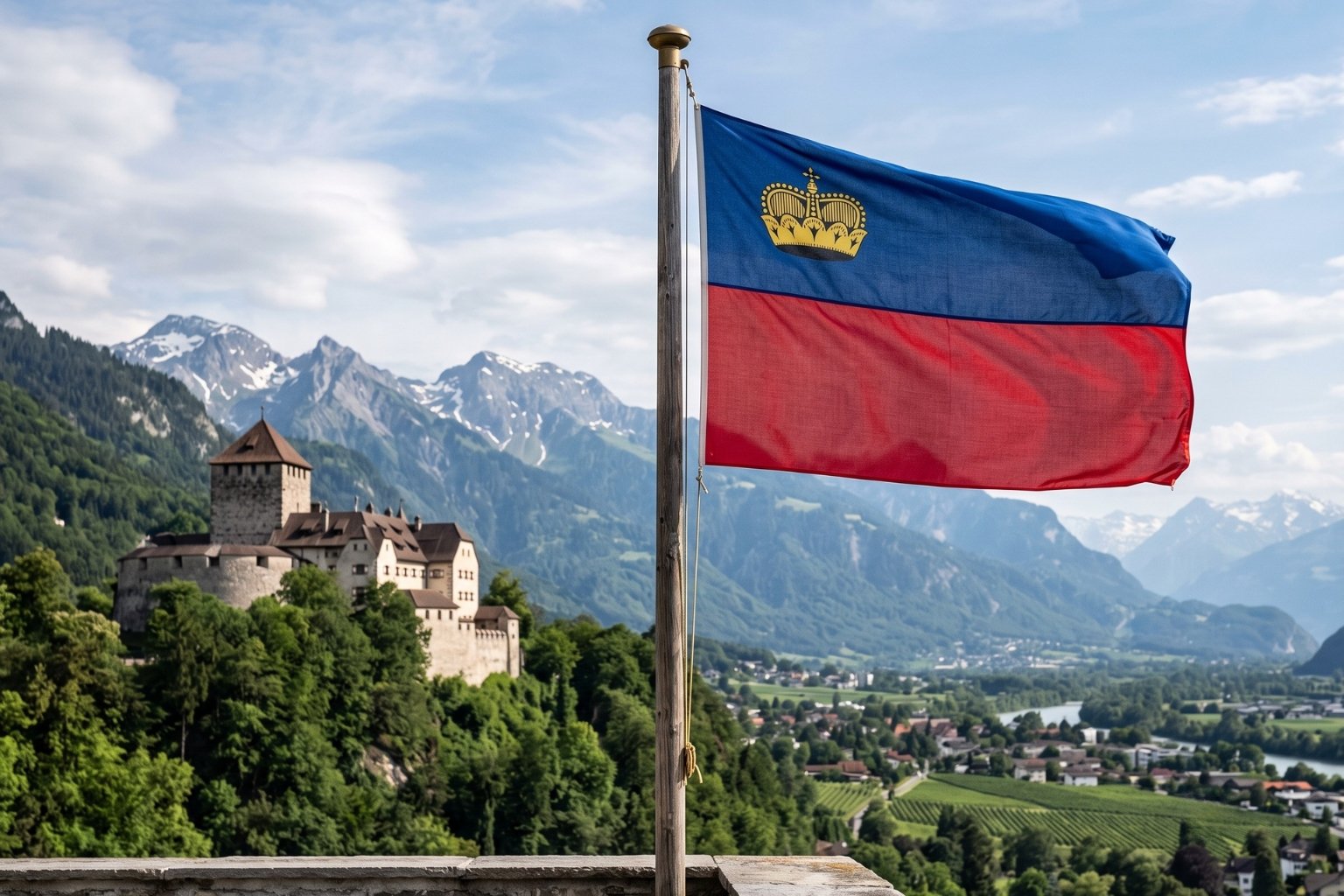

Two horizontal bands, one blue on top, one red below, with a small gold crown resting in the corner. That is the Liechtenstein flag, and it happens to be one of the only national banners in the world modified specifically because it kept getting confused with another country’s. Behind that simple geometry sits three centuries of princely history, a genuinely awkward Olympic moment, and colors tied to real mountain households rather than abstract symbolism.
What the Liechtenstein flag looks like
The flag is a horizontal bicolor. Blue occupies the top half, red the bottom half, in two equal bands. In the upper corner nearest the flagpole sits a small gold crown, tilted slightly toward the center of the flag rather than standing upright.
The official width to length ratio is 3:5, a proportion less common than the 2:3 used by neighbors like Austria or Switzerland. Flown side by side with those flags, Liechtenstein’s looks a touch more compact and square.
What the colors and crown mean
Every element on the flag points to something specific about the country, not a generic royal palette borrowed for its own sake.
| Element | What it represents |
|---|---|
| Blue | The alpine sky over the principality |
| Red | The evening fires once lit inside homes across the valleys |
| Gold crown | The bond between the reigning prince and the population, and the country’s identity as a monarchy |
The red stripe in particular carries a lived detail most flag explanations skip. Those household fires were not just for warmth. In a small, mountainous territory, a lit hearth visible from a neighboring farm or village was a quiet form of communication, a sign that someone was home and the valley was calm.
Where the colors actually come from
Blue and red reached the flag through the royal household, not through the coat of arms. In 1764, Prince Joseph Wenzel I adopted these two colors as his court’s livery, meaning they appeared on the clothing worn by his servants, on ceremonial ribbons, and on the seals attached to official documents.
That is close to a century before anyone thought to put them on a national flag. When Liechtenstein eventually needed one, the livery colors were simply the ones already tied to the ruling house, so they carried over naturally.
The flag’s history, step by step
| Year | What happened |
|---|---|
| 1719 | Liechtenstein becomes a principality within the Holy Roman Empire. Its first flag uses the coat of arms colors, gold over red |
| 1852 | Blue and red, the princely livery colors, are adopted for the flag, arranged as vertical stripes |
| 1921 | A new constitution makes the flag official and switches the design to horizontal bands |
| 1936 | At the Berlin Summer Olympics, Liechtenstein’s delegation realizes the flag is identical to Haiti’s |
| 1937 | A gold crown is added on June 24 to distinguish the two flags |
| 1957 | The shape of the crown is slightly refined |
| 1982 | The current version of the crown is formally adopted on June 30 |
The Haiti mix up, and why it still comes up
At the 1936 Summer Olympics in Berlin, Liechtenstein’s delegation noticed something uncomfortable. Their flag, a plain blue and red bicolor with no emblem, was identical to Haiti’s civil flag at the time.
Nobody had caught this in the decades the design had already been in use. The two countries simply had little reason to fly their flags next to each other before an international event forced the comparison.
The following year, on June 24, 1937, Liechtenstein added the gold crown specifically to end the confusion and to underline its status as a principality rather than a republic. Haiti’s own flag has since changed too, gaining a central coat of arms, so the two are not visually close today even without the crown.
Flag versus coat of arms, the confusion nobody clears up
People researching this flag often stumble onto Liechtenstein’s coat of arms and assume they are looking at the same symbol. They are not.
The coat of arms uses a shield split into orange and red, topped with a princely hat, and combines several older heraldic elements, including the arms of Silesia and the Kuenring family, reflecting territories once tied to the House of Liechtenstein.
The flag, on the other hand, uses only the household livery colors, blue and red, plus the crown. Both symbols point to the same monarchy, but they come from two entirely different sources. One from heraldic history, the other from court fashion.
The flag in daily and national life
On National Day, August 15, flags appear outside private homes across the country, not only on government buildings, which gives this small principality a genuinely visible wave of blue and red for the occasion.
Each of Liechtenstein’s 11 municipalities also flies its own flag, and nearly all of them use a long vertical banner format rather than the horizontal rectangle most people expect. It is a small, unusual local detail worth noticing if you happen to be traveling through.
Visitors who make the trip to Vaduz, easily reached from Zurich by train and bus since Liechtenstein has no airport of its own, will see the national flag flying above government buildings, the castle overlooking the capital, and along the crossings from Switzerland.
Quick facts
| Fact | Detail |
|---|---|
| Current design adopted | June 30, 1982 |
| Crown first added | June 24, 1937 |
| Proportions | 3:5 |
| Legal basis | Law on the Coat of Arms, Colors, Seal and Flags of the Principality of Liechtenstein |
| Blue (common digital approximation) | #002B7F |
| Red (common digital approximation) | #CE1126 |
| Gold (common digital approximation) | #FFD83D |
| National Day | August 15 |
| Population of Liechtenstein | Around 38,000 |
The exact official shades are set by government standard rather than a single universal Pantone reference, so the hex values above reflect the commonly used digital equivalents rather than a legally binding code.
Frequently asked questions
Why does Liechtenstein’s flag look like Haiti’s?
It did, until 1937. Both countries independently used a plain blue and red horizontal bicolor, and the overlap only became obvious when Liechtenstein noticed it at the 1936 Olympics. The gold crown was added the following year specifically to tell the two apart.
What do the colors of the Liechtenstein flag mean?
Blue represents the alpine sky over the principality, and red recalls the evening fires once lit inside homes across the valleys. The gold crown stands for the unity between the reigning prince and the people.
When was the crown added to the flag?
The crown was first added on June 24, 1937. Its shape was refined in 1957 and again in 1982, when the current version was formally adopted on June 30 of that year.
What are the official colors of the flag?
Liechtenstein’s law defines the flag as blue, red, and gold. For digital and print use, the widely used approximations are #002B7F for blue, #CE1126 for red, and #FFD83D for gold, though the government standard does not publish a single universal Pantone code.
