

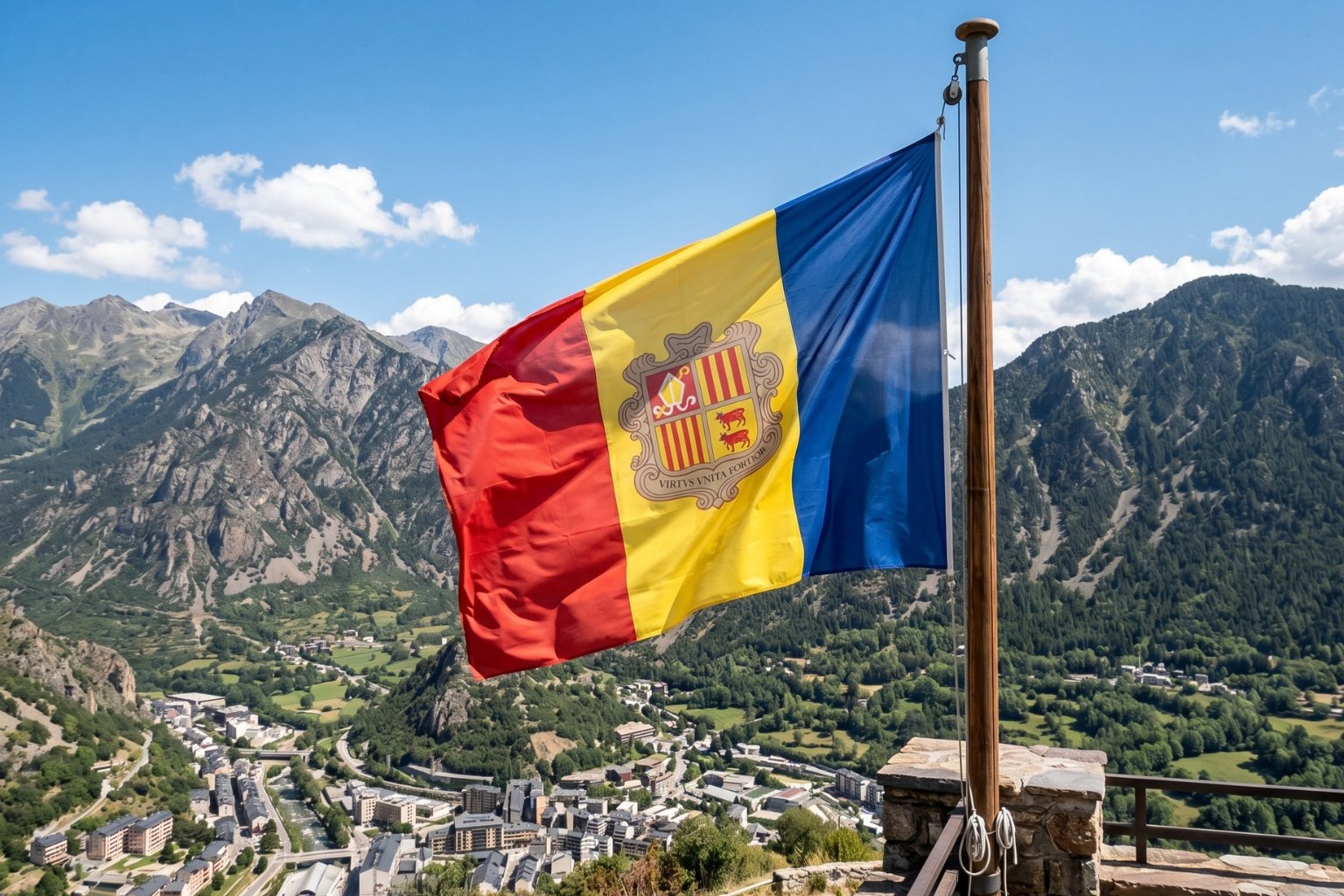

Andorra is easy to overlook on a map. Wedged between France and Spain in the eastern Pyrenees, it covers less than 470 square kilometers and has a population smaller than most mid-sized European cities. But its flag rewards attention. Three vertical stripes, a coat of arms dense with medieval heraldry, and colors borrowed from two neighboring nations: everything about it encodes a political arrangement so unusual it has lasted over seven centuries.
What the Andorra Flag Looks Like
The flag of Andorra consists of three vertical stripes in blue, yellow, and red, arranged left to right. The central yellow stripe is slightly wider than the other two, and the coat of arms is centered on it. Beneath the shield runs the Latin motto “Virtus unita fortior”, which translates as “Strength united is stronger.”
The flag follows a standard 2:3 ratio. It serves simultaneously as the national flag and the civil flag. For centuries, private citizens flying the banner typically omitted the coat of arms altogether, displaying only the three colored stripes.
The Colors of the Andorra Flag and What They Represent
Blue, Yellow, Red: A Shared Inheritance
There is no official, legally defined symbolic meaning attached to each color of the Andorra flag. What the colors do carry is something more concrete and more interesting: geopolitical memory.
Blue and red mirror the French Tricolore. Yellow and red echo the Spanish flag and the traditional colors of Catalonia. The Andorra flag essentially holds both neighbors inside itself at once, a visual summary of the co-sovereignty arrangement that has defined the country since the 13th century.
Some sources assign abstract values to each color: blue for loyalty, yellow for wealth, red for courage. These associations are plausible but unofficial. The honest reading is simpler and more telling: the colors are not symbols of national character. They are an acknowledgment of history and dependency, worn openly on a banner.
Why the Stripes Are Vertical and Unequal
The choice of vertical stripes aligns Andorra visually with France rather than Spain, whose flag uses horizontal bands. It was not an accident. Vertical stripes carried the suggestion of the French republic, of modernity, of a particular kind of political alignment.
The unequal widths of the stripes, with the yellow center band slightly broader, are often linked to the vexillological tradition of Aragon, whose historical banners featured stripes of varying proportions. It is a small detail, but in a flag this compact and historically layered, small details tend to mean something.
The Coat of Arms: Four Shields, One History
The coat of arms at the center of the Andorra flag is a quartered shield. Each quarter represents one of the four historical powers that shaped the country. Read together, they are a compressed history of Andorran co-sovereignty.
Top left: The Bishop of Urgell. A golden mitre and crosier on a red background. The Bishop of Urgell, based in what is now northeastern Spain, has been one of Andorra’s two co-princes since the 13th century. His presence on the coat of arms signals the deep interweaving of religious and political authority in Andorran governance, an arrangement that has no equivalent anywhere else in Europe.
Top right: The Count of Foix. Three red bars on a golden background. The County of Foix, now part of southwestern France, was the secular counterpart to the bishop’s religious authority. The counts of Foix were warriors and lords; their arms appear on the flag of a country that has not fought a war in centuries.
Bottom left: Catalonia and the Crown of Aragon. Four red vertical bars on gold, the iconic symbol of Catalonia and the historical Crown of Aragon. Andorra’s Iberian ties run through this quarter, a reminder of the complex web of feudal allegiances that once governed every inch of the Pyrenees.
Bottom right: Béarn. Two red cows on gold. Béarn was a territory in what is now the French department of Pyrénées-Atlantiques. The counts of Foix also held Béarn, and when that title eventually passed to the kings of France, Béarn’s two cows came with it, ending up on the flag of a microstate they no longer have any practical relationship with.
The motto beneath the shield, “Virtus unita fortior,” is not a platitude. It is a precise description of Andorra’s founding logic: that two powers sharing sovereignty over one territory are stronger together than either would be in competition. Seven hundred years of uninterrupted independence have not proven that idea wrong.
The History of the Andorra Flag
1278: The Paréage That Built the Flag’s DNA
The document that made the Andorra flag inevitable was signed in 1278. Known as the Paréage, it was a treaty between the Bishop of Urgell and the Count of Foix establishing joint sovereignty over the valleys of Andorra. Neither party could afford to let the other dominate this strategic Pyrenean corridor. Shared control was the pragmatic solution.
The Paréage did not create a flag. But it created the political reality that the flag would eventually have to represent. The coat of arms that now sits at the center of the banner is a direct visual translation of that 13th-century agreement. The bishop’s mitre, the count’s bars, Catalonia’s stripes, Béarn’s cows: all of it flows from a single medieval compromise.
A centuries-old carving of the coat of arms is still visible on the exterior wall of the General Council of the Valleys, Andorra’s national parliament in Andorra la Vella.
1806 to 1866: From Two Colors to Three
The first formal versions of the Andorra flag appeared in the early 19th century, around 1806. They featured only two colors: yellow and red, the colors of the County of Foix and of Catalonia. Horizontal stripes appeared on some versions; vertical stripes on others. The design was inconsistent and uncodified.
In 1866, the blue stripe was added, completing the tricolor as it exists today. The addition of blue brought France’s color into the flag explicitly, at a moment when Andorra was undergoing political reforms and asserting its particular form of autonomy more clearly. The British travel writer Harold Spender, visiting around that period, noted that the flag “originated in the reform of 1866 to emphasize the autonomy of the valley,” and that neither France nor Spain had formally approved it. It flew nonetheless.
1934: Thirteen Days of Boris I
In July 1934, a Russian-born adventurer named Boris Skosyrev arrived in Andorra and, with a combination of charm and audacity, persuaded the General Council to proclaim him Boris I, King of Andorra. He immediately adopted a modified version of the flag: a horizontal tricolor with a crown placed at the center of the yellow stripe.
The experiment lasted thirteen days. The Bishop of Urgell, one of the two co-princes, refused to recognize the new king, contacted Spanish authorities, and had Boris arrested. He was expelled from the country, the horizontal flag was abandoned, and the vertical tricolor with the coat of arms was restored.
The episode reads as farce. But it is also a precise illustration of how fragile the symbols of sovereignty can be, and how quickly they are contested when authority itself is in question. The Andorran flag survived Boris I unchanged.
1993: The Flag Made Official
For most of its history, the Andorra flag had no legal foundation. Its design was customary, its proportions approximate, its coat of arms present or absent depending on who was flying it.
That changed in 1993, when Andorra adopted its first written constitution and joined the United Nations. As part of the process of formalizing statehood, the flag was officially standardized: fixed proportions, mandatory coat of arms, precise colors. The banner that had existed informally for over a century finally had legal standing.
Andorra’s admission to the United Nations, flying this flag, was also a quiet statement: that a country governed jointly by a Spanish bishop and the French president, with no army, no airport, and fewer than 80,000 inhabitants, had a legitimate place among the world’s sovereign nations.
The Andorra Flag Today
The flag flies across Andorra la Vella and the country’s seven parishes: Andorra la Vella, Canillo, Encamp, Escaldes-Engordany, La Massana, Ordino, and Sant Julià de Lòria. Each parish also has its own separate flag, but the national tricolor remains the primary symbol of the state.
The situation it represents has not changed in its essentials since 1278. Andorra still has two co-princes: the Bishop of Urgell and the President of France, currently Emmanuel Macron. It remains the only country in the world with two heads of state from different sovereign nations, and the only one where a head of state is determined by another country’s election results.
The coat of arms on the flag still shows the bishop’s mitre. It still shows the cows of Béarn. The Latin motto still reads “Strength united is stronger.”
For a flag that was never designed to be permanent, it has turned out to be remarkably durable.
