

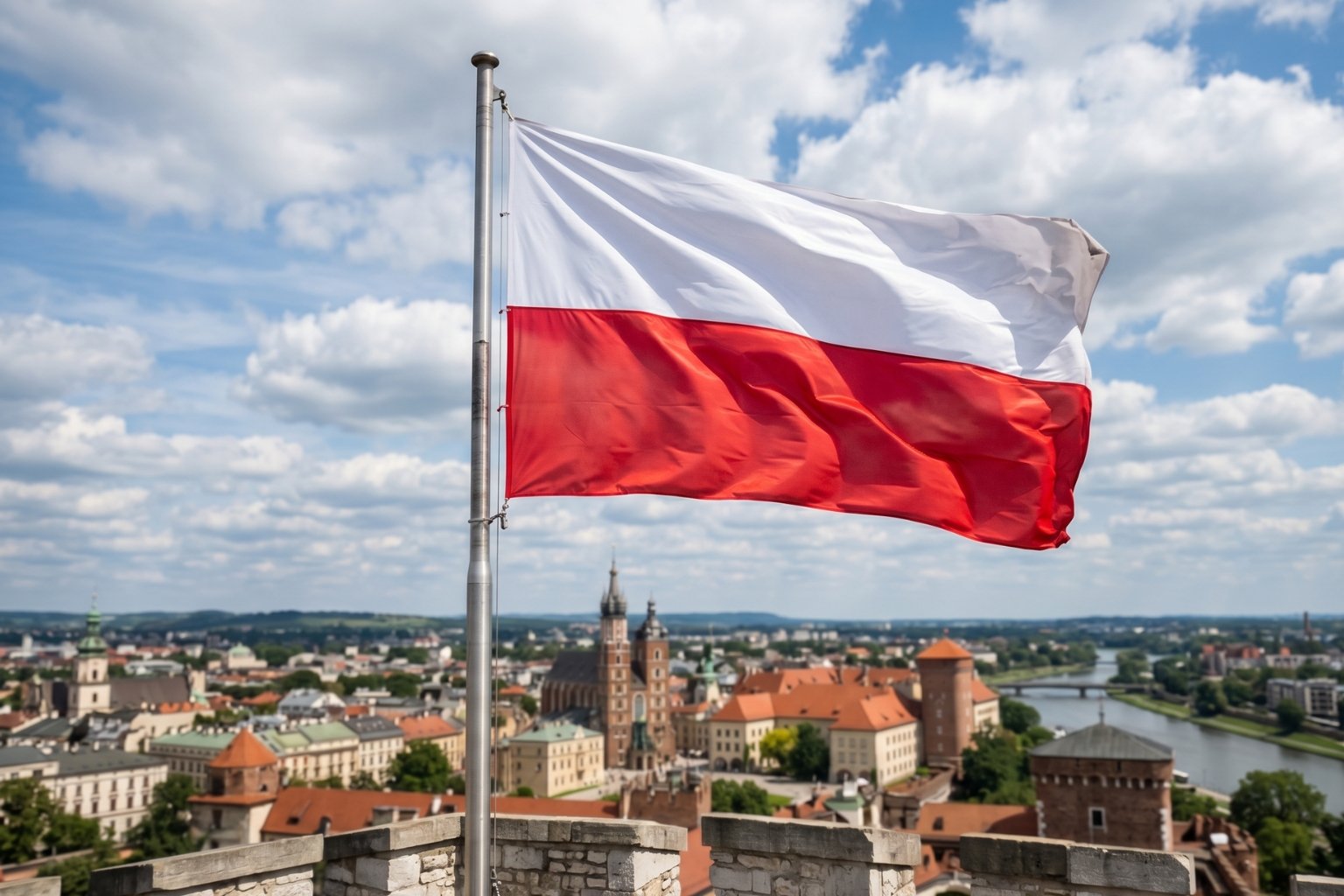

Two horizontal stripes. No emblem on the version most people know. No text, no star, no intricate seal. The Polish flag is one of the most stripped-back national symbols in the world, and yet it carries more history per square centimeter than almost any other. White over red: a formula that survived partition, occupation, uprising, and the slow collapse of communism. Understanding it means understanding something essential about Poland itself.
What Does the Polish Flag Look Like?
A Bicolor with a Precise Order
The flag of Poland is a horizontal bicolor: two equal rectangular stripes, white on top and red on the bottom. Its proportions follow a 5:8 ratio (height to width), and the exact shades are defined by law since 1980 using the CIELUV color model, the result of a surprisingly long national debate about the right shade of red that stretched from 1919 to 1980, passing through crimson, cinnabar, and several legislative compromises along the way.
In Polish, the flag is simply called the biało-czerwona, “the white and red.” The phrase is not bureaucratic. It is the name a grandmother uses. It is what sports commentators say when the crowd waves it. It belongs to the language of emotion, not administration.
Civil Flag vs. State Flag
There are technically two versions of the Polish flag, and the confusion between them is common.
The civil flag is the familiar white-and-red bicolor with no additional markings. This is the version flown by citizens, hung from apartment windows on national holidays, and waved in stadiums.
The state flag (also called the flag with the coat of arms) bears the crowned white eagle centered on the white stripe. This version is used by Polish diplomatic missions, official state institutions, and the merchant navy abroad. It is not the flag most people picture when they think of Poland, but it is the one that carries the full weight of the national emblem.
The Colors of the Polish Flag and Their Meaning
White: More Than Purity
White in the Polish flag does not simply mean purity in the greeting-card sense of the word. Its origins are heraldic: in the language of medieval coats of arms, white stands for argent, silver, one of the two metals in classical heraldry. On the Polish coat of arms, it is the color of the eagle itself, a white eagle on a red shield, documented since at least the 13th century.
The modern, more accessible reading attributes to white the values of honor, peace, and truth. These interpretations came later, overlaid on a much older visual logic. The stripe is white because the eagle is white. Everything else is commentary.
Red: From Crimson to Courage
Red in Poland has never been a simple color. For centuries, Polish nobility was among the most extravagant consumers of crimson dye in Europe, an expensive pigment that signaled rank, prestige, and royal proximity. Early Polish banners were not the bright red we see today but a deep, costly crimson that quite literally announced wealth.
Over time, as flags multiplied through wars and uprisings, the practical need for cheaper dye shifted the palette toward a more standard red. The heraldic meaning followed its own track: red stood for courage, the valor of soldiers, the blood paid in defense of the nation.
The color’s political valence became particularly charged during the communist period, when red carried ideological weight across the Eastern Bloc. In Poland, the flag’s red was never surrendered to that association. It was always older than the ideology.
Why White on Top?
The stripe order is not arbitrary, and it was not always agreed upon. Before 1919, Polish flags appeared with red on top and white on the bottom, or the reverse, depending on who was making them and why.
The definitive answer came from the coat of arms itself. On the shield, the white eagle sits above the red background. When the flag was formalized in August 1919, the Legislative Sejm followed this logic precisely: white on top, red on the bottom. The flag mirrors the emblem. The order is a visual argument.
The Origins of the Polish Flag: A Medieval Foundation
The Legend of Lech and the White Eagle
Every origin has its myth, and Poland’s is worth knowing. According to founding legend, Lech, the chieftain of the Polanie tribe and the ancestral founder of the Polish state, was hunting when he came upon a great white eagle perched in a nest against a sky blazing red at sunset. He took it as a sign. He planted his standard there and called the place Gniezno, from gniazdo, the Polish word for nest.
The white eagle on a field of red, the coat of arms, the flag, the national symbol: all of it begins here, in a story old enough that no one knows exactly when it was first told. Its power is not in its historical accuracy but in what it chooses to remember: a bird, a sky, a land claimed by looking upward.
The Coat of Arms as the True Source
The first recorded use of the Polish coat of arms, a white eagle on a red shield, dates to the 13th century. The choice of colors is not entirely explained by the historical record. One compelling theory, noted by Britannica, is that the contrast with the Holy Roman Empire was deliberate: where the Empire used a black eagle on gold, Poland answered with white on red. A neighboring difference, a declaration of distinction made in pigment.
For centuries, Polish flags were essentially armorial banners: the coat of arms translated directly onto cloth. There was no abstract bicolor. The eagle was always present. The shift toward a simpler, stripe-based design came much later, shaped by the logic of modern nation-states and the need for a flag that could be read from a distance, produced cheaply, and carried by ordinary people rather than knights.
A Flag Forged Through Uprisings and Occupation
1792: The First Public Use of White and Red
The colors did not become a popular national symbol all at once. A decisive early moment came in 1792, during celebrations marking the first anniversary of the May 3rd Constitution, one of the earliest modern constitutions in the world. Polish patriots appeared wearing white and red cockades and ribbons, a spontaneous, public claiming of heraldic colors as the colors of a people.
This was a political act dressed as a fashion choice. Poland was already under enormous pressure from its neighbors. Wearing the colors was a way of saying something that could not yet be said openly.
The November Uprising of 1830 and the Road to 1831
When Polish forces rose against Russian rule in November 1830, the white and red followed them into the streets and onto the barricades. The uprising was crushed within a year, but it left a legal trace: in 1831, red and white were officially recognized as the national colors of Poland for the first time.
Recognition in the middle of defeat is its own kind of statement. The colors survived the uprising even when the uprising did not.
August 1, 1919: Official Adoption
Poland regained its independence after more than a century of partition at the end of the First World War. On August 1, 1919, the Legislative Sejm formally adopted the white-and-red bicolor as the national flag.
The decision settled the question of stripe order. It did not, however, settle the shade of red. Over the following decades, the exact tone migrated: crimson was specified in 1921 by the Ministry of War, then replaced by cinnabar in 1927, revisited again in 1955, and finally fixed with precision using the CIELUV color model in 1980, when the Sejm passed a law defining the flag’s appearance down to its spectral values. A century of argument about a single color.
The Flag Under Communism and After
What Changed and What Stayed
During the communist period (1944 to 1989), the civil flag, the plain bicolor, was left structurally intact. What changed was the state emblem: the crown was removed from the eagle. In heraldic terms, this was not a minor adjustment. The crown had been part of the Polish coat of arms for centuries. Removing it was a calculated erasure of royal and religious symbolism, a quiet but unmistakable ideological edit.
The flag that flew over Polish institutions for more than four decades was the same white and red, but with an eagle that had been decapitated of its sovereignty.
1989 to 1990: The Crown Returns
As communism collapsed in Poland through the winter of 1989 and into 1990, the crown was restored to the eagle on the state flag. It was one of the earliest and most visible symbolic acts of the transition. Before new laws, before new governments, the eagle got its crown back.
The civil flag had never changed. The red had never become socialist, at least not in the eyes of most Poles. But the return of the crown meant something specific: the state was acknowledging a continuity that had been interrupted by force, not extinguished by consent.
The Polish Flag in the World: Confusion and Distinction
Poland, Indonesia, Monaco: The Same Colors, Very Different Stories
Anyone who has traveled to Southeast Asia has noticed it. The flag of Indonesia is also a horizontal red-and-white bicolor. The flag of Monaco is the same pairing. All three flags use the same two colors. None of them share the same history, heraldry, or meaning.
The key difference with Indonesia is the stripe order: red on top, white on the bottom, the exact inverse of Poland’s. Indonesia’s flag traces its origins to the Majapahit Empire and the nation’s 20th-century independence movement, entirely separate from European heraldry.
Monaco’s flag, red on top and white on the bottom like Indonesia’s, derives from the heraldic colors of the House of Grimaldi, the ruling family since the late 13th century.
Coincidences in vexillology, the study of flags, are more common than most people realize. Red and white are among the most widely used colors in national symbols worldwide, partly for their visual clarity, partly because they appear in so many medieval European heraldic traditions that eventually spread across the globe. That three sovereign states ended up with nearly identical designs is less a mystery than a reminder that flags are products of their local history, not their global optics.
The Biało-Czerwona Today
Poland celebrates National Flag Day on May 2nd, a date chosen deliberately to sit between May 1st (International Workers’ Day, a politically loaded holiday during the communist era) and May 3rd (Constitution Day, commemorating the 1791 constitution). The placement is intentional: the flag belongs to a democratic tradition, not an ideological one.
On that day, flags go up on private homes, on public buildings, on balconies in cities and villages. The biało-czerwona reappears at football matches and international sports events, at Polish communities abroad, at protest marches and national commemorations.
What makes the Polish flag unusual as a cultural object is precisely its simplicity. Two stripes, no text, no emblem on the version most citizens fly. It requires no translation. And yet for anyone who knows what those colors have survived, partition, occupation, uprising, erasure, and restoration, the plainness feels less like simplicity and more like restraint. Like someone who has been through enough to know that saying too much would diminish it.
