

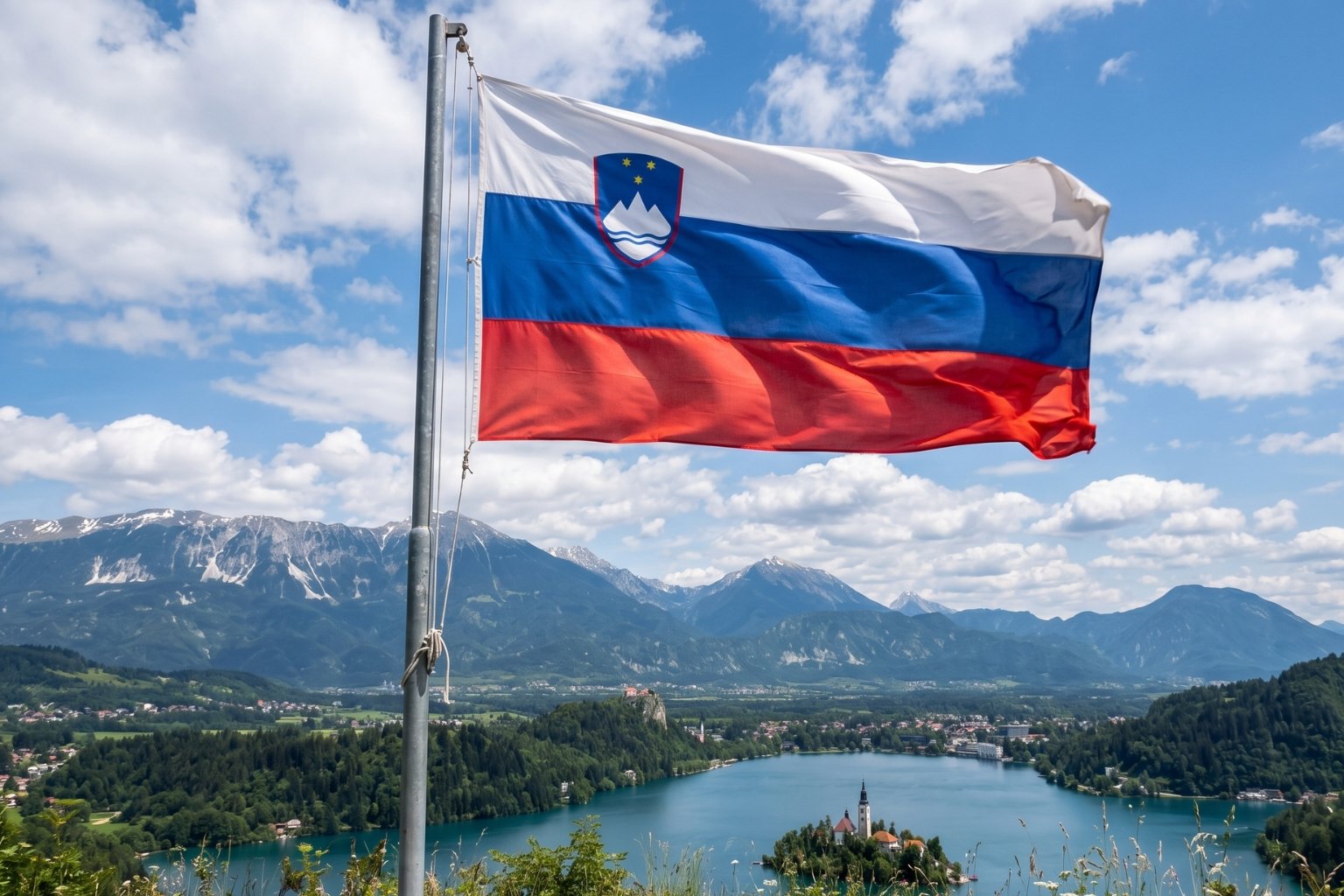

At first glance, the Slovenia flag looks almost familiar. Three horizontal bands of white, blue, and red, arranged in that order from top to bottom. You have seen this palette before, on Russian trains, Slovak storefronts, somewhere in a European capital you cannot quite place. But look to the upper left corner, and the resemblance ends. What you find there is one of the most layered pieces of national heraldry in Europe, a shield that compresses seven centuries of Slovenian history into an image smaller than a postcard stamp.
The Three Colors and Where They Actually Come From
The story of the Slovenian tricolor has two roots, and most accounts only give you one.
The first is well known. During the Napoleonic Wars of the early 19th century, Slavic peoples across Central and Eastern Europe were developing a sense of shared identity against a backdrop of foreign domination. Slovenes, then living under Habsburg rule, adopted the white, blue, and red palette in solidarity with other Slavic nations, mirroring the Russian flag as a gesture of pan-Slavic unity. The color order was a statement of kinship.
The second root goes deeper and is more specifically Slovenian. The Duchy of Carniola, the historical region covering much of present-day Slovenia, had its own medieval coat of arms granted by the Holy Roman Emperor. That coat of arms featured a white shield bearing a blue eagle with a red-and-white checkered crescent on its breast. White, blue, red. The same three colors, centuries earlier, already attached to this specific piece of land.
Two sources converging into one flag. That convergence was not accidental. It told Slovenians that their identity was both locally rooted and part of something larger.
What each color carries today:
- White represents peace, honesty, and the defining visual of the Slovenian landscape: the snow-covered ridges of the Julian Alps visible for miles on a clear morning
- Blue reflects the rivers threading through the interior and the narrow but historically significant stretch of Adriatic coastline
- Red speaks to strength, valor, and the long struggle for sovereignty against empires that rarely acknowledged Slovenian identity on its own terms
The Coat of Arms: Three Symbols, One Landscape
The coat of arms sits in the upper hoist, its center precisely positioned by law at the intersection of the white and blue stripes, one quarter of the flag’s length from the left edge. Every proportion is regulated. Nothing is approximate.
Mount Triglav: The Alpine Anchor
The central image is a stylized white silhouette of Mount Triglav on a blue shield. At 2,864 meters, Triglav is the highest peak in Slovenia and the undisputed symbol of the nation. Its three summits gave it the name, from the Slavic for “three heads.” The poet France Prešeren, whose work defines Slovenian literary identity, wrote about it. Generations of Slovenians have treated climbing it as a rite of passage, something close to an obligation.
Putting Triglav on the flag was not a geographic choice. It was a declaration that this nation is alpine at its core, shaped by the mountains, defined by them.
The Wavy Lines: Rivers and a Coastline Hard-Won
Below the mountain, two wavy blue lines run across the lower part of the shield. They represent Slovenian rivers and the Adriatic Sea. Slovenia has only 46 kilometers of coastline, a strip of the Adriatic around the town of Piran that might seem almost symbolic in its brevity. But that coastline was fought over, traded, and reclaimed through the 20th century, and its presence on the national emblem insists that Slovenia is not simply a landlocked alpine state. Water, in multiple forms, is part of the national self-understanding.
The Stars of Celje: Medieval Power in a Modern Republic
Above Triglav, three golden six-pointed stars are arranged in an inverted triangle. They come directly from the medieval coat of arms of the Counts of Celje, the most powerful noble dynasty ever to emerge from Slovenian territory.
At their peak in the 14th and 15th centuries, the Counts of Celje controlled vast territories across Central Europe and came close to rivaling the Habsburgs themselves. Their blue shield bearing three gold stars was one of the most recognized heraldic symbols in the region. When the dynasty died out in 1456, their legacy was absorbed, but their emblem was not forgotten.
Placing those stars above Triglav was a deliberate act of historical reclamation. The new republic was saying: we have roots, and they go back further than Yugoslavia, further than Austria-Hungary, further than anyone inclined to deny our existence as a distinct people might prefer to acknowledge.
The Man Who Designed the Coat of Arms
The coat of arms on the current flag was not inherited from history. It was designed in 1991 by Marko Pogačnik, a Slovenian sculptor and conceptual artist who won a public competition organized in the months leading up to independence.
The decision to run a competition matters as much as the result. In a moment of enormous political uncertainty, Slovenia chose to select its national symbol through an open, democratic process. The act said something about the kind of country it intended to become.
Pogačnik’s design is clean, readable at a distance, and carries every historical reference with precision. The red outline on the left and right edges of the shield ensures that all three colors of the tricolor appear in the coat of arms itself, binding emblem and flag into a single visual logic.
A Flag Born From Protest: April 7, 1848
The tricolor did not wait for independence to make its debut. Its public birth was an act of defiance.
On April 7, 1848, during the revolutionary Spring of Nations sweeping across Europe, a group of nationally minded students in Ljubljana raised the white, blue, and red flag over the city in direct response to a German flag that had been planted on Ljubljana Castle. The action was led by the poet and activist Lovro Toman. It was theatrical, politically pointed, and immediately understood by everyone present.
The Austrian authorities, under pressure from revolutionary movements across the empire, made an unusual concession. They officially recognized the tricolor as the flag of the Carniola region, one of the very few provinces granted permission to use a tricolor rather than the bicolor flags typical of Habsburg territories. The flag had gone from protest symbol to official recognition in a matter of months.
Over the following decades, it grew beyond its regional designation and became the unifying national symbol for Slovenians wherever they lived within the empire.
From a Red Star to Independence: The Yugoslav Decades
When Slovenia joined the Kingdom of Serbs, Croats and Slovenes after World War I, the tricolor endured as a symbol of Slovenian identity within the new state. But its most difficult period came after 1945.
Under the Socialist Federal Republic of Yugoslavia, the Slovenian flag kept its three colors but gained a red five-pointed star at its center, the symbol of socialist revolution and communist authority. The star replaced everything the coat of arms had once said about Slovenian specificity, medieval heritage, and alpine identity. It was a flag that belonged as much to an ideology as to a people.
For 46 years, Slovenians lived with that version. Then, on June 25, 1991, Slovenia declared independence from Yugoslavia. The red star came down. The coat of arms, redesigned by Pogačnik, went up. That exchange was not merely aesthetic. It was the visual expression of everything the independence movement had been working toward: a flag that said Slovenia specifically, and nothing else.
How to Tell It Apart From Russia and Slovakia
The confusion is understandable and comes up often. Three flags, same palette, horizontal stripes.
| Flag | Color Order (top to bottom) | Coat of Arms |
|---|---|---|
| Slovenia | White, Blue, Red | Yes, upper hoist |
| Russia | White, Blue, Red | No |
| Slovakia | White, Blue, Red | Yes, center-left |
The color order for Slovenia and Russia is identical. The difference is in the coat of arms. Slovakia also carries arms, but they sit closer to the center and feature a double cross on three hills, a distinctly different image.
On the Slovenian flag, the coat of arms is positioned deliberately in the upper left, overlapping the white and blue stripes. At a distance, it is the mountain silhouette with stars above it that identifies the flag immediately. No other national flag carries that combination.
The Flag in Slovenia Today
Slovenians do not wear their flag with the performative nationalism common in some countries. You will not find it draped from every window or emblazoned on every surface. But you will find it in places that matter: above Ljubljana Castle on national holidays, outside government buildings, alongside the EU flag at border crossings and international events.
Slovenia joined the European Union in 2004, and that membership sits comfortably alongside national pride rather than competing with it. A country that spent centuries under the flags of other empires tends to treat its own with quiet seriousness rather than noise.
The Slovenian flag earned its form slowly, across more than 170 years of political change, resistance, and deliberate design. Every element on it was chosen, contested, and ultimately affirmed by people who understood that a flag is not decoration. It is an argument about who you are and where you come from.
For a country the size of Switzerland with a population under two and a half million, Slovenia has made that argument with remarkable coherence.
