

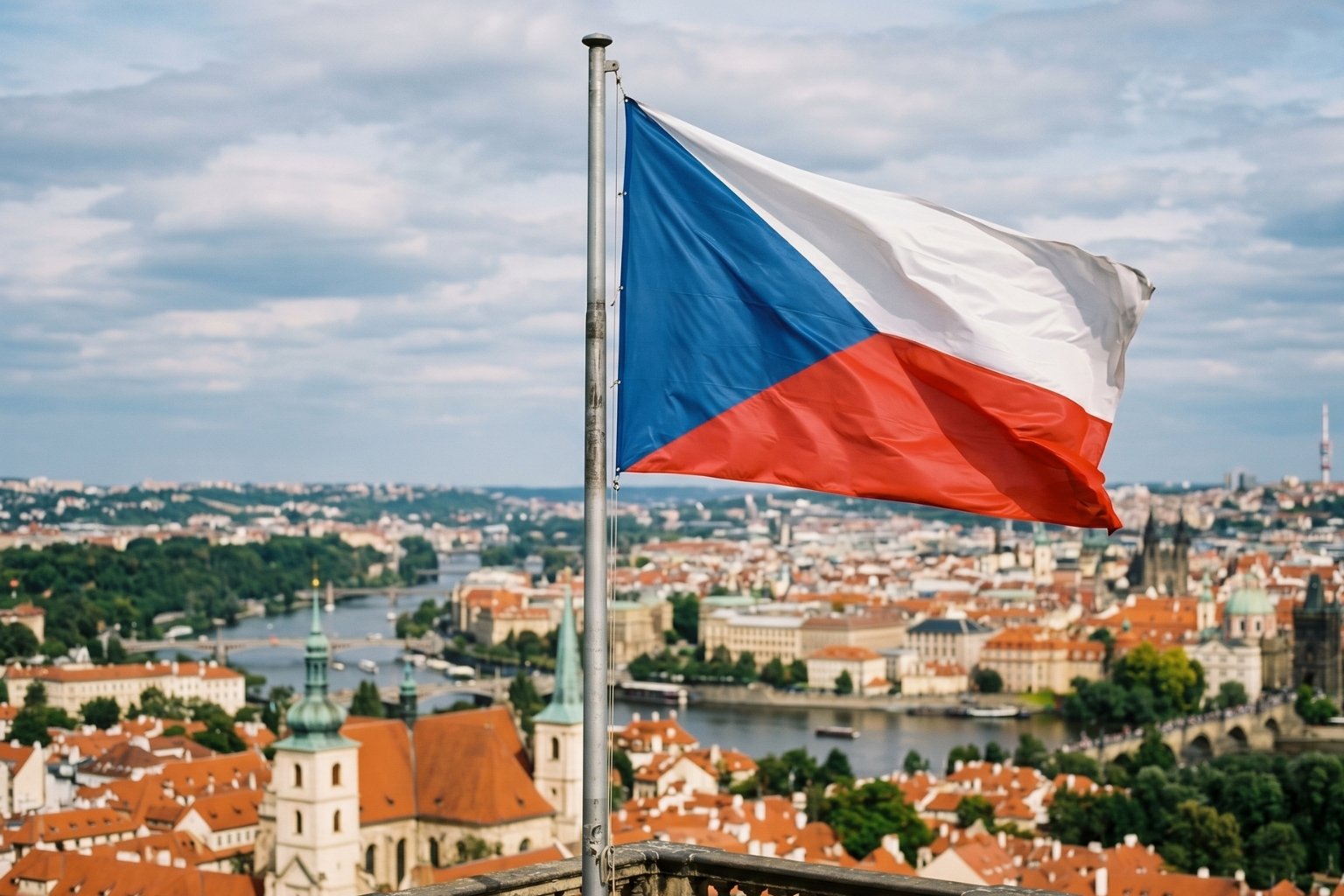

The Czech flag is one of the few national symbols in the world that was designed for a country that no longer exists. Born in 1920 as the standard of Czechoslovakia, it survived a world war, four decades of communist rule, and a peaceful national divorce. It emerged from all of it still flying, officially unchanged, over a republic its creators never imagined.
That kind of continuity does not happen by accident. It tells you something about how the Czechs understand identity, history, and the weight of symbols.
What Does the Czech Flag Look Like?
The flag follows a simple but distinctive geometric logic. Two equal horizontal stripes run the full length of the flag: white on top, red on the bottom. From the left (hoist) side, a blue triangle extends inward, with its tip reaching the midpoint of the flag’s length. The official proportions are 2:3 (width to length).
The result is immediately recognizable. No other European flag shares this exact configuration, which was, as we will see, entirely intentional.
The Colors of the Czech Flag and What They Mean
White
White in Czech heraldry is not a modern invention. It traces back to the coat of arms of the Kingdom of Bohemia, first recorded in the 12th century: a crowned, double-tailed lion in silver (heraldic white) on a red field. For Bohemia, white was never an abstract idea. It was a dynastic mark, a territorial claim, a centuries-old visual identity carried through the Holy Roman Empire, the Habsburg rule, and eventually into the modern republic.
The Czech Ministry of Foreign Affairs describes white as “a historic shade for Bohemia, symbolizing open skies.” Both readings, heraldic and poetic, coexist without contradiction.
Red
Red shares the same deep Bohemian root. The lion on the red shield. The Hussite Wars of the 15th century, fought on Bohemian soil and soaked in the memory of religious conflict. The Battle of White Mountain in 1620, a defining defeat that shaped Czech national consciousness for the next three centuries.
Red here carries both heraldic weight and a more visceral symbolism: blood shed for the freedom of the state, as official government sources put it. Moravia, the historical region forming the eastern part of today’s Czech Republic, has its own heraldic link to red through its traditional silver-and-red checkered eagle.
Blue
Blue is the most politically complex of the three colors, and the one whose meaning has quietly shifted over time.
When the blue triangle was added to the flag in 1920, its purpose was explicit: to represent Slovakia and Ruthenia, the other constituent nations of the new Czechoslovak state. Blue was the dominant color in Slovak heraldry, and the broader pan-Slavic color tradition of the 19th century, which paired red, white, and blue as the Slavic tricolor, gave the combination additional cultural resonance.
After Slovakia and the Czech Republic went their separate ways in 1993, the original symbolic logic became awkward. Blue no longer represented a part of the state. Gradually, the official reading shifted: blue is now more commonly associated with Moravia, with impartiality, and with sovereignty. The triangle remained. The meaning was quietly reassigned.
From the Bohemian Lion to Czechoslovakia: The Origins of the Flag
For most of its history, Bohemia had no need for a recognized national flag. As a kingdom embedded first in the Holy Roman Empire, then in the sprawling machinery of the Austro-Hungarian Empire, its symbols were dynastic and regional, not national in the modern sense. The double-tailed Bohemian lion appeared on military standards, seals, and coats of arms, but it carried no international standing as a state flag.
That changed on October 28, 1918. In the chaos of the collapsing Habsburg order, Czechs, Slovaks, and Ruthenians declared a new state: Czechoslovakia. The first flag raised was simple, almost improvised: two horizontal stripes of white over red, drawn directly from the Bohemian heraldic palette.
The problem was immediately obvious. The flag looked almost identical to the Polish flag. More importantly, it said nothing about the Slovaks or Ruthenians who were now part of the same republic. A white-and-red bicolor was a Czech flag, not a Czechoslovak one.
1920: The Blue Triangle That Changed Everything
In the two years following independence, a design competition was held to find a flag that could represent the full complexity of the new state. Multiple proposals circulated, including one featuring five stars for the five constituent territories.
The winning solution, attributed to Jaroslav Kursa, was elegant in its political logic. Keep the white-and-red base, honoring the Czech historical identity, and add a blue triangle at the hoist, pointing inward. Blue for Slovakia, for Ruthenia, for the pan-Slavic tradition that gave the whole Slavic independence movement its visual vocabulary in the 19th century.
The triangular shape was not arbitrary. A third horizontal stripe would have produced something too close to the Dutch, French, or Russian flag. The triangle created a genuinely unique design while keeping the existing Czech colors intact and adding the third color without visually dominating them.
The flag was officially adopted on March 30, 1920.
The Flag Through the 20th Century
In 1939, when Nazi Germany dismembered Czechoslovakia and established the Protectorate of Bohemia and Moravia, the Czechoslovak flag disappeared from official use. The protectorate operated under German authority, and national symbols were suppressed or replaced.
Liberation in 1945 brought the flag back without modification. That restoration mattered: it was a deliberate act of historical continuity, a refusal to let occupation erase what had existed before.
What followed was nearly five decades of communist rule, from 1948 to 1989. During this period, many Eastern Bloc states redesigned their flags to incorporate socialist symbols: red stars, wheat sheaves, hammers. Czechoslovakia did not. The 1920 flag survived the entire communist era intact, which is rarer than it might seem.
1993, the Velvet Divorce, and a Promise That Was Not Kept
On January 1, 1993, Czechoslovakia peacefully dissolved into two independent states: the Czech Republic and Slovakia. The process, so civil and orderly that it became known as the Velvet Divorce, included one explicit agreement: neither successor state would use the symbols of the former Czechoslovakia.
Slovakia honored that agreement. It adopted a new flag: three horizontal stripes of white, blue, and red, with the Slovak coat of arms on the left side. A clean break.
The Czech Republic did not. Despite the agreement, Prague readopted the 1920 Czechoslovak flag as its official national symbol, unchanged. The stated rationale pointed to historical continuity, to the flag’s deep roots in Bohemian heraldry, to the practical and symbolic awkwardness of starting from scratch.
The contradiction has never been fully resolved. The Czech flag is, technically, the flag of a state that ceased to exist. It was designed to represent Slovaks and Ruthenians who now belong to different countries. The blue triangle stands for a political reality that dissolved more than three decades ago.
And yet the flag flies. Widely, proudly, without apparent discomfort. Which may say more about Czech pragmatism than any official explanation could.
The Czech Flag Today
The flag appears on Czech Statehood Day (September 28, honoring Saint Wenceslas, patron of Bohemia), on national holidays, and at sporting events where it becomes an extension of collective emotion. Czech ice hockey fans, some of the most passionate in the world, drape arenas in red and white when the national team plays at the IIHF World Championship.
Flag etiquette follows standard European conventions: when displayed horizontally, the white stripe is on top. The blue triangle faces left when raised on a pole.
For a country whose modern history has been shaped by occupation, partition, and reinvention, the flag carries a particular kind of weight. It is not a simple symbol. It is a layered document: medieval heraldry, 20th-century political compromise, a broken post-1993 agreement, and a stubborn claim to continuity all compressed into white, red, and blue.
That the flag still works as a symbol, despite all of that, might be its most Czech quality of all.
